

More news on this day
Passengers across Riyadh, Kuwait City, Manama and Dubai faced mounting disruption this week as Saudia, Gulf Air, Air Arabia and Kuwait Airways scrubbed multiple services in response to volatile airspace conditions and ongoing security tensions in the Gulf.
Get the latest news straight to your inbox!
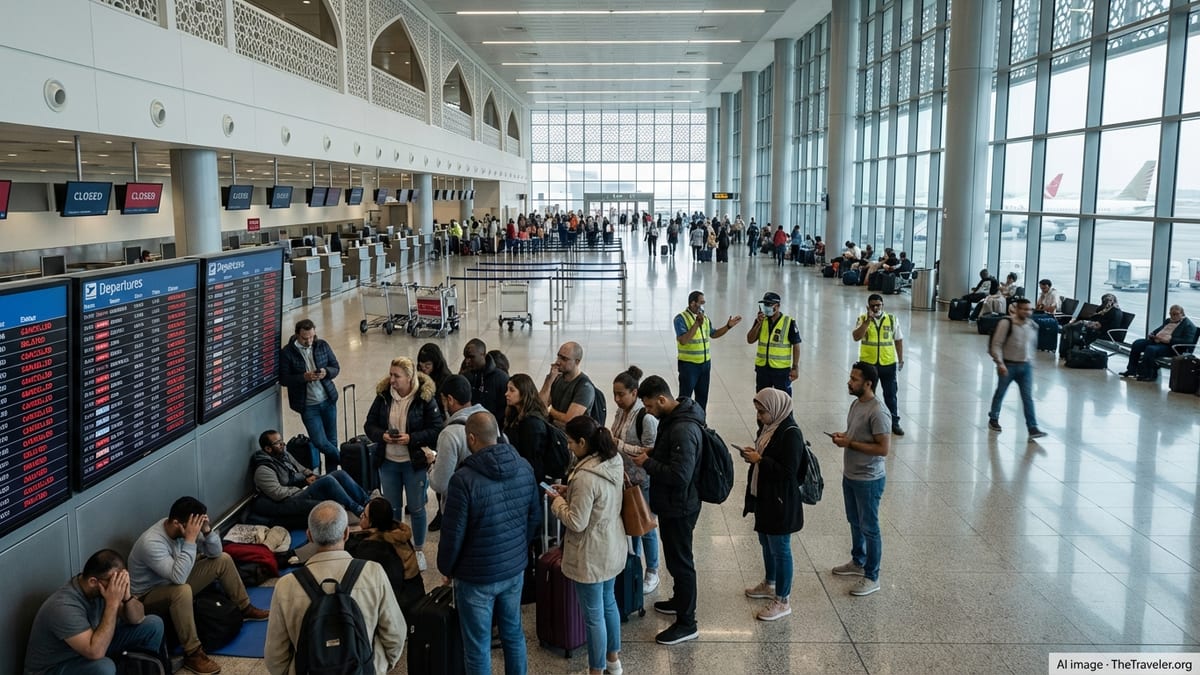
Airspace Disruptions Ripple Across Key Gulf Gateways
Travelers arriving at major Gulf airports in recent days have encountered departure boards dominated by cancellations or indefinitely delayed services. Publicly available aviation data and airline notices indicate that a tangle of airspace closures, route restrictions and short-notice safety reviews has heavily constrained regional traffic patterns since late February, with particular pressure on hubs in Saudi Arabia, Kuwait, Bahrain and the United Arab Emirates.
Industry briefings on the Middle East logistics situation describe Kuwait’s airspace and airports as effectively closed for routine commercial operations, while Bahrain and parts of United Arab Emirates airspace have undergone intermittent suspensions or tight capacity controls. Saudi airports, including Riyadh, remain technically open but are subject to Gulf-facing airspace limitations that complicate routings to neighboring states and beyond. These measures have reduced flexibility for carriers that depend on dense networks of short regional hops and onward connections.
Operational updates from supply chain and cargo specialists portray a region where airlines are continually revising flight paths or diverting services to alternative gateways, including Dammam and Jeddah, in an effort to maintain minimum connectivity. However, many point to a widening gap between what is published in schedules and what ultimately operates on the day, as security assessments trigger last-minute adjustments.
For passengers, the result is a patchwork of disruption that varies by country and carrier but increasingly shares a common pattern: repeated schedule changes, rolling cancellations and limited clarity about when normal operations might resume.
Saudia Trims Regional Network as Safety Constraints Mount
Saudi flag carrier Saudia has continued to operate out of domestic hubs such as Riyadh and Jeddah, yet multiple routes into neighboring Gulf states have been curtailed or suspended as regional airspace has tightened. Travel forums and flight-tracking data suggest that while core domestic and select long haul services remain active, flights touching airspace subject to higher risk assessments are particularly vulnerable to cancellation.
Analyst commentary circulating in logistics updates notes that Saudi airspace remains more open than that of several neighbors, but that corridors over adjacent Gulf waters and toward closed or partially closed states are constrained. In practical terms, this has reduced Saudia’s ability to offer reliable point to point links between Saudi cities and hubs such as Kuwait City, Manama and Dubai.
Passengers booked on Saudia itineraries involving regional connections report being rebooked through alternative Saudi airports or advised to seek surface transport to operational gateways. In some cases, itineraries that once relied on short Gulf hops now require longer detours via less affected corridors, adding hours to total journey times and increasing the risk of missed onward connections.
Travel advisers monitoring the region note that this evolving pattern is likely to continue as long as neighboring airspaces remain restricted, making it difficult for Saudia to commit to stable timetables on sensitive routes and adding volatility to what was previously a highly predictable network.
Gulf Air and Manama Passengers Caught in Prolonged Uncertainty
In Bahrain, national carrier Gulf Air has found its operations closely tied to the status of the kingdom’s airspace and its role as a regional connecting point. Social media posts and community discussions from Manama describe a wave of cancellations and diversions that began when Bahrain’s airspace was placed under tight restrictions, with many flights grounded even as airport facilities technically remained open.
Publicly accessible maritime and aviation disruption bulletins characterize Bahrain’s airspace as closed or severely limited for extended periods, forcing carriers to suspend most passenger operations. Reports discussing Gulf Air’s contingency planning indicate that some traffic has been rerouted through Saudi airports such as Dammam, but with significantly fewer frequencies than normal and with limited capacity for stranded travelers.
For passengers in Manama, the impact has been acute. Many describe booking and rebooking multiple times only to see flights disappear from departure boards at short notice. Those who are able to travel often need to cross land borders to Saudi Arabia to access flights that still operate under constrained corridors, adding logistical complexity, visa considerations and additional cost.
Industry observers note that Gulf Air’s role as a bridge between the wider Middle East, South Asia and Europe has amplified the knock-on effects of its reduced schedule. With fewer connection options through Manama, travelers face longer detours via alternative hubs that are themselves under pressure from increased demand and their own operational limits.
Kuwait Airways Customers Face Closures and Limited Options
Kuwait has emerged as one of the hardest hit states in the current disruption, with multiple specialist briefings classifying its airspace and airports as closed for standard commercial traffic. This designation has had far reaching consequences for Kuwait Airways, which has seen a broad swath of its network effectively frozen while authorities assess the security environment and infrastructure resilience.
Travelers with Kuwait Airways tickets report receiving little concrete information beyond generic advisories, with many scheduled flights in March and April effectively grounded. Online discussions among affected passengers highlight concerns about refunds, rebooking windows and the lack of clarity on when normal flights through Kuwait City might resume.
Some itineraries that previously relied on convenient Kuwait connections have been shifted to workarounds via other regional hubs. Budget carrier Jazeera Airways, for instance, has routed certain services through secondary Saudi airports reachable by overland travel from Kuwait, illustrating the extent to which surface transport is increasingly intertwined with disrupted air networks.
For Kuwait Airways customers, however, such alternatives are often limited or more expensive, particularly for long haul journeys to Europe and Asia that were priced around direct or one stop connections via Kuwait City. Consumer advocates following the situation recommend that passengers monitor airline portals closely, document any cancellations and explore their rights under applicable air passenger protection regimes where relevant.
Air Arabia and Dubai Feel the Impact of Tight Capacity Controls
In the United Arab Emirates, Dubai International Airport and the wider Dubai airspace have endured a series of interruptions and capacity constraints since late February. Publicly available reports on recent security incidents, including debris near airport perimeters and impacts on fuel infrastructure, describe periods when flights were temporarily halted and traffic flows sharply reduced before limited operations resumed.
As a carrier heavily reliant on short haul services across the Gulf and into South Asia, Air Arabia has been particularly exposed to these fluctuations. Passengers recount situations in which the airline initially maintained regular schedules out of Sharjah and other UAE airports, only to cancel flights a day later when airspace restrictions tightened again. In some cases, services operated up to mid March before being suspended until early April, leaving travelers with narrow windows in which flights actually departed.
Airport capacity controls and slot limitations have also affected the number of movements Air Arabia can schedule from Sharjah, which shares aspects of its controlled airspace with Dubai. Flyers describe full flights on the limited services still running, while others find themselves repeatedly shifted to later dates or alternative routes via secondary cities that are less constrained.
Travel specialists caution that the apparent resumption of flights at Dubai or Sharjah on booking platforms may not guarantee actual departure if security dynamics shift. They advise travelers booked on Air Arabia and other UAE based carriers to anticipate possible last minute schedule changes, allow generous connection times and remain prepared for extended waits at the airport or unexpected overnight stays.
Stranded Passengers Navigate Refunds, Rerouting and Future Travel Plans
Across Riyadh, Kuwait City, Manama and Dubai, the most visible consequence of the rolling cancellations has been crowds of stranded passengers negotiating compensation, rerouting and revised itineraries with airline staff and online support channels. Publicly shared experiences suggest a wide range of outcomes, with some travelers successfully rebooked on alternative airlines or via different hubs, while others encounter long delays and limited information.
Consumer guidance documents circulated in regional forums emphasize that passengers flying from affected Gulf states are typically entitled to options such as rebooking at the earliest opportunity or full refunds when flights are cancelled. However, implementation can be uneven, particularly when call centers are overwhelmed and carriers themselves are uncertain about future schedule viability.
Many travelers are responding by adjusting their future plans, either postponing nonessential trips or routing journeys through airports that currently show more stable operations. Bookings via hubs perceived as less exposed to immediate airspace closures are reportedly on the rise, even if that means longer itineraries or higher fares, as travelers place a premium on predictability.
With security dynamics in the region still evolving and official timelines for the full reopening of all affected airspaces yet to be clearly defined, aviation analysts caution that disruption may persist for weeks. Passengers planning to travel through Riyadh, Kuwait City, Manama or Dubai in the near term are being encouraged by travel industry sources to monitor schedules closely, remain flexible about routing and build contingencies into their plans.