

More news on this day
As war involving Iran, the United States and Israel ripples across West Asia, sweeping airspace closures are battering aviation heavyweights in the United Arab Emirates, Qatar, Saudi Arabia, Bahrain, Kuwait, Iraq, Lebanon and beyond, leaving once-crowded hubs in Dubai, Doha, Jeddah and Riyadh operating on skeleton schedules and straining to keep airlines financially afloat.
Get the latest news straight to your inbox!
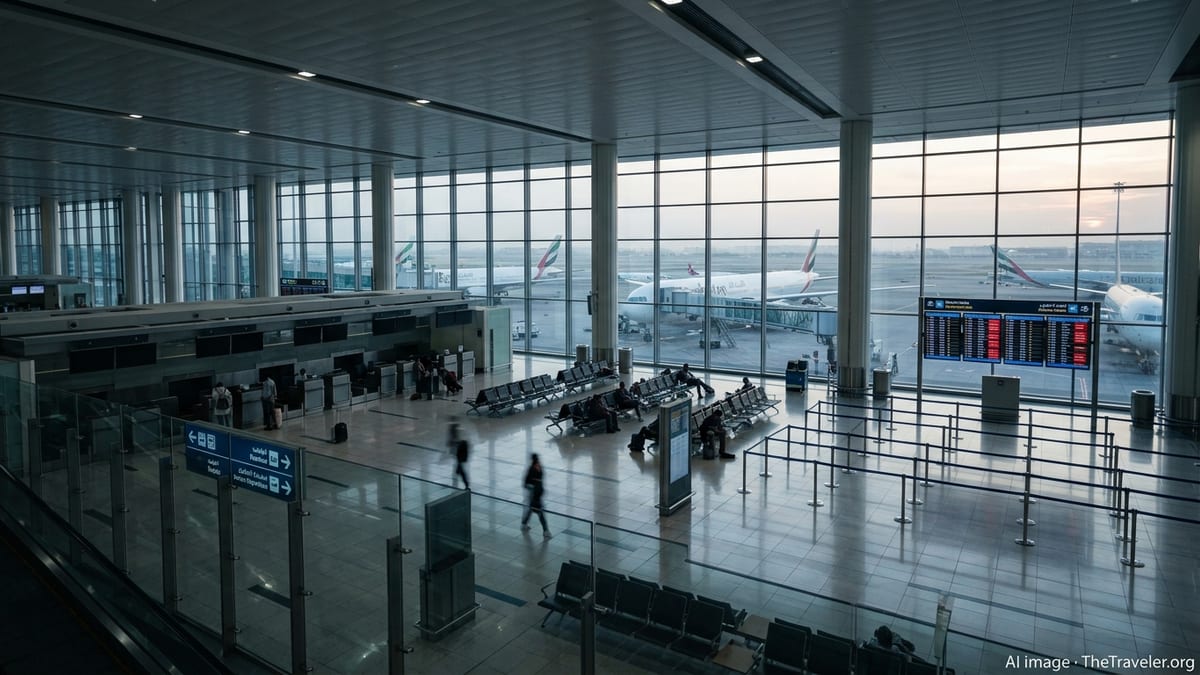
War in Iran Turns Gulf Skies Into No-Go Zones
Commercial skies across West Asia have emptied at unprecedented speed since coordinated strikes on Iran on February 28, 2026 triggered retaliatory missile and drone attacks on Gulf states. Publicly available flight-tracking data cited in recent news coverage shows vast swathes of airspace over the United Arab Emirates, Qatar, Bahrain, Kuwait, Iraq and parts of the Levant temporarily closed or heavily restricted, forcing airlines to cancel or reroute hundreds of services in a matter of hours.
Reports indicate that Dubai International, Abu Dhabi, Doha Hamad International, Riyadh King Khalid, Jeddah King Abdulaziz, Dammam King Fahd and Kuwait International all saw large parts of their operations suspended after governments introduced what they described as precautionary measures in response to active military operations and missile risks. In the UAE, coverage of the conflict notes that a drone strike ignited a fuel tank at Dubai International, briefly halting flights before the country’s flagship carrier resumed limited operations under tight safety constraints.
Similar shutdowns were reported over Iraq, Lebanon and Jordan, effectively closing a vital north-south and east-west corridor that connects Europe with Asia and Africa. Aviation analysts quoted in regional and international outlets describe the current pattern as a rolling patchwork of closures and reopenings, creating an environment in which schedules change by the hour and traditional Gulf routing via Iran and Iraq is often unavailable.
Although some restrictions have since eased, with Gulf airlines cautiously restoring a fraction of their pre-crisis services, warnings from ratings agencies and industry experts suggest that prolonged disruption could inflict lasting damage on airline balance sheets, airport revenues and the broader tourism economy across West Asia.
UAE Carriers Face Mounting Costs at Dubai and Abu Dhabi
The United Arab Emirates, home to global transit giants based in Dubai and Abu Dhabi, has emerged as one of the most exposed aviation markets in the current crisis. According to operational updates and media reports, the country imposed a temporary and partial airspace closure following initial strikes, later tightening restrictions as Iranian missiles and drones targeted infrastructure around major cities.
Flight data and airport advisories show that Dubai International and Abu Dhabi’s main hub each handled only a fraction of their typical daily traffic in the days after February 28, with hundreds of departures and arrivals canceled or redirected to secondary airports in the region. Limited evacuation flights gradually resumed in early March to move stranded residents and visitors, but most regular commercial services remained suspended or sharply curtailed, depriving carriers of their most lucrative connecting flows.
For UAE-based airlines built around high-density east–west connections, the sudden loss of safe and efficient corridors over Iran and Iraq has also driven a surge in operating costs. Longer routings over the Caspian Sea or far south over the Arabian Sea add significant fuel burn, crew hours and maintenance complexity. Analysts tracking the sector say those additional expenses come atop existing headwinds from slower global growth and higher interest rates, raising concerns about cash burn if the conflict drags on into the peak summer season.
Airport operators and tourism bodies in Dubai and Abu Dhabi are simultaneously contending with empty terminals, shuttered retail units and hotel cancellations across the emirates. Publicly available information from credit rating agencies highlights the risk that prolonged aviation disruption could spill over into real estate, hospitality and retail, sectors that depend heavily on the UAE’s status as a global travel crossroads.
Qatar, Bahrain, Kuwait and Saudi Arabia Battle a Regional Shock
Across the Gulf, carriers and airports in Qatar, Bahrain, Kuwait and Saudi Arabia are grappling with the same structural shock. Reporting from regional outlets notes that Qatar temporarily closed its airspace following missile strikes, disrupting operations at Doha’s Hamad International, a critical hub for east–west traffic. Earlier financial statements had shown Qatar’s national airline entering this crisis from a position of strength after posting record profits in the 2024–25 fiscal year, but rerouting, cancellations and lost transfer traffic now threaten to erode those gains.
Bahrain and Kuwait, whose smaller national carriers lean heavily on feeder traffic into larger regional hubs, have also seen schedules cut and flights diverted as airspace restrictions pulse across the Gulf. Industry bulletins describe airlines suspending services to conflict-adjacent markets such as Jordan and parts of Iraq, while keeping only skeletal operations to key Gulf destinations under carefully controlled flight paths.
Saudi Arabia, which has been investing heavily in transforming Riyadh into a global aviation hub and expanding Jeddah’s role as a gateway for religious tourism, is confronting its own set of challenges. Travel advisories and regional reporting point to waves of delays and cancellations at Riyadh King Khalid, Jeddah King Abdulaziz and Medina’s main airport as airlines navigate shifting no-fly zones and missile alerts. Ambitious growth plans for a new national carrier and an expanded network of long-haul routes now face a near-term environment in which capacity is constrained and traveler confidence is fragile.
For all these states, the timing compounds the impact. The crisis overlaps with key religious travel periods and the build-up to summer holidays, moments when Gulf carriers typically fill wide-body jets to and from South Asia, Europe and North America. Instead, many aircraft are grounded or flying half-empty on suboptimal routings, while airports pivot from growth strategies to crisis management.
Lebanon, Iraq and the Wider Region See Tourism Prospects Dim
The fallout is not limited to the wealthy Gulf monarchies. Iraq and Lebanon, both striving to re-establish themselves on global air maps after years of instability, have again found their skies largely deserted. Reports drawing on radar tracking services describe extended periods in which commercial flights over Baghdad and Beirut nearly disappeared as airlines opted to skirt perceived missile corridors and potential conflict zones.
For Beirut’s airport and Lebanon’s tourism sector, which had been tentatively rebuilding after economic collapse and the port explosion of 2020, the renewed downturn in air connectivity is a serious setback. Tour operators and hoteliers who had counted on a gradual return of Gulf and European visitors now face new waves of cancellations and uncertainty about when a reliable flight schedule will return.
In Iraq, efforts to attract regional investment and expand air links to Gulf hubs, Istanbul and European cities have similarly stalled. Aviation advisories note that several foreign carriers have suspended or sharply reduced frequencies to Iraqi destinations, citing operational risks and the need to avoid overlapping military activity in adjacent airspace.
Neighboring markets such as Jordan and parts of Turkey are also contending with the knock-on effects. Even when their own airspace remains nominally open, carriers often find that their most efficient routes pass through closed corridors, forcing detours, missed connections and reduced capacity that echo across the region’s complex web of fifth-freedom and interline agreements.
Empty Skies Threaten Airline Finances and Traveler Confidence
Behind the dramatic radar images of empty skies lies a deepening financial strain. Airlines in the UAE, Qatar, Saudi Arabia, Bahrain, Kuwait, Iraq and Lebanon all rely to varying degrees on connecting traffic, high aircraft utilization and premium cabin demand. With schedules slashed and key markets cut off, those business models are under pressure.
Analysts at major rating agencies have warned that if airspace closures persist, even historically profitable Gulf carriers could see material hits to revenue and margins in 2026. The combination of lost ticket sales, higher fuel and insurance costs, and the need to accommodate stranded passengers with hotels and rebookings is already weighing on earnings expectations. Smaller and less diversified airlines in Iraq, Lebanon and parts of the Gulf may find it particularly difficult to absorb sustained shocks without state support or restructuring.
The human impact is equally visible. International news coverage describes hundreds of thousands of travelers stranded across the Middle East and beyond as flights were abruptly grounded or rerouted. Many tourists, migrant workers and business travelers have been left navigating complex rebooking processes, extended hotel stays and uncertain timelines for return, eroding trust in the reliability of regional connections even once some services resume.
For now, the ability of airlines and airports from Dubai and Doha to Jeddah, Riyadh and Beirut to withstand the crisis hinges on both geopolitical developments and financial resilience built up in the post-pandemic recovery. As West Asia’s war drags on, the region’s aviation sector finds itself at a crossroads, caught between its historic role as the world’s transit backbone and a conflict that has literally cleared its skies.