

More news on this day
Thousands of cruise passengers are stranded in Persian Gulf ports this week as escalating missile threats and the effective closure of the Strait of Hormuz force governments and cruise lines into rapid-fire evacuations and route cancellations.
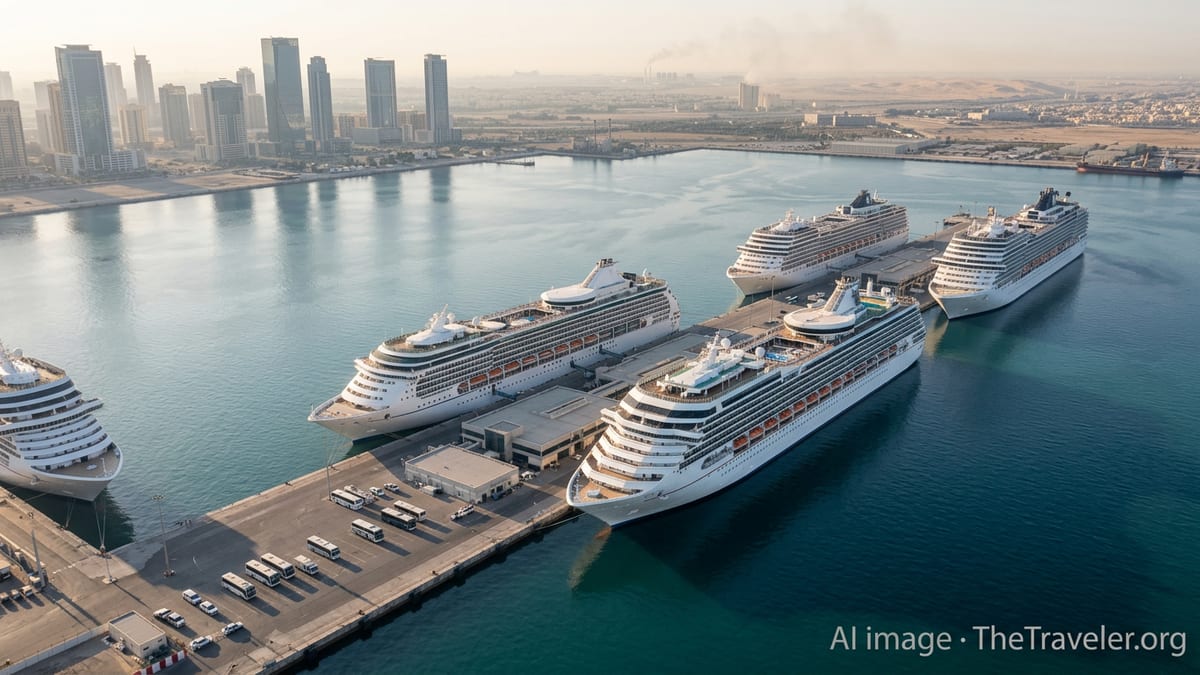
Cruise Ships Frozen in Place Across Gulf Ports
At least six major cruise ships from four international lines remain confined to ports in the United Arab Emirates, Qatar and Oman after regional authorities sharply restricted vessel movements through the Strait of Hormuz. The de facto shutdown follows retaliatory missile and drone strikes between Iran and a US–Israeli coalition since February 28, which have sharply raised the risk profile for any large passenger vessel attempting to sail out of the Gulf.
Port officials in Dubai, Abu Dhabi and Doha have ordered cruise ships to remain berthed while regional militaries assess the evolving threat, according to industry and government statements. Satellite tracking data and cruise line updates show vessels from TUI Cruises, MSC Cruises, Celestyal Cruises and at least one US-based brand effectively immobilized along the southern Gulf coastline.
The operational freeze has hit during what should be a peak winter-sun season for Gulf itineraries, abruptly pausing turnarounds and day calls that feed hotels, tour operators and airport traffic. Travel agents report a surge in calls from anxious families seeking clarity on whether voyages will resume or be terminated, as the situation shifts by the hour.
Industry analysts say the stoppage marks the most severe disruption to Gulf cruise tourism since the sector began its rapid regional expansion a decade ago, eclipsing even the pandemic-era pause in terms of geopolitical risk and security complexity.
Missile Near-Misses Trigger Emergency Drills Aboard
The security clampdown follows several close calls that underscored the vulnerability of large passenger ships in contested waters. In Abu Dhabi’s Port Zayed on March 1, a missile struck the water close to TUI Cruises’ Mein Schiff 4, rattling the vessel with a loud blast and sending plumes of smoke skyward, according to passenger accounts and local media reports.
Civil defense alerts on passengers’ phones ordered them to shelter and assemble at muster stations as the crew initiated emergency procedures. Images and testimonies circulating in European media describe a rapid but orderly response, with guests guided into interior theaters and lounges while crew monitored developments outside.
No injuries were reported aboard the ship, but security experts say the incident highlighted the narrow margin for error in congested Gulf ports that now sit within range of ballistic and cruise missile systems. Nearby container terminals and fuel depots are widely viewed as potential targets, raising the risk that cruise ships could be caught in the blast radius of attacks aimed at infrastructure or military assets.
The blast in Abu Dhabi came as maritime security advisories warned of a credible risk of missile and drone activity across Gulf shipping lanes, following Iranian statements restricting passage through the Strait of Hormuz and reports of attacks on commercial vessels.
Governments Race to Evacuate Citizens by Air
With ships unable to sail safely out of the Gulf, governments have pivoted to airlifts and overland routes to bring their citizens home. European foreign ministries have confirmed they are working with cruise lines to organize charter flights from Dubai, Abu Dhabi and Doha, prioritizing vulnerable travelers and those with imminent onward connections.
German authorities have been among the most visible, after several hundred of their nationals found themselves confined to Gulf ports following the missile scare near Mein Schiff 4. Consular teams have been dispatched to terminals to assist passengers with documentation, rebooking and medical needs, while hotline numbers circulate on social media and through tour operators.
Other European and North American governments are issuing updated travel advisories urging citizens to avoid nonessential travel to Gulf waters and to register their details if currently on a vessel in the region. Diplomatic sources say coordination cells linking embassies, port authorities and naval commands are now meeting multiple times a day to synchronize evacuation options and share threat intelligence.
The sudden reliance on emergency flights is placing additional pressure on Gulf airports that also serve as regional hubs for diverted business and cargo traffic. Airline schedulers are juggling the need for extra repatriation capacity with airspace restrictions and changing risk assessments that can affect routing and crew duty times.
Red Sea and Strait of Hormuz Become Dual Flashpoints
The crisis in the Gulf is unfolding against the backdrop of renewed threats to shipping in the Red Sea and Bab al Mandab, creating what maritime analysts describe as a dual choke point emergency for global seaborne travel. Yemen’s Houthi movement has signaled its intent to resume missile and drone attacks on commercial vessels in and around the Red Sea after a lull in confirmed strikes late last year.
That warning comes as Iran’s Revolutionary Guard has issued restrictions and threats around transit through the Strait of Hormuz, which handles a significant share of the world’s oil exports as well as the only sea exit for passenger ships homeported in the Gulf. Together, the overlapping threats leave cruise lines with few viable alternatives for repositioning vessels between Asia, Europe and the Middle East without lengthy detours around the Cape of Good Hope.
Container and tanker operators began rerouting away from the Red Sea months ago, but the cruise sector had been slower to alter long-planned itineraries, hoping for a more durable reduction in attacks. In recent days, however, leading lines have acknowledged that both the Red Sea corridor and the Strait of Hormuz can no longer be considered acceptable for leisure cruising under current conditions.
Travel economists warn that any prolonged disruption affecting both waterways simultaneously would carry knock-on effects for regional tourism economies from Dubai to Aqaba, and could push more cruise capacity back toward the Caribbean and Mediterranean, further crowding those markets.
Cruise Lines Slash Itineraries and Review Summer Deployments
Under mounting pressure from security advisers and insurers, cruise operators are rapidly rewriting schedules. Gulf sailings for March and April are being canceled or converted into so-called “floating hotel” stays, with ships remaining at berth and offering onboard services while passengers are progressively flown home.
Several lines have already announced that ships positioned in the Middle East will not operate repositioning cruises via the Red Sea this spring, instead planning non-revenue transits around Africa once naval authorities deem it safe to move. Industry officials say these deadhead voyages could take weeks longer than usual, consuming fuel and crew resources while generating no ticket revenue.
Summer 2026 deployment plans are also under review. Itineraries featuring Red Sea ports such as Safaga and Jeddah, as well as Gulf homeports like Dubai and Doha, are either being suspended or labeled “subject to change pending security conditions” in sales materials. Some lines are quietly incentivizing passengers to switch to alternative cruises in Europe or North America rather than wait for last-minute cancellations.
Travel agents in key source markets report a noticeable softening in demand for itineraries touching the wider Middle East, even in the eastern Mediterranean, as risk perception spills beyond the immediate conflict zones. Advisors are steering clients toward regions with more predictable security environments, at least for the next several months.
Passengers Face Uncertainty as Future Bookings Hang in the Balance
For travelers currently onboard affected ships, the experience is a mix of resort-style normality and underlying tension. Restaurants and entertainment continue to operate, but shore excursions have been curtailed and outdoor decks periodically closed during heightened alerts. Many guests are spending sea days glued to news updates or in line at guest services desks seeking information on flights and refunds.
Cruise lines are offering varying compensation packages, including future cruise credits, partial refunds and complimentary onboard services. However, consumer groups argue that passengers should not be left to shoulder the financial consequences of a crisis they could not reasonably anticipate, especially in cases where itineraries were marketed as “safe to sail” until shortly before departure.
Forward bookings are now under intense scrutiny by both travelers and the industry. Some passengers are choosing to keep Gulf and Red Sea reservations for late 2026 or 2027, betting that the security picture will improve. Others are shifting to destinations perceived as lower risk, from northern Europe to Alaska, even if that means higher fares and longer flights.
For the moment, the only certainty is that cruise tourism in the Gulf and along key Middle Eastern sea lanes will look very different from what was envisioned at the start of the decade. How quickly confidence returns will depend not only on diplomatic breakthroughs and military de-escalation, but also on whether the current wave of missile threats gives way to a sustained period of calm at sea.