

More news on this day
Thousands of passengers across Asia, Europe, Africa and the Americas are facing severe disruption as Emirates, Qatar Airways, Saudia and Etihad cancel and curtail flights amid sweeping airspace closures triggered by the expanding war between Iran, the United States and Israel.
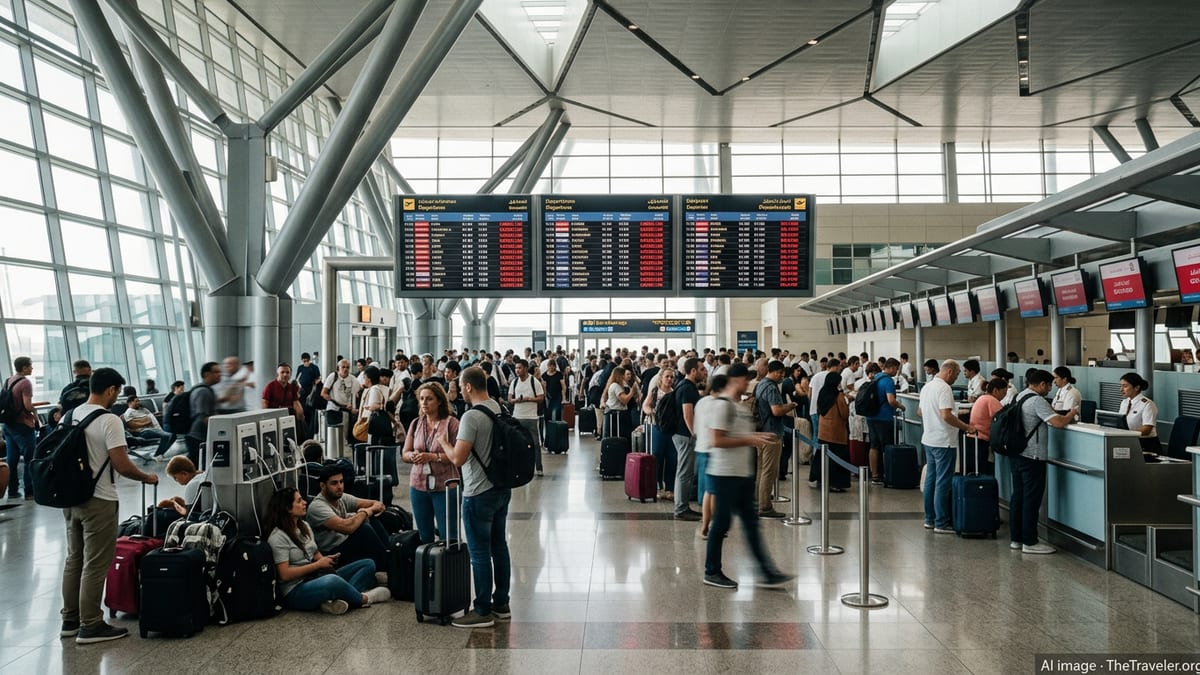
War Turns Gulf Aviation Superhubs Into Bottlenecks
The rapid escalation of conflict since late February has transformed the skies over the Gulf from some of the world’s busiest transit corridors into a patchwork of no-fly zones and tightly controlled corridors. Regional airspace over Iran, Iraq, Israel, Qatar, Bahrain, Kuwait and parts of the United Arab Emirates and Saudi Arabia has been temporarily shut or heavily restricted, forcing carriers to ground aircraft, cancel services or send planes on lengthy detours.
Dubai, Abu Dhabi and Doha normally function as high-capacity aviation superhubs, funneling tens of thousands of long-haul passengers between Europe, Asia, Africa and Oceania each day. Industry analytics firms report that more than 3,000 flights were cancelled across key Middle Eastern airports in the first days of the crisis alone, with cancellations and delays continuing as governments reassess the safety of regional skies.
Authorities in the UAE and Qatar have framed the closures as precautionary safety measures following Iranian strikes and missile interceptions near major airports. Damage to infrastructure has been limited, but the risk of debris and miscalculation in crowded skies has led civil aviation regulators to keep tight controls in place even as some routes begin to reopen.
The disruption has rippled far beyond the Gulf. Airlines from Europe and Asia that depend on overflying Iranian and Gulf airspace have rerouted services via Central Asia, North Africa or the eastern Mediterranean, increasing flight times, fuel burn and costs. For many travelers, the most visible impact is at the check-in desk, where departure boards show wave after wave of cancellations.
Emirates and Etihad Edge Back Toward Limited Operations
Dubai-based Emirates, the region’s largest long-haul carrier, was among the hardest hit when UAE authorities imposed sweeping airspace controls. For several days, the airline suspended the bulk of its operations to and from Dubai, grounding much of its widebody fleet and stranding transit passengers across multiple continents. Travel data providers estimated that at the peak of the crisis, more than a third of Emirates’ scheduled flights were cancelled.
In recent days, Emirates has begun a cautious restart. The carrier has announced a phased resumption of services, with priority given to trunk routes linking Dubai to major cities in Europe, Asia and Australia, supported by a series of relief flights aimed at repatriating stranded travelers. Executives say they are targeting a return to full network operations in the coming days, but stress that this remains contingent on further easing of regional airspace restrictions.
Abu Dhabi’s Etihad Airways has followed a similar pattern. After initially suspending all departures from its hub, the airline has introduced a slimmed-down timetable covering a reduced list of destinations in Europe, Asia and North America. The temporary schedule, currently in place through mid-March, is being adjusted almost daily as the carrier gains additional slots in newly opened corridors and receives updated guidance from regulators.
Passengers booked with Emirates and Etihad are being urged to check flight status before leaving for the airport and to make use of flexible rebooking and refund policies that were triggered as part of the carriers’ disruption waivers. However, long call center wait times and heavy pressure on online self-service tools mean many customers are still struggling to secure alternative travel plans.
Qatar Airways Hobbled by National Airspace Closure
While UAE carriers are slowly rebuilding their schedules, Qatar Airways remains constrained by a near-total closure of Qatari airspace following missile strikes and interceptions around Doha. The Gulf state’s civil aviation authority moved quickly to shut its skies to most civilian traffic as Iran targeted infrastructure in Qatar and neighboring states, including areas near Hamad International Airport, one of the region’s most modern hubs.
Qatar Airways suspended regular commercial services through Doha as a result, triggering hundreds of cancellations on routes linking Europe, Africa, Asia and the Americas. The carrier, which has built its global brand on seamless connectivity via its centralized hub, has been forced instead to focus on operating limited relief and repatriation flights through specially authorized corridors as security conditions allow.
Announcements from the airline and aviation authorities indicate that a small number of one-off services are being mounted from major European and Asian capitals back to Doha to bring Qatari citizens and stranded residents home. For now, however, there is no clear timeline for the full reopening of Hamad International to routine transit traffic, leaving Qatar Airways’ broader network effectively on pause.
The shutdown is reverberating through global travel patterns. Many passengers who would typically transit via Doha to reach destinations in Africa or South Asia are being rebooked via alternative hubs in Turkey, Europe or the Gulf, adding hours to journey times. For Qatar Airways, each extra day of inactivity at its primary hub deepens both the operational backlog and the financial hit.
Saudia Extends Cancellations as Saudi Airspace Tightens
Saudi Arabia’s flag carrier Saudia has been somewhat less exposed than its Emirati and Qatari rivals, given its more regionally focused network, but the conflict has still taken a significant toll. Airspace controls over parts of Saudi territory and neighboring countries, combined with knock-on effects from closures in Qatar and the wider Gulf, have forced the airline to trim its schedules sharply.
Saudia has cancelled or suspended flights to and from several key regional destinations, including Dubai, Abu Dhabi, Doha and multiple Gulf capitals, as well as select routes beyond the Middle East. Advisories issued through the week show cancellations extending across multiple days, with some services grounded until at least early March deadlines set by regulators and internal safety assessments.
In practical terms, the airline has focused on maintaining domestic links between major Saudi cities such as Riyadh and Jeddah, while selectively operating international services judged to be less exposed to overflight risks. Even so, connecting itineraries that once relied on swift regional hops through Gulf hubs have been heavily disrupted, eroding the appeal of Saudi Arabia’s growing tourism and business travel offering.
Saudi authorities, like their counterparts in the UAE and Qatar, have framed their decisions as temporary but necessary steps to shield civilians and critical infrastructure from the fallout of cross-border missile and drone exchanges. Aviation analysts warn that if the conflict widens further or drags on, the kingdom could be forced into deeper capacity cuts, undermining its ambitions to position itself as a major global transit player.
Longer Routes, Rising Costs and a Shaken Hub Model
For travelers, the most immediate impact of the crisis is felt in lost time and uncertainty. Journeys that once involved a single overnight stop in Dubai or Doha now require multiple connections or circuitous routings via Europe, Central Asia or the Indian Ocean. Flight times have lengthened by one to three hours on many long-haul sectors, while last-minute cancellations remain an ever-present risk as military developments reshape the airspace map.
For airlines, the disruption translates directly into higher costs. Detouring around closed skies means burning more fuel, adding crew hours and sometimes making extra technical stops. Hotels and rebooking for stranded passengers add further strain at a time when carriers were only beginning to rebuild balance sheets after the pandemic and earlier regional shocks.
Industry observers note that the crisis has also exposed the vulnerability of the Gulf hub-and-spoke model. Emirates, Qatar Airways, Saudia and Etihad have all built global networks on the assumption that their airspace and infrastructure would remain stable, secure bridges between continents. The current war has shown how quickly that assumption can be upended by geopolitical events, prompting some corporate travel buyers to reconsider routing policies and diversify away from a single region.
Still, few expect the Gulf’s dominance as a transit crossroads to disappear once the conflict eases and airspace reopens. The scale and efficiency of airports in Dubai, Abu Dhabi and Doha, along with the fleets deployed by their home carriers, give them a structural advantage. For now, though, those strengths are outweighed by the brutal arithmetic of closed skies, cancelled flights and anxious travelers waiting for a safe route home.