

More news on this day
Gulf and neighboring governments are coordinating emergency measures to assist hundreds of thousands of stranded travelers after widespread airspace closures intensified across the Middle East, following Iran’s formal rejection of a United States ceasefire proposal and continued missile and drone strikes in the region.
Get the latest news straight to your inbox!
Regional Airspace Closures Deepen After Ceasefire Rebuff
Publicly available information shows that Iran’s dismissal this week of an American ceasefire initiative in the ongoing 2026 Iran war has coincided with renewed strikes and a tightening of flight restrictions across the Gulf. Reports indicate that Iranian attacks on infrastructure, including fuel facilities and aviation assets, have kept regional risk levels elevated, with Iranian officials reiterating hardline conditions for any pause in fighting.
Since late February, multiple Gulf states have progressively restricted or suspended civilian flights as military operations expanded over and around the Strait of Hormuz. Aviation tracking data and airport advisories describe large portions of airspace over Iran as effectively closed to commercial traffic, prompting neighboring states to implement their own bans and diversions on safety grounds. Industry analyses suggest that thousands of flights have been canceled each day at the peak of the crisis, disrupting key Europe Asia and Africa Asia corridors.
In this context, regional media coverage and operational bulletins describe the United Arab Emirates, Saudi Arabia, Qatar, Bahrain, Kuwait, Oman, Iraq, and Jordan as acting in concert on temporary closures and route suspensions, even when formal declarations differ by country. Authorities in several capitals have framed the moves as precautionary steps to shield civilian passengers and aviation infrastructure from spillover risk as cross border strikes continue.
Economic assessments of the conflict note that aviation is among the hardest hit sectors, with major Gulf carriers suspending most operations and foreign airlines rerouting long haul services away from the region. Analysts warn that the longer Iran’s position on ceasefire terms remains unchanged and the Strait of Hormuz stays constrained, the more prolonged the period of airspace disruption is likely to be.
Emergency Transit and Repatriation Corridors Take Shape
As cancellations mounted and travelers became stranded at hubs from Dubai to Doha at the start of March, governments across the Gulf and Levant began to pivot from ad hoc responses to more coordinated emergency arrangements. Port and airport circulars reviewed by TheTraveler.org describe the gradual opening of limited humanitarian and evacuation slots within otherwise restricted airspace, focused on moving passengers out of the highest risk zones.
Qatar’s civil aviation authorities, for example, initially maintained a full closure of national airspace after Iranian missile strikes, before later allowing a narrow band of emergency flights for evacuations and cargo, while keeping regular commercial schedules suspended. Similar patterns emerged elsewhere in the region, with small numbers of specially authorized services approved to repatriate citizens or relocate transit passengers who had been grounded mid journey by sudden bans.
Travel industry briefings indicate that, behind the scenes, officials and aviation regulators from the UAE, Saudi Arabia, Qatar, Bahrain, Kuwait, Jordan, Oman, and Iraq have been sharing operational data, aligning routing corridors where possible, and designating specific airports to handle emergency movements. Publicly available security advisories highlight the role of secondary airports, such as facilities in Oman and on the Arabian Sea, which have been used as staging points for charter flights extracting travelers away from the Gulf’s most congested hubs.
While the emerging framework falls short of a formal multilateral treaty, experts describe it as an evolving emergency agreement in practice. By carving out controlled transit channels within a broader patchwork of no fly zones, the participating states aim to balance air safety concerns with mounting pressure to relieve overcrowded terminals and reconnect stranded passengers to their home countries or onward routes.
Stranded Travelers Face Prolonged Disruption and Uncertainty
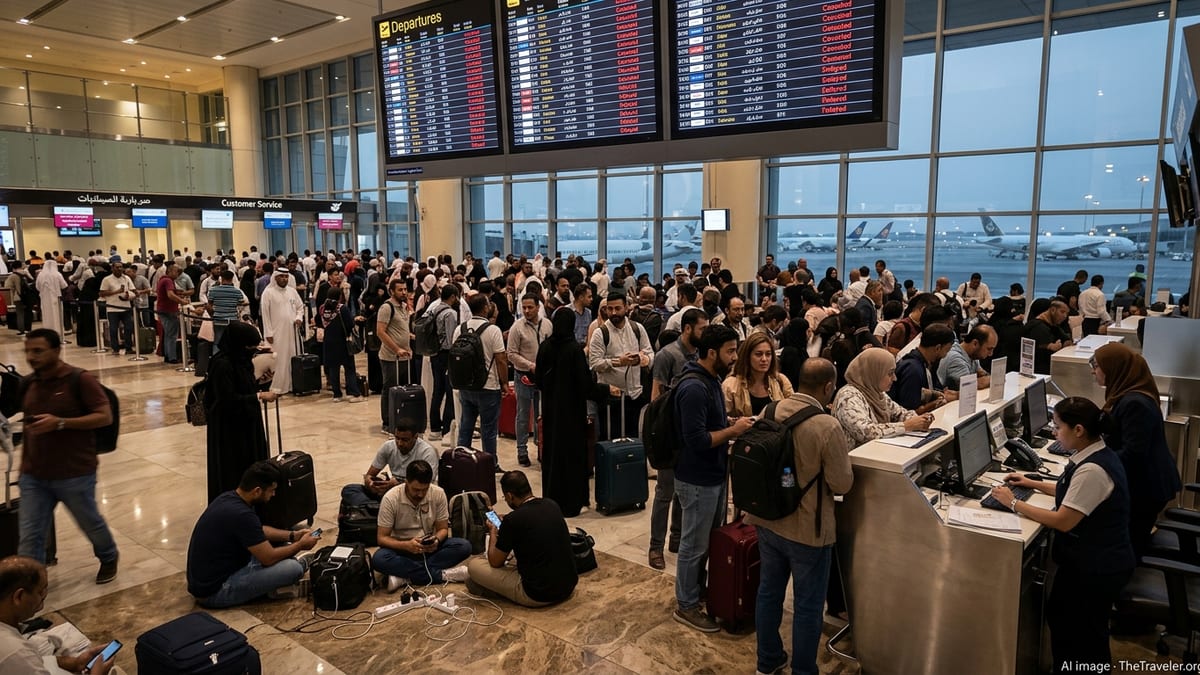
For passengers caught in the middle of the closures, the experience has been one of extended waits, rolling rebookings, and rapidly changing information. Social media posts and traveler testimonies gathered by regional newspapers depict crowded departure halls, long lines at airline desks, and repeated last minute cancellations as airspace restrictions shift in response to new military activity.
Reports from major airports such as Dubai International, Abu Dhabi, Doha’s Hamad International, and Kuwait International describe departure boards dominated by canceled or delayed flights in the days after the first wave of closures. Some terminals temporarily suspended all movements, forcing inbound aircraft to divert to airports as far away as Europe, South Asia, or East Africa, leaving passengers separated from luggage and original itineraries.
Travel forums and online advice threads emphasize that many airlines have relaxed change and refund rules, offering free rebooking or full reimbursements for journeys touching the Gulf during the crisis period. However, with limited alternative capacity and long haul routes needing extensive detours to avoid restricted skies, even rebooked flights can involve significantly longer travel times and extra connections. Travelers connecting between continents through Gulf hubs have been particularly affected, with some facing days long delays before they can secure seats out of the region.
Consumer advocates caution that disruption is likely to remain uneven, with some national carriers prioritizing evacuation style operations, while low cost and foreign airlines may take longer to restore even skeleton services. Passengers are being urged by travel industry bulletins to confirm flight status repeatedly, maintain flexible plans, and avoid heading to airports without written confirmation of a departure.
Coordinated Measures to Protect Tourists and Migrant Workers
Beyond flight logistics, the emerging emergency arrangements among Gulf and neighboring states are also focused on the welfare of tourists, expatriates, and migrant workers who have found themselves stuck in transit or unable to depart for home. Media coverage from India, Pakistan, the Philippines, and other labor sending countries highlights large numbers of workers stranded in the Gulf, many of whom were traveling on tight budgets or time limited visas.
Publicly available government statements in the region indicate that consular teams are working with local authorities and airlines to prioritize vulnerable travelers on limited outbound flights, particularly those without accommodation or financial reserves. In some cases, temporary shelters and discounted hotel blocks have been set up around major airports, while national airlines have operated special repatriation services when airspace windows allow.
Tourism and hospitality sectors are also adjusting. Hotels near major hubs report an influx of guests staying far beyond planned check out dates, with some properties offering crisis rates or waiving change fees. Destination marketing bodies in the UAE, Qatar, and Saudi Arabia have used official channels to share practical guidance on visa extensions, healthcare access, and safety instructions for visitors unable to leave.
Observers suggest that the coordinated stance of the UAE, Saudi Arabia, Qatar, Bahrain, Kuwait, Jordan, Oman, and Iraq on traveler support represents a learning curve from earlier crises, including the COVID 19 pandemic. While the current conflict dynamics are very different, the shared emphasis on clear public messaging, structured repatriation, and consular coordination reflects experience gained from that period of mass disruption.
What Travelers Should Expect in the Coming Weeks
Looking ahead, aviation experts and regional analysts broadly agree that the outlook for travel through the Gulf will depend heavily on the trajectory of the 2026 Iran war and any shift in Iran’s negotiating posture after its rejection of the latest US proposal. As long as Iranian forces continue to threaten or target transport infrastructure and maintain a hard line on control of the Strait of Hormuz, commercial risk assessments are likely to keep airspace restrictions in place across a swath of the Middle East.
Industry forecasts suggest that when reopenings do occur, they are likely to be gradual rather than sudden, with priority given to repatriation flights and essential cargo before full scale passenger operations resume. Airlines may initially concentrate on a limited number of trunk routes, relying on code shares and interline agreements to extend connectivity while minimizing exposure to remaining conflict zones.
Travel risk consultants are advising passengers with nonessential trips involving the UAE, Saudi Arabia, Qatar, Bahrain, Kuwait, Jordan, Oman, or Iraq in the next several weeks to consider postponement or rerouting via alternative hubs in Europe, South Asia, or North Africa. Those who must transit the region are encouraged to maintain close contact with airlines and tour operators, keep flexible accommodation arrangements, and monitor official travel advisories from both origin and destination countries.
For now, the emergency coordination among Gulf and neighboring capitals provides a measure of structure in an otherwise highly volatile environment. While it cannot fully offset the disruption caused by closed skies and a stalled ceasefire process, the evolving framework is intended to reduce the number of travelers left without options as the region navigates one of the most severe aviation shocks since the pandemic.