

More news on this day
Bahrain’s move to align more closely with Gulf neighbours confronting Iran comes amid an escalating Middle East conflict that is shuttering airspace, shaking energy markets and draining hundreds of millions of dollars a day from the global tourism economy.
Get the latest news straight to your inbox!
Regional Front Narrows Around Iran
Publicly available coverage of the 2026 Iran war indicates that Bahrain, already hosting the United States Navy’s Fifth Fleet, has come under direct Iranian missile and drone fire, alongside other Gulf states. In parallel, reports describe Qatar, the United Arab Emirates, Oman and Saudi Arabia tightening coordination with Western partners as the conflict spills across borders and into critical infrastructure.
The strikes on and around Manama, following earlier attacks on hubs in the UAE and elsewhere, have reinforced the perception that Gulf monarchies are converging around a unified security posture that treats Iran primarily as a military threat rather than a diplomatic counterpart. Commentators note that this marks a sharp turn from the cautious rapprochement efforts seen as recently as 2024, when Bahrain and Iran agreed to explore restoring political ties.
Observers say the emerging pattern resembles a de facto bloc, in which states such as Bahrain, the UAE, Qatar and Oman are calibrating their positions in step with Saudi Arabia’s leadership and the presence of United States forces. The result is a more polarized regional landscape, with fewer buffers between Iran and its rivals and greater potential for economic sectors such as tourism to be used as instruments of pressure.
For travel and tourism, this geopolitical alignment narrows the map of perceived safe havens in West Asia. Destinations that had marketed themselves as neutral or insulated from regional rivalries are now frequently mentioned in the same breath as front-line states, reshaping risk assessments for airlines, tour operators and travellers.
Saudi Air Base Access Highlights Military Escalation
According to international media analyses of the current crisis, Saudi Arabia has expanded cooperation with the United States by facilitating the use of key air facilities for operations linked to the Iran conflict. This reported opening up of bases to US forces underscores how deeply embedded the kingdom has become in the effort to contain Iranian capabilities and reassure partners across the Gulf.
Military analysts cited in open sources suggest that increased access to Saudi infrastructure allows for faster deployments, more persistent air patrols and tighter coordination with nearby hubs in Bahrain, Qatar and the UAE. That, in turn, reinforces a security arc stretching from the Red Sea to the Gulf of Oman, with implications not only for defense but also for civilian aviation corridors and insurance costs.
Expanded foreign military use of Gulf airfields is feeding into higher alert levels, additional airspace suspensions and more stringent risk calculations by commercial carriers. Even when facilities remain technically open to civilian traffic, the proximity of active operations raises concerns about miscalculation, debris hazards and the potential for sudden closures that can leave passengers stranded.
For Saudi Arabia, which has poured billions into high-profile destinations and events under Vision 2030, the intensifying role as a staging ground for conflict risks undercutting its parallel narrative as an emerging leisure powerhouse. Large-scale tourism investments in desert resorts, megaprojects and cultural festivals now sit uncomfortably alongside images of warplanes and missile-defense batteries.
Airspace Closures Choke a Once-Booming Travel Hub
Industry research and aviation tracking data show that the latest Middle East crisis has turned one of the world’s most important transit regions into a patchwork of no-fly zones and rerouted corridors. Airspace restrictions affecting Iran, Iraq, Israel, Jordan, Kuwait, Qatar, Bahrain, Syria and the United Arab Emirates have forced thousands of flight cancellations and diversions between Europe, Asia and Africa in a matter of days.
Analysts at Tourism Economics and other consultancies now forecast that inbound arrivals to the Middle East could fall by double digits in 2026, with some scenarios pointing to an 11 to 27 percent year-on-year decline. Estimates referenced by global tourism bodies indicate that the regional sector is losing around 600 million dollars in visitor spending every day, compared with pre-war expectations for more than 200 billion dollars in receipts this year.
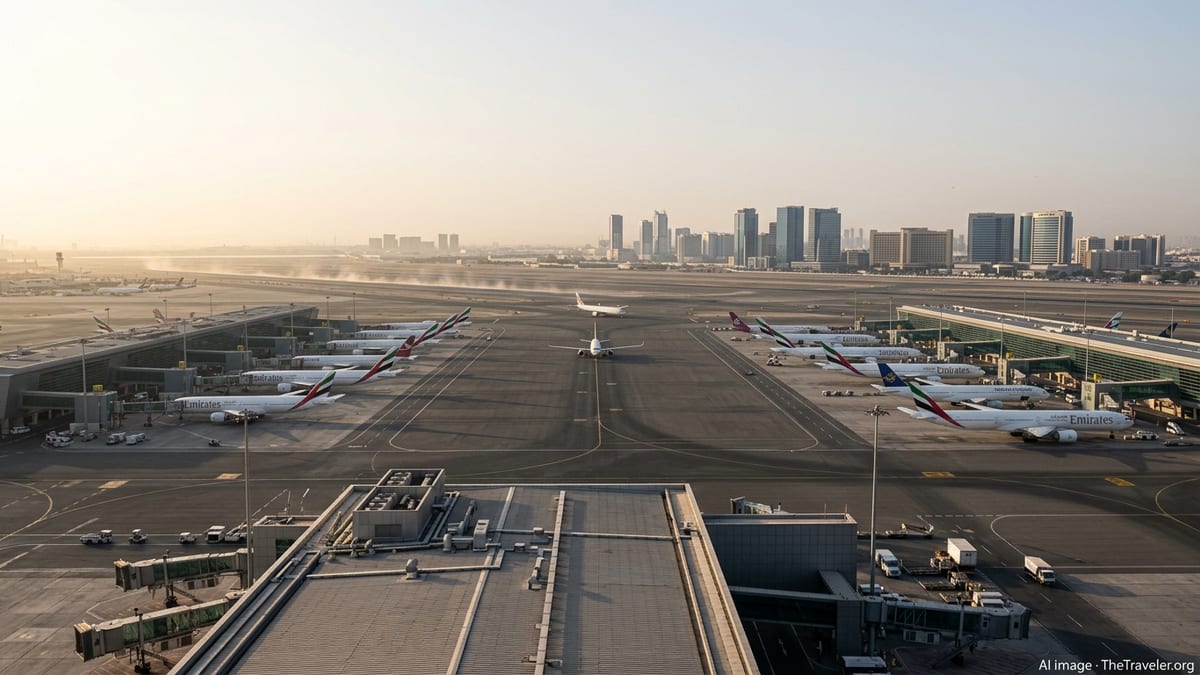
Major hubs such as Dubai, Doha and Abu Dhabi, which had capitalised on their reputations for safety and seamless connectivity, are experiencing intermittent shutdowns, reduced schedules and complex detours around conflict zones. These disruptions add hours to long-haul itineraries and drive up fuel consumption, crew costs and fares, eroding the competitive advantage that Gulf carriers built over the past two decades.
Beyond the immediate operational headaches, the turmoil is undermining confidence at a moment when Middle East destinations had just surpassed pre-pandemic visitor levels. United Nations tourism data had highlighted the region as one of the fastest-growing globally in 2025, but that momentum is now colliding with heightened risk perceptions, government advisories and widespread booking freezes.
From Regional War Zone to Global Tourism Shock
The conflict’s tourism impact is no longer confined to West Asia. With key corridors over the Gulf and Iran constrained, airlines are stretching routes over the Caucasus, Central Asia or Africa, leading to higher operating costs and, in many cases, sharply higher ticket prices. Travel trade publications report that these increases are beginning to weigh on demand, particularly for price-sensitive long-haul leisure travel.
Forecasts shared at recent industry gatherings suggest that global tourism growth in 2026 will fall short of earlier expectations if the Middle East remains unstable. Research notes that regions from Southeast Asia to southern Europe are exposed, not only because they receive large numbers of visitors from Gulf markets but also because they rely heavily on Gulf and Iranian airspace as a bridge between continents.
Travel analytics firms have begun to track a redistribution of demand, with short-haul and intra-regional trips gaining ground over intercontinental itineraries that require multiple connections through volatile airspace. Mediterranean countries, for example, are reported to be positioning themselves as alternative sun-and-sea options for travellers who might have considered Dubai or Oman but now prefer to stay closer to home.
Yet the same reports caution that rerouted flows will not fully compensate for the scale of lost capacity and spending. Even if some destinations benefit from diverted tourism, the overall effect on global air connectivity, cruise deployments and corporate travel budgets remains negative as long as geopolitical tensions depress mobility.
Gulf Tourism Visions Under Pressure
The turmoil is testing the resilience of ambitious tourism strategies across the Gulf Cooperation Council. Before the war, Saudi Arabia, the UAE, Qatar, Oman and Bahrain were investing heavily in new museums, eco-resorts, entertainment districts and event infrastructure designed to diversify economies away from hydrocarbons. Many of these projects assumed steadily rising international arrivals and a stable security environment.
Current projections, however, point to a sharp near-term setback. Economic research cited by regional media suggests that Gulf economies could face sizeable hits to growth in 2026, with tourism, aviation and hospitality among the sectors most exposed. Hotel operators, destination marketing organisations and event organisers are now recalibrating expectations, shifting focus toward domestic and regional markets where travel remains feasible.
Despite the shock, some analysts argue that the long-term fundamentals underpinning Gulf tourism remain intact. They highlight young populations, major infrastructure already in place and the region’s strategic position between Europe, Asia and Africa. The key variables, they say, will be how quickly airspace normalises, whether energy markets stabilise and to what extent Iran and its neighbours are able to de-escalate.
Until then, Bahrain’s alignment with its Gulf partners in a hardened stance toward Iran, Saudi Arabia’s closer military coordination with the United States, and the continuing volatility across West Asia ensure that tourism will remain collateral damage in a conflict that is redrawing both the security and travel maps of the region.