

More news on this day
Saudi Arabia has joined a widening ring of Gulf and wider Middle East states scrambling to coordinate around fast-changing storms, strikes, and security restrictions that are reshaping tourism and air travel across one of the world’s most important transit corridors.
Get the latest news straight to your inbox!
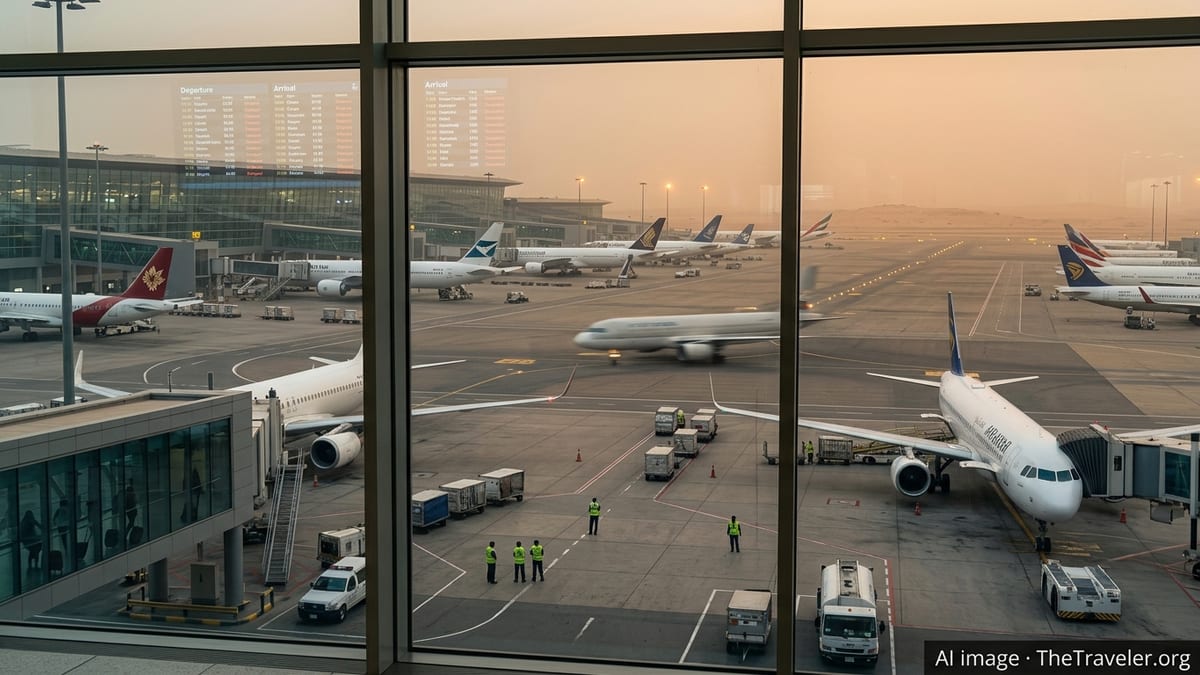
Airspace Closures Turn the Gulf Into an Aviation Bottleneck
Since late February, overlapping airspace closures and restrictions have turned skies over much of the Middle East into a patchwork of no-go zones and tightly controlled corridors. Following United States and Israeli strikes on Iran on 28 February, countries including the United Arab Emirates, Qatar, Kuwait, Bahrain, Iraq and Israel moved to either close or heavily restrict their airspace, according to multiple aviation advisories and industry updates. Saudi Arabia, Oman and others have kept core airports operating but within a landscape of rerouting, delays and intermittent suspensions.
Operational bulletins circulated to airlines and freight forwarders in early March describe a cascading closure of flight information regions across the Gulf, with Iran’s airspace largely off limits and surrounding states introducing their own restrictions for overflights and arrivals. A regional briefing dated 3 March reported that airspace was closed in most Gulf countries and that many carriers were avoiding the Strait of Hormuz entirely, compounding congestion on remaining routes.
The effect has been felt well beyond the Middle East. Carriers operating long-haul services between Europe and Asia have had to design longer routings to skirt conflict zones, adding flight time and fuel burn. Supply chain analyses describe the situation as a domino effect, with the Gulf’s role as a global aviation hub turning localized closures into a systemic constraint for passenger and cargo flows.
For travellers, the most visible outcome has been widespread schedule changes. Regional updates from early and mid March show airlines repeatedly revising timetables as airspace rules shift, often with only hours of notice. Advisories consistently recommend that passengers recheck flight status on the day of travel and expect longer journeys via alternative hubs.
Missile Strikes and Security Alerts Hit Key Tourism Gateways
The airspace crunch has unfolded against the backdrop of intensifying missile and drone activity linked to the broader 2026 Iran war, which has brought strikes closer to major tourism and aviation hubs. Public reporting on the conflict outlines repeated attacks on several Arab countries, including Saudi Arabia, Qatar, Iraq and Kuwait, as well as targets in Israel and Iran. Some strikes have directly threatened, or in a few cases hit near, civilian airports and high-profile hospitality properties.
Published coverage of Iranian strikes on Qatar notes that Qatari authorities closed the country’s airspace on 28 February following waves of missiles and drones, with disruptions radiating from Hamad International Airport in Doha. Similar patterns of heightened alert and temporary suspensions have been documented around airports in Bahrain, Kuwait and parts of Iraq, feeding into the region-wide decision by airlines and regulators to route traffic away from perceived risk zones.
Saudi Arabia has faced its own pressures. Reporting on the March drone attack against an Aramco facility in Ras Tanura, on the kingdom’s Gulf coast, describes how oil installations and critical infrastructure have become entangled in the military escalation. While core airports in Riyadh, Jeddah and Dammam remain open, travel security advisories indicate that operations have been limited at times by regional airspace closures and the need for rapid defensive responses to inbound threats.
In parallel, longer-running maritime insecurity in the Red Sea and Gulf of Aden, driven by attacks on commercial vessels by Yemen-based groups, has raised broader questions about the reliability of routes linking Europe and Asia. Although primarily a shipping issue, these tensions contribute to the general risk calculus affecting how airlines, tour operators and travellers view the wider region.
Gulf Carriers, Low-Cost Airlines and Global Partners Scramble
Gulf-based airlines and their international partners have been forced into an almost continuous process of schedule triage. Industry updates show that Emirates and Etihad temporarily suspended many flights in the first days of March before progressively restoring parts of their networks as the situation evolved. Other regional carriers, including Oman Air and airlines in Bahrain and Kuwait, have issued rolling cancellations on selected routes, sometimes stretching weeks into the future.
Saudi Arabia’s aviation market has not been immune. A recent operational notice from Saudi budget carrier Flynas confirms that it has extended suspensions on services to several Middle East destinations until at least 31 March, citing ongoing operational challenges. Although Saudi domestic flying continues at scale, the interruption of shorter regional hops to nearby Gulf capitals has disrupted typical itineraries for both residents and visitors who depend on multi-stop journeys.
Foreign airlines have also adjusted sharply. According to published coverage from travel and aviation outlets, South Asian and European carriers have cancelled or rerouted flights into the Gulf, in some cases following national directives to avoid specific Middle East airspaces encompassing Iran, Saudi Arabia, the UAE, Bahrain, Oman, Iraq, Jordan, Kuwait, Qatar and Israel. Notices from India’s aviation regulators, for example, advised carriers to bypass a cluster of regional airspaces at the height of the March escalation, prompting mass cancellations and detours.
The knock-on effects are substantial for global connectivity. The Gulf’s hub-and-spoke model, centered on cities such as Dubai, Doha and Abu Dhabi, usually channels millions of passengers between Europe, Africa, Asia and Australasia. With parts of that network constrained, some travellers have been redirected through southern corridors over the Arabian Sea, Oman and Egypt, or shifted entirely onto alternative hubs in Turkey and southern Europe.
Tourism Hotspots Face Cancellations, Higher Costs and Uneven Demand
The combination of conflict, storms and security settings is reshaping tourism demand patterns across the Middle East. Before the latest escalation, Gulf states including Saudi Arabia, the UAE and Qatar were widely expected to lead global tourism growth in 2026, underpinned by high-profile events and aggressive investment in resorts, cruises and cultural attractions. Analyses published in recent weeks by travel industry groups now estimate that the conflict-linked disruption is costing the wider regional travel sector hundreds of millions of dollars per day in lost international visitor spending.
Travel and tourism commentators report that many visitors are postponing or rerouting trips that involve transiting conflict-affected airspace, even when final destinations remain technically open. High-profile leisure centers in the UAE and Qatar, along with cultural and religious destinations in Saudi Arabia, are seeing a mix of cancellations and shortened stays, especially from long-haul markets wary of perceived instability. At the same time, some intra-regional trips, including religious travel to Saudi cities such as Mecca and Medina, continue with tightened contingency planning.
The financial impact is uneven but mounting. Hotels and tour operators in the Gulf that rely heavily on long-haul guests are confronting softer forward bookings and a more volatile last-minute market. In Jordan, Egypt and Lebanon, earlier tensions had already dented arrivals linked to the Gaza conflict and Red Sea insecurity; the latest airspace upheaval now risks further depressing multi-country itineraries that stitch together several Middle East destinations in a single trip.
Destination marketing bodies and hotel groups are responding with flexible booking policies, incentives for regional visitors and messaging that emphasizes safety measures away from active conflict zones. However, analysts warn that repeated episodes of airspace disruption tend to have a cumulative effect on traveller confidence, reinforcing perceptions that the region is unpredictable even when day-to-day life in many cities carries on largely as normal.
What Travelers Should Expect in the Coming Weeks
Looking ahead into late March and early April, publicly available notices from airlines, logistics companies and risk consultancies suggest that volatility will remain the defining feature of Middle East travel. Some airspaces that fully closed in early March are gradually reopening in a limited way, while others retain strict controls that can be tightened again without much warning in response to new strikes or security alerts.
Regional travel advisories emphasize three overlapping challenges for anyone moving through the area. The first is uncertainty around flight schedules, as carriers adjust routings and frequencies in line with evolving no-fly zones, storm systems and military activity. The second is a potential rise in fares, driven by longer routings, higher fuel costs linked to energy market turbulence, and constrained seat capacity on certain corridors. The third is a more complex risk environment for multi-stop itineraries that rely on seamless connections through Gulf hubs.
Experts in aviation logistics note that cargo and passenger operations are intertwined, meaning disruption in one can spill into the other. Supply chain assessments from early March describe how air freight capacity has been squeezed by the same airspace closures affecting passengers, especially on lanes that normally route via the Gulf between Asia and Europe. This can indirectly affect travellers through higher prices for shipped goods and tighter baggage handling and belly cargo constraints on some flights.
For now, the consensus across industry reporting is that travellers with imminent plans involving Saudi Arabia, the UAE, Iraq, Qatar, Bahrain, Oman, Kuwait or neighboring states should build in extra time, monitor airline and airport updates closely, and be prepared for sudden shifts in routing. With regional governments and carriers still coordinating responses to storms, strikes and security risks, the Middle East’s role as a global crossroads remains intact, but its travel landscape is likely to stay unsettled well into the northern spring.