

More news on this day
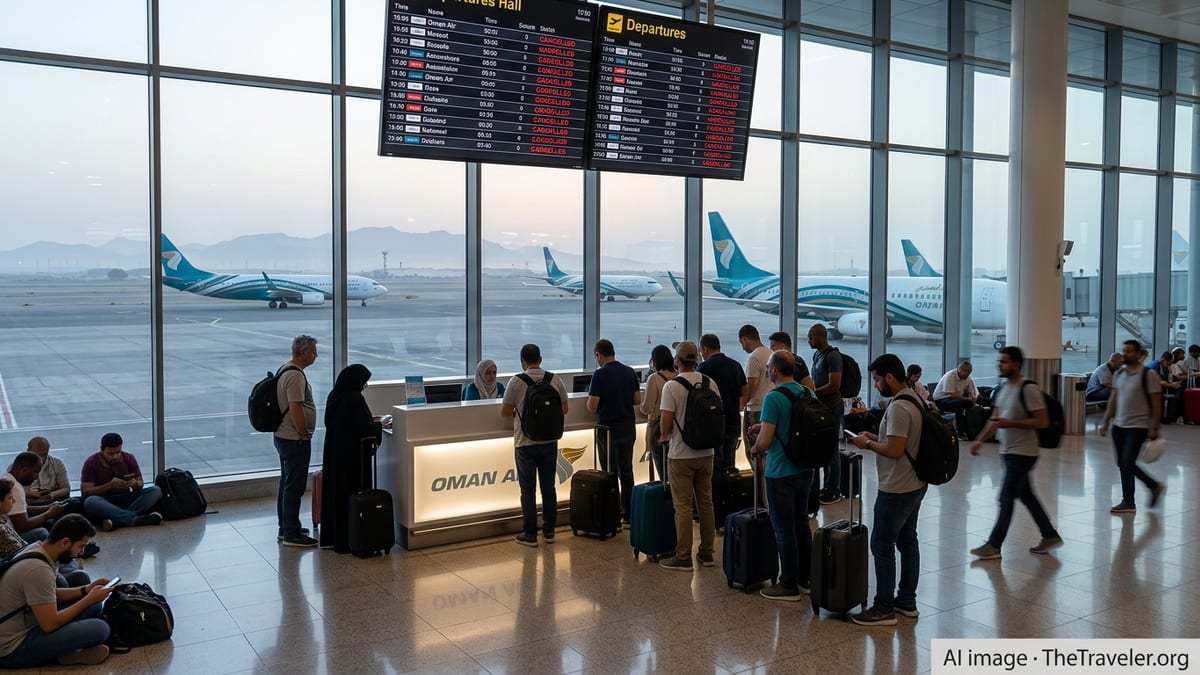
Gulf travel disruption is deepening as the United Arab Emirates joins Qatar, Bahrain, Jordan, Kuwait, Iraq and other regional states in sharply restricting or halting incoming passenger travel from Oman, while Oman Air prolongs a broad wave of flight cancellations until at least March 31 amid ongoing conflict and widespread airspace restrictions across the Middle East.
Get the latest news straight to your inbox!
Regional Airspace Closures Reshape Gulf Connectivity
Publicly available aviation advisories show that large parts of Middle East airspace have been intermittently closed or heavily restricted since late February, when the latest phase of the Iran war triggered missile strikes and defensive interceptions across the Gulf. Several Gulf Cooperation Council states, including Qatar, Bahrain, Kuwait, Iraq and the United Arab Emirates, have either fully shut or severely curtailed their airspace to civil traffic at various points in March, prompting cascading schedule changes for both local and international carriers.
Analyst summaries and industry notices indicate that Qatar, Bahrain, Kuwait and Iraq rapidly moved to limit overflights and inbound services as the conflict escalated, effectively cutting a key east west aviation corridor that normally funnels traffic between Europe, Asia and Africa. Travel discussion forums that collate airline statements describe widespread cancellations on routes touching Doha, Manama, Kuwait City and Baghdad, with airlines rerouting via southern corridors or suspending services altogether.
Within this tightening environment, the UAE has become the latest state to halt or sharply restrict incoming commercial travel from Oman, despite having partially reopened some routes to other destinations on a reduced basis. The measure is framed in aviation circulars and travel advisories as a safety-driven response to the conflict and to the risk of spillover from Iranian and counter-strikes that have periodically pushed missile and drone activity close to busy regional flight paths.
Security-focused risk bulletins further underline that while not every Gulf state has issued a formal blanket closure at all times, the combination of state-imposed restrictions, airline-level risk assessments and insurance constraints has produced a de facto shutdown of many traditional routings, especially those relying on airspace over Iran, Iraq and the northern Gulf.
Oman Air Extends Cancellations Through March 31
Against this backdrop, Oman Air has extended a wide-ranging suspension of flights until March 31, significantly lengthening what began as a more limited series of cancellations in early March. Commercial policies circulated to travel agents and corporate clients outline that services across multiple regional and long-haul markets remain halted due to airspace closures and conflict-related operational challenges, with options for rebooking, rerouting or refunds offered to affected passengers.
These documents indicate that connections within the Gulf region and to key cities in Iraq and Jordan have been particularly affected, alongside selected European and Asian routes that normally depend on overflight permissions now subject to tight restrictions. Industry advisories note that while Oman’s own airspace has not been universally closed at all times, the ability of Oman Air to operate viable schedules is constrained by closures and risk advisories in neighboring flight information regions.
Travel trade updates show that Oman Air has adopted flexible commercial measures, including date changes and, in some cases, allowing passengers to alter their origin or destination within the same country. Despite these steps, passengers transiting through Muscat continue to report prolonged delays, complex rebookings and extended stays in airport hotels as the airline adapts to shifting airspace availability and slot constraints.
The decision to set March 31 as the current horizon for cancellations provides a provisional planning date for travelers and agents, but aviation risk assessments caution that this timeline could change if the regional security situation worsens or if overflight bans are extended into April.
UAE Ban on Incoming Travel From Oman Ripples Across the Region
The UAE’s move to halt or heavily curb incoming travel from Oman adds a new layer of complexity to an already fragmented regional network. While the UAE has begun to restore a reduced schedule to selected long-haul destinations as its own airspace management stabilizes, the specific restrictions on traffic originating in Oman effectively close off one of the main alternative gateways that many travelers had been using to bypass closures elsewhere in the Gulf.
Publicly shared travel advisories and airline notices describe how, earlier in March, some passengers from the UAE and other Gulf states attempted to reach long-haul flights by crossing into Oman overland and departing from Muscat. Recent updates now warn that such workarounds are increasingly impractical, as entry rules tighten and carriers adjust schedules to reflect the UAE’s stance on inbound traffic from Omani departure points.
Forwarders and corporate travel managers report that the UAE decision has knock-on effects for business and leisure trips across the wider region. Passengers who once relied on hub-and-spoke itineraries combining Muscat with Dubai or Abu Dhabi are being urged to consider routing through more distant hubs in Europe or South Asia, often at higher cost and with longer journey times.
The restriction also places additional pressure on ground transport corridors linking the UAE and Oman, with reports of longer queues and heightened scrutiny at border crossings as travelers seeking to reach alternative flights in Muscat contend with uncertain entry and exit conditions on both sides.
Qatar, Bahrain, Jordan, Kuwait and Iraq Maintain Tight Controls
Elsewhere in the region, publicly available information suggests that Qatar, Bahrain, Jordan, Kuwait and Iraq continue to maintain strict controls over airspace usage and inbound travel from conflict-affected areas, including Oman. National aviation authorities and flag carriers in these states have issued a series of rolling notices detailing suspended routes, reduced frequencies and, in some cases, outright bans on traffic from specific origins on safety grounds.
Travel megathreads and specialist aviation forums that aggregate official updates describe prolonged suspensions of flights through Doha, Manama and Kuwait City, alongside capacity cuts on routes into Amman and Baghdad. Several carriers based in these markets have scaled back operations across the Gulf, citing both airspace limitations and waning demand from travelers wary of transiting through the conflict zone.
Jordan’s position as a secondary gateway for travel between Europe and the wider Middle East has also been affected, with published schedules revealing reduced frequencies and increased operational buffers on flights that previously crossed Iranian or Iraqi airspace. Airlines serving Amman and other regional airports are instead favoring southern routings that lengthen journey times but keep aircraft further from areas subject to active missile activity.
In Iraq, where commercial aviation has periodically resumed in recent years despite security challenges, the current conflict has once again narrowed available corridors. Notices to air missions and insurer guidance have combined to sharply limit the number of foreign carriers operating to Baghdad, Basra and Erbil, while local airlines confront restrictions that curtail their ability to link with hubs in Qatar, Bahrain and Kuwait.
Travelers Face Longer Journeys, Limited Alternatives and Persistent Uncertainty
The combined impact of Oman Air’s extended cancellations and the growing list of states curbing or halting incoming travel from Oman is being keenly felt by travelers who rely on Gulf hubs for both regional and intercontinental journeys. Reports from passengers on widely read travel forums highlight experiences of last-minute cancellations, lengthy rebooking queues and multi-stop routings that add both time and expense to trips.
With Qatar, Bahrain, Kuwait, Iraq, Jordan and now the UAE enforcing strict controls, options for using Muscat as a bridge between closed or constrained hubs have narrowed considerably. International airlines that previously overflew the Gulf to connect Europe, Asia and Africa are instead diverting around the region altogether, sometimes adding technical refueling stops or choosing more southerly paths that avoid the most heavily restricted airspace.
Risk consultancies advise that this pattern of disruption is likely to persist at least through the end of March and potentially longer, pointing to continuing military activity and the slow pace at which airspace advisories are typically relaxed even after immediate dangers subside. Travelers are being encouraged by airlines and travel agents to monitor bookings closely, allow generous connection times and remain flexible about routing and dates.
For Gulf tourism and business travel, the evolving situation underscores the region’s vulnerability to geopolitical shocks that affect the narrow band of airspace through which much of its aviation connectivity runs. As long as Oman Air’s network remains heavily curtailed and neighboring countries maintain tight barriers to incoming traffic from Oman, the Gulf’s once-seamless hub system will continue to operate in fragmented and unpredictable fashion.