

More news on this day
Four of the world’s most powerful hub airlines – Emirates, Qatar Airways, Etihad Airways and FlyDubai – are scrambling to contain an unprecedented wave of disruption as the US–Israel–Iran war triggers rolling airspace closures and partial shutdowns at their home hubs in Dubai, Abu Dhabi and Doha.
How the Conflict Brought Gulf Hubs to a Near Halt
The crisis erupted after coordinated US and Israeli strikes on Iran on 28 February 2026, prompting a barrage of Iranian missile and drone attacks across the Gulf. Within hours, airspace over Iran, Israel, Iraq, Qatar, Bahrain, Kuwait and parts of the United Arab Emirates was closed or heavily restricted, severing many of the key east–west corridors that have made Gulf hubs central to global aviation.
Dubai International Airport and Abu Dhabi International Airport, normally among the world’s busiest long-haul transfer points, saw operations suspended or sharply curtailed as authorities prioritized air defense and emergency responses. Hamad International Airport in Doha was also hit by the closure of Qatari airspace, forcing Qatar Airways to cancel or divert nearly all scheduled services and leaving wide-body jets parked along remote stands.
According to regional aviation data and government briefings, more than 20,000 flights across the Gulf Cooperation Council states have been cancelled or rerouted in the past week alone, with Dubai, Abu Dhabi and Doha bearing the brunt. Analysts warn that the knock-on effects to aircraft rotations and crew schedules will reverberate for weeks even if airspace gradually reopens.
For the big Gulf carriers, the disruption strikes at the core of their business model. Emirates, Qatar Airways and Etihad collectively carry tens of thousands of transiting passengers each day through carefully timed hubs built on precise connectivity. The sudden loss or limitation of those hubs has forced an emergency pivot to evacuation-style flying and limited point-to-point services.
What Each Airline Is Doing Right Now
Emirates initially suspended all flights to and from Dubai for several days as missile fragments and a suspected strike near the airport raised safety concerns. The airline has now begun restoring a reduced schedule on carefully vetted routes, focusing on key long-haul corridors to Europe, Asia and Oceania while continuing to bar flights to high-risk destinations such as Iran, Iraq and parts of the Levant.
Etihad Airways, based in Abu Dhabi, followed a similar pattern: a full stop to scheduled commercial flights at the height of the attacks, followed by a phased resumption of limited services. The carrier is prioritizing routes that enable passengers to connect on to relatively unaffected regions, such as parts of Europe and Southeast Asia, using alternative routings that skirt closed or hostile airspace.
Qatar Airways remains the most constrained of the four, with Qatari authorities keeping national airspace largely closed except for emergency and strictly controlled relief operations. The airline has announced temporary suspension of regular commercial flights from Doha, instead planning one-off relief services from major global capitals to evacuate stranded passengers back to Qatar under military and civil aviation oversight.
FlyDubai, the Dubai-based low-cost carrier that normally feeds regional traffic into Emirates’ long-haul network, has also cut back operations to a fraction of normal levels. Its focus has shifted to limited regional links judged safe to operate and to special flights arranged in coordination with governments seeking to extract citizens from the conflict-affected region.
What This Means if You Are Due to Transit via Dubai, Abu Dhabi or Doha
For travelers with tickets on Emirates, Qatar Airways, Etihad or FlyDubai, the most immediate impact is uncertainty. Many passengers have discovered their itineraries cancelled mid-journey, with onward connections evaporating as hubs closed or schedules were slashed. In some cases, long-haul flights already in the air have turned back to their origin or diverted to secondary airports as far away as Europe or South Asia.
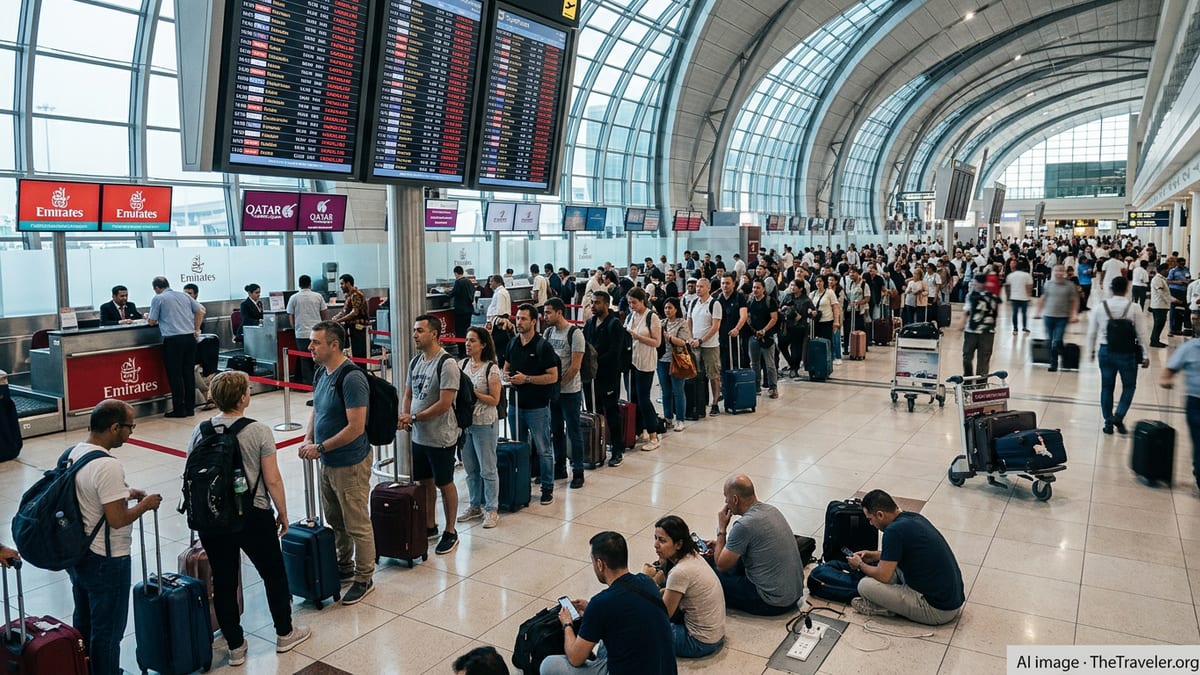
Industry advisories are unanimous on one point: passengers should not go to the airport unless they have a confirmed, rebooked itinerary and have been explicitly notified by their airline. Airport terminals across the Gulf have already seen surges of stranded travelers sleeping on floors and queuing for hours at service desks, a situation carriers and authorities are keen to avoid repeating as limited flights restart.
Travelers who had planned to use Dubai, Abu Dhabi or Doha as transit points in the coming days should assume significant disruption. Even where flights are technically operating, schedules are volatile, and last-minute cancellations remain likely as military activity and airspace notices evolve. Many airlines are waiving change fees, but rebooking options are constrained by limited capacity on alternative routings that avoid the Gulf.
Those yet to depart are being urged to consider rerouting through other hubs where possible, such as in Europe or Southeast Asia, or to postpone nonessential travel entirely. For some long-haul city pairs that normally rely on Gulf connections, there may simply be no viable alternative until more airspace opens.
Safety, Rerouting and Your Rights as a Passenger
Despite the chaos on the ground, safety remains the overriding factor in every operational decision. Airlines are coordinating closely with national aviation authorities and militaries to establish so-called safe corridors that allow flights to thread between restricted zones. In practice, that can mean longer flight times, unusual routings that curve far north or south of the usual tracks, and mid-journey diversions if the risk picture changes.
For passengers, the visual manifestation of this can be striking: flight maps showing dramatic detours around the Gulf, arrivals landing hours late, and aircraft overnighting at unexpected airports. Crews are also facing duty-time limits, which can force unscheduled layovers and further delays even once a safe route is identified.
When it comes to compensation, travelers should temper expectations. Because the disruption is rooted in an armed conflict and government-imposed airspace closures, it is widely considered an extraordinary circumstance outside airline control. That typically limits entitlement to cash compensation under most consumer protection regimes, although carriers are providing refunds, free date changes and in some cases hotel accommodation for stranded passengers where logistics allow.
Experts recommend that travelers keep all documentation, including cancellation notices and receipts for extra expenses, and stay in close contact with their airline or travel agent. Comprehensive travel insurance that covers war-related disruption is rare, but policies may still reimburse some costs linked to delays, missed connections or enforced stopovers, depending on the fine print.
How Long Could the Disruption Last and What Comes Next
The outlook hinges almost entirely on developments in the conflict itself. Aviation authorities stress that airspace will only fully reopen once they are confident that the threat from missiles, drones and potential spillover attacks has receded to an acceptable level. Even then, the process is likely to be staggered, with priority given to evacuation flights, cargo operations and a skeleton network of commercial services.
Emirates has signaled that it aims to restore something close to full capacity in the coming days if security conditions allow, while Etihad is moving more cautiously with a partial schedule focused on key markets. Qatar Airways faces a longer road to normality because of the extended closure of Qatari airspace, although limited relief corridors are starting to emerge under tight control.
Travel analysts warn that, beyond the immediate humanitarian and logistical challenges, the war risks denting the Gulf’s hard-won reputation as a reliable crossroads between continents. Forecasts suggest international arrivals to the wider region could fall sharply this year if travelers and tour operators perceive the skies over the Middle East as unstable, even after formal restrictions lift.
For now, anyone planning to fly through Dubai, Abu Dhabi or Doha in the coming weeks should be prepared for a fluid situation. Schedules will change at short notice, routings may be unconventional, and airlines will continue to juggle the competing demands of safety, government directives and the sheer scale of demand from stranded travelers trying to get home.