

More news on this day
A widening Middle East crisis is forcing some of the world’s biggest long haul airlines to rip up schedules, slash capacity and design new routings almost overnight, creating fresh uncertainty for travelers planning trips between Europe, Asia and North America.
Get the latest news straight to your inbox!
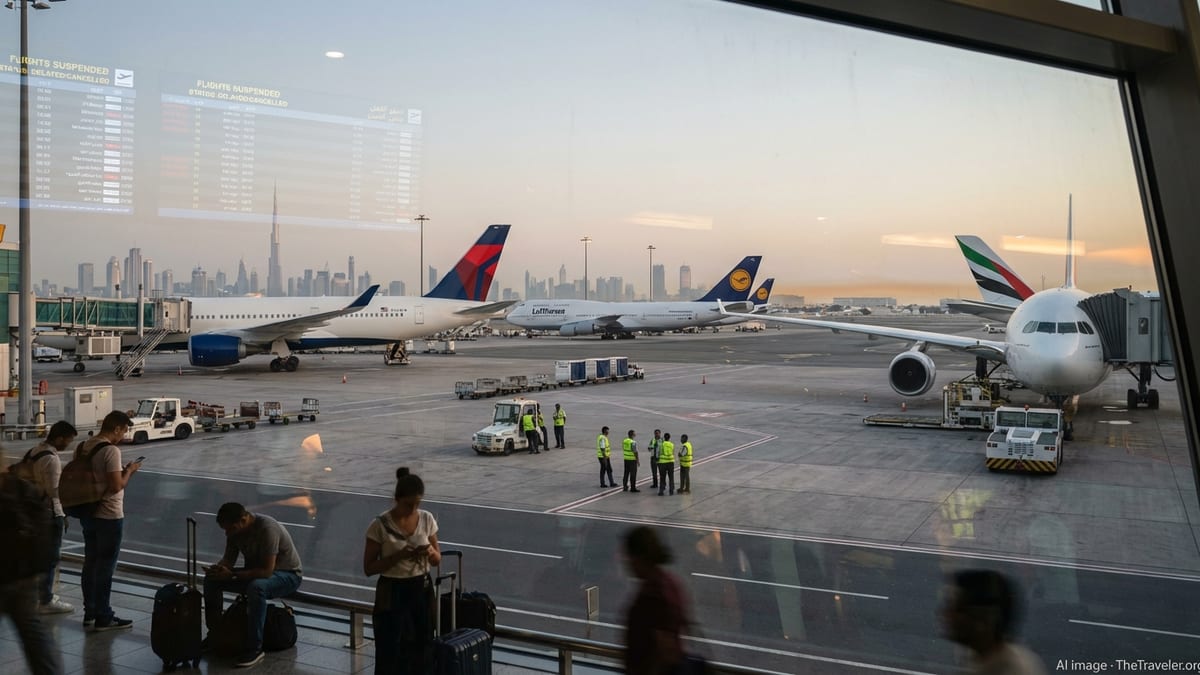
Conflict Closes Key Corridors And Grounds Thousands Of Flights
Since late February 2026, a rapidly escalating conflict involving Iran has triggered a series of airspace closures across the Gulf and wider Middle East, including restrictions over Iran, Iraq and parts of the Arabian Peninsula. Publicly available aviation data and media coverage indicate that more than 14,000 to 15,000 flights were canceled in the first weeks alone, with major hubs such as Doha, Dubai and Abu Dhabi among the hardest hit.
The closures have disrupted one of the world’s most important aviation corridors linking Europe and North America with South and Southeast Asia. Airlines have been forced either to suspend operations entirely at certain hubs or to add significant detours around closed airspace, lengthening flight times and increasing fuel burn.
Industry analytics cited in recent reports show Middle East airline capacity down by more than half in March compared with a year earlier, dragging global seat supply lower. For passengers, the impact is showing up as rolling cancellations, longer journey times and higher fares on many long haul itineraries that once relied on Gulf connections.
The situation remains fluid. Regulators continue to adjust permitted flight paths as the security picture shifts, and airlines are reissuing schedules week by week rather than months in advance, a sharp departure from normal long term planning.
Qatar Airways: From Airspace Shutdown To Gradual Rebuild
Qatar Airways has faced some of the most severe operational disruption. Following missile strikes that affected areas around Doha in early March, Qatari airspace was temporarily closed, and the carrier’s regular commercial operations were largely suspended. For several days, only limited relief and repatriation flights operated under special permissions, while most scheduled services through Hamad International Airport were canceled.
By mid March, authorities allowed restricted reopening of air navigation, first for evacuation and cargo flights, and then for a controlled ramp up of passenger services. Qatar Airways introduced an emergency rebooking and refund policy covering travel dates from late February into late March, reflecting the scale of cancellations affecting connecting traffic between Europe, Africa and Asia.
More recent schedule updates for April indicate that the airline is now rebuilding its network, targeting more than 120 destinations by mid May under a revised timetable that still allows for further cuts. Newer public guidance stresses that passengers whose flights are canceled are entitled to refunds or rebooking, but the carrier has tightened earlier practices that saw widespread rerouting on partner and competitor airlines. Travelers now report that alternatives are more likely to be offered on Qatar Airways’ own services or on closely coordinated partners, reducing flexibility for those who want to avoid the region altogether.
Forward bookings suggest that demand remains strong on routes that have resumed, but with seats constrained and routings still subject to last minute changes, many Qatar Airways customers are being advised via public updates to monitor flight status closely and consider flexible travel dates where possible.
Emirates And Etihad Trim Capacity And Add Detours
In the United Arab Emirates, Emirates and Etihad have kept their hubs at Dubai and Abu Dhabi operating but on significantly reduced schedules. According to airline advisories and operational data, Emirates is currently flying at around two thirds to seventy percent of its pre conflict capacity from Dubai, while its regional counterpart flydubai is operating well below normal levels.
Published travel advisories from UAE based outlets describe a patchwork of suspensions and delays, particularly on routes that would usually overfly Iranian or Iraqi airspace. Some services have been retimed or combined, while others have been temporarily halted, with passengers encouraged to check status even after completing online check in because of the risk of late changes.
Etihad has issued its own policy for the “Middle East situation,” offering flexible changes and refunds for affected tickets. At the same time, the carrier is prioritizing key trunk routes, including services to major Asian and European cities, sometimes at the expense of secondary destinations. Capacity to India and parts of Europe has been maintained using larger aircraft and higher load factors, even as other regional links are temporarily paused.
Both Emirates and Etihad are also wrestling with the cost implications of longer routings. Flights that previously crossed Iran or Iraq now often detour via Central Asia or the eastern Mediterranean, adding up to an hour or more to some sectors. Higher fuel use, combined with strong demand for the remaining seats, is reinforcing an upward push on fares visible in booking channels.
Singapore Airlines Pulls Back From The Gulf And Reroutes Long Hauls
The effects of the Middle East crisis are not limited to Gulf carriers. Singapore Airlines, one of Asia’s largest long haul operators, has suspended or reduced several services into the region, particularly routes to Saudi Arabia and other Gulf states served directly or through its low cost subsidiary Scoot.
Coverage from aviation industry outlets in early March reported that Singapore Airlines and Scoot extended suspensions on key Middle East routes as airspace restrictions tightened and demand from point to point travelers and pilgrims fell sharply. The adjustments affect connections for passengers who previously used Singapore as an alternative gateway between Southeast Asia, the Middle East and beyond.
At the same time, long haul flights linking Singapore with Europe and North America have been reprofiled to avoid the most sensitive airspace. Nonstop transpolar and transpacific routings are being emphasized over one stop itineraries via the Gulf. For travelers originating in the United States or Europe, itineraries that once relied on a stop in Dubai, Doha or Abu Dhabi are increasingly being replaced by journeys via East Asian hubs such as Tokyo, Seoul or Hong Kong.
The combined effect is a gradual shift in global traffic flows. While Singapore Airlines is absorbing some displaced demand on east west corridors, the loss of direct Middle East capacity is still translating into fewer available seats overall, longer travel times and higher prices on popular routes linking Europe with South and Southeast Asia.
What Travelers Need To Know Right Now
For passengers booked with Qatar Airways, Emirates, Etihad or Singapore Airlines over the coming weeks, the most important reality is that schedules remain subject to rapid change. Airlines are publishing revised timetables and special policies that typically allow free date changes, rerouting on their own networks or refunds when flights are canceled, but conditions vary by ticket type and point of sale.
Travel advisories and consumer advocates note that travelers starting their journeys in the European Union, United Kingdom or Canada may benefit from additional protections under local passenger rights rules when flights are canceled or significantly delayed. Even outside those jurisdictions, most carriers are publicly committing to at least full refunds for flights they cancel, though compensation for knock on costs such as hotels and missed connections is more limited.
Because airspace closures are driving last minute operational decisions, experts recommend building extra time into itineraries that involve connections, especially those that previously funneled through the Gulf. Where feasible, routing via hubs in Europe or East Asia that avoid the Middle East can reduce exposure to disruption, albeit often at a higher price.
With no clear timeline for a full reopening of regional airspace, travelers planning trips between now and early summer 2026 are likely to face elevated fares and constrained capacity on some of the world’s busiest long haul corridors. Monitoring airline advisories closely, opting for flexible tickets and considering alternative routings can help mitigate the impact as Gulf supercarriers and their Asian counterparts struggle to rebuild stable operations in the shadow of the crisis.