

More news on this day
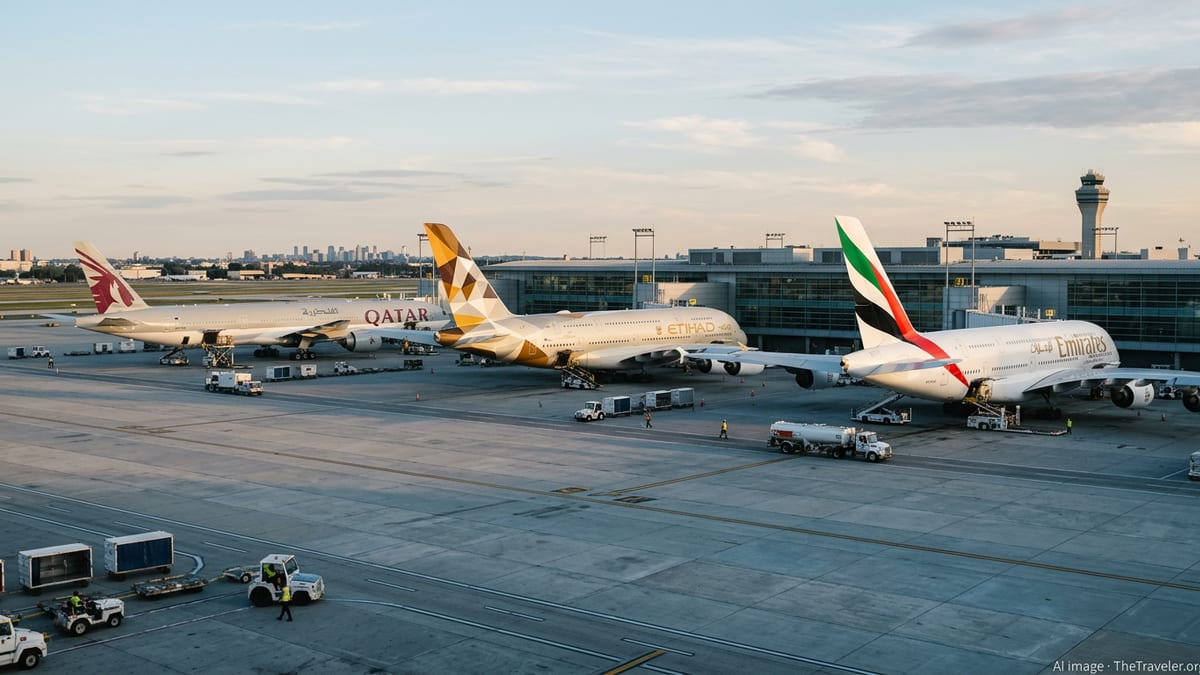
Gulf megacarriers Emirates, Etihad Airways and Qatar Airways are pressing ahead with ambitious United States expansion plans in 2026, using new routes, upgraded aircraft and deepening partnerships to cement their role as key connectors between North America, the Middle East and fast-growing markets across Asia and Africa.
Get the latest news straight to your inbox!
Etihad Targets Secondary Hubs as It Adds a New US Gateway
Etihad Airways is moving beyond its traditional focus on the largest coastal gateways and is now targeting fast-growing secondary hubs in the United States. Publicly available information shows that Charlotte Douglas International Airport will become Etihad’s newest US destination in 2026, providing nonstop service between Charlotte and Abu Dhabi on Boeing 787-9 aircraft. Reports indicate the route is planned at four weekly frequencies and will be among the longest flights operated from Charlotte.
The move aligns with Etihad’s broader growth phase. In 2025 the Abu Dhabi carrier recorded the strongest financial performance in its history, supported by what company disclosures describe as the largest expansion year it has ever undertaken. Its operating fleet has grown past 110 aircraft and continues to rise, underpinned by firm orders for additional Boeing 787s and 777X jets that are due to support long-haul expansion through the latter half of the decade.
For US travelers, the Charlotte link and Etihad’s wider US build-out are designed to open one-stop access to cities across the Middle East, Indian subcontinent and Southeast Asia. Travel industry coverage notes that Etihad is marketing its network as an alternative to congested European hubs, with a focus on shorter minimum connection times in Abu Dhabi and growing cooperation with US carriers on interline and codeshare flows beyond its American gateways.
Looking ahead through 2026, aviation analysts expect Etihad to keep scaling capacity into the US market as new aircraft arrive and as Abu Dhabi positions itself as a global hub for both leisure and business traffic. The Charlotte launch is viewed as a test case for further moves into large inland US hubs that offer strong local demand and feed from alliance partners.
Emirates Bets on Premium Cabins and Network Recovery
Emirates is pairing a renewed push into US markets with a major investment in refurbished long-haul aircraft. Company announcements show that by early 2025, ten of the carrier’s twelve US gateways were scheduled to feature Premium Economy cabins, primarily through a rolling program of Airbus A380 and Boeing 777 retrofits. Routes such as New York, Los Angeles, San Francisco, Houston, Dallas and Boston have been among the first to see the upgraded interiors.
The retrofits introduce a four-class product on many US routes, adding a dedicated Premium Economy cabin between Economy and Business. Industry reports highlight strong demand from US passengers seeking additional comfort on ultra-long-haul flights without paying full business-class fares. Emirates has indicated that booking patterns on early US routes with Premium Economy have supported plans to accelerate the rollout through 2026 as more refurbished aircraft re-enter service.
At the same time, Emirates is rebuilding its wider global schedule following recent disruptions linked to regional geopolitical tensions and temporary airspace closures. Aviation tracking data and airline communications in early March 2026 indicate that the carrier is restoring frequencies to its full pre-disruption network and expects to return to its typical US schedule in the near term. This recovery is expected to stabilize connections for US travelers heading via Dubai to destinations across Africa, South Asia and Australasia.
The combination of upgraded cabins, a young long-haul fleet and Dubai’s status as a major global hub is reinforcing Emirates’ appeal in the competitive US long-haul market. For US airports, the return of high-capacity A380 services and enhanced 777 cabins translates into more premium seats, higher passenger throughput and increased connectivity to secondary cities across the Middle East and beyond.
Qatar Airways Leans on Partnerships to Grow US Reach
Qatar Airways is expanding its US footprint less through new own-metal routes and more through a dense web of partnerships and codeshares. The Doha-based carrier already serves multiple major US gateways directly, but recent announcements highlight a strategy of deepening connectivity beyond those airports using alliances with Aer Lingus, American Airlines and other partners.
In 2024 and 2025 Qatar Airways extended its codeshare agreement with Aer Lingus to cover flights from Dublin to a growing list of US cities, including Boston, Cleveland, Indianapolis, Nashville, Minneapolis, Orlando and Philadelphia, among others. Passengers can book itineraries that combine US domestic legs on Aer Lingus with transatlantic and onward Doha connections on Qatar Airways, effectively adding more US entry points to the Gulf carrier’s network without launching new standalone routes.
The airline has also been expanding its longstanding cooperation with American Airlines. Published schedules and route updates show Qatar Airways’ code appearing on an increasing number of American-operated flights within the Americas, including services from Miami into the Caribbean and Latin America. This approach allows Qatar Airways to market a broader range of US and regional destinations while concentrating its own aircraft on high-demand trunk routes to hubs such as New York, Chicago, Dallas and Miami.
For US travelers, these partnership-driven expansions mean more one-ticket, through-checked options linking smaller American cities to Doha and onward to more than 170 global destinations. They also underline how alliance dynamics are reshaping the competitive landscape, as Qatar Airways leverages the oneworld network to match or exceed the reach of rivals without committing additional widebody capacity to every new city.
Open Skies, Politics and the Competitive Landscape
The renewed growth of Gulf carriers in the United States comes against the backdrop of long-running political and commercial debates over market access. A decade ago, major US airlines raised concerns about alleged state support for Emirates, Etihad and Qatar Airways and called for limits on their expansion. While those disputes have largely eased following various understandings and changes in competitive focus, policy analysts note that the regulatory environment remains a key factor shaping future growth.
In practice, current arrangements under bilateral air services agreements give the three Gulf carriers considerable freedom to add capacity and adjust schedules on US routes, provided they can secure airport slots and commercial demand. Recent fleet orders, including additional Boeing 777X and 787 aircraft for Emirates and Etihad, indicate that both carriers are preparing for sustained long-haul growth through the late 2020s and early 2030s. Qatar Airways, meanwhile, continues to modernize its own widebody fleet while maximizing network breadth through partnerships.
Competition on US long-haul corridors is intensifying as European and Asian airlines also rebuild capacity, launch new routes and upgrade cabins. Transatlantic joint ventures led by large US and European airline groups remain dominant on many flows, but industry observers point out that Gulf carriers hold particular advantages on itineraries linking the US with South Asia, Southeast Asia and parts of Africa, where their hubs are geographically well positioned for one-stop connections.
For travelers, the result is a more crowded marketplace with a wider range of products and price points. Premium Economy and refreshed business-class cabins on Gulf carriers are competing directly with new-generation seats from US and European rivals, while basic economy-style fares and ancillary fees continue to shape the lower end of the market.
What US Travelers Should Watch in 2026
For US-based passengers planning long-haul trips in 2026, the expansion strategies of Emirates, Etihad and Qatar Airways translate into several practical developments. New and reinstated routes such as Etihad’s Charlotte service, ongoing Emirates capacity restoration and Qatar Airways’ growing codeshare footprint are increasing the number of one-stop options to destinations that previously required multiple connections.
Travelers can expect more choice in cabin products, particularly in the increasingly popular Premium Economy segment. As Emirates rolls out its retrofitted aircraft across additional US gateways and competitors respond with their own offerings, price gaps between economy, premium economy and business are likely to become more finely segmented, giving passengers clearer trade-offs between comfort and cost.
At the same time, recent geopolitical tensions in the wider Middle East have underscored the importance of monitoring travel advisories and airline operational updates. Temporary suspensions and schedule changes in 2025 and early 2026 demonstrated how quickly conditions can shift for carriers based in the Gulf region. Publicly available information suggests that the three airlines are now focused on restoring reliability, but flexible booking policies and travel insurance remain important considerations for passengers connecting through the region.
Overall, the determined push by Emirates, Etihad and Qatar Airways into the US market is reshaping how Americans reach destinations across the Middle East, Asia and Africa. With new routes, upgraded fleets and deeper partnerships set to mature through 2026, the Gulf carriers’ presence in US skies is poised to become even more visible in the year ahead.