

More news on this day
A new wave of widebody upgrades led by Etihad Airways, Emirates, Qatar Airways and Lufthansa is reshaping travel flows between the Gulf, Asia and Europe, with Bangkok emerging as a prime winner and global hotel giants Hilton, Marriott and Accor positioning for a fresh tourism surge in 2026.
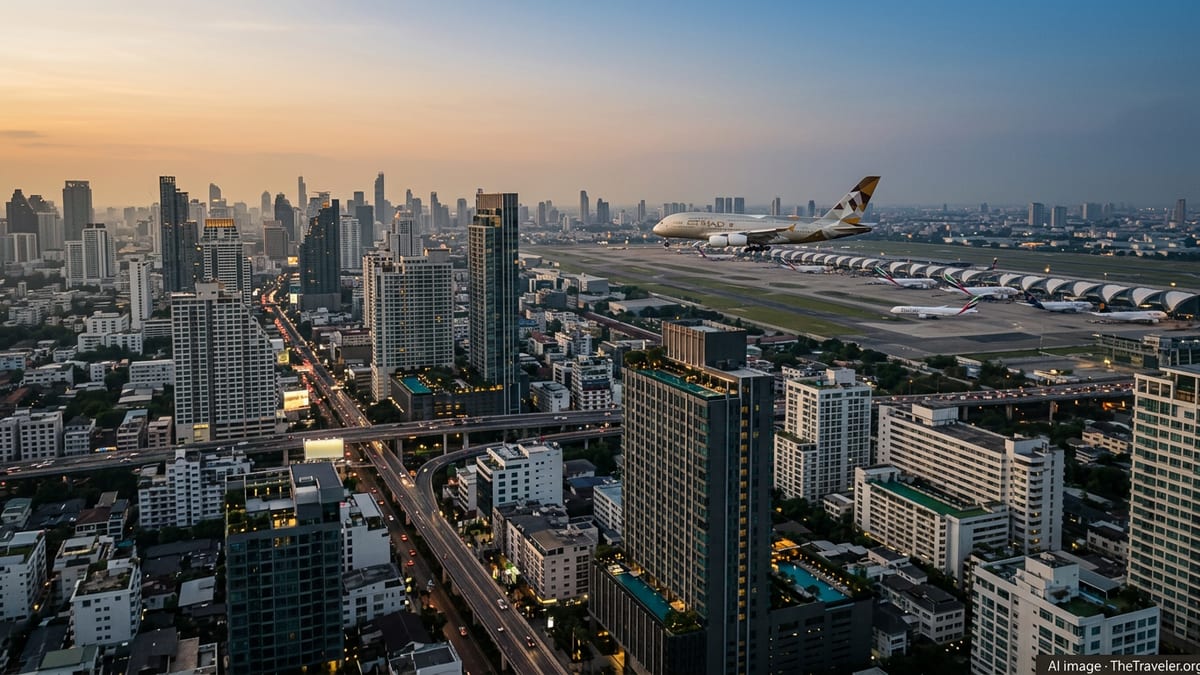
Etihad’s A380 Move Puts Bangkok at the Center of Its Network
Etihad Airways has fired the latest shot in the battle for Gulf–Asia premium travelers, confirming that its flagship Airbus A380 will be deployed on the Abu Dhabi–Bangkok route from October 25, 2026. The daily evening service from Zayed International Airport to Suvarnabhumi replaces a Boeing 777-300ER and brings a sharp jump in capacity on one of the carrier’s busiest leisure markets.
The service will feature The Residence, billed as the only three-room suite in commercial aviation, alongside nine First Apartments, 70 business class seats and more than 400 economy and extra-legroom seats. The decision follows Etihad’s step-by-step reactivation of its small A380 fleet on high-yield routes including London, Paris, Singapore, Toronto and Tokyo, and signals growing confidence in sustained demand between Southeast Asia, the Middle East and Europe.
Schedule details underscore how strategically the new superjumbo has been placed. Flight EY402 will depart Abu Dhabi at 21:20 and arrive in Bangkok at 06:35 the following morning, with the return EY403 leaving Bangkok at 08:30 and touching down in the UAE at 12:20. The timings are designed to feed Etihad’s connecting banks to and from Europe, the United Kingdom and North America, tightening the airline’s grip on Thailand-bound traffic from Western origin markets.
Industry analysts say the upgauge caps a wider Thailand push, with Etihad already having expanded winter frequencies to Bangkok and Phuket. The A380 switch effectively turns Bangkok into the airline’s premier leisure gateway in mainland Southeast Asia and raises the stakes for rival Gulf carriers that have long treated the Thai capital as a core trunk route.
Emirates, Qatar Airways and Lufthansa Ride Thailand, UAE, Swiss and UK Demand
Emirates continues to anchor the Gulf side of the corridor, with Bangkok already ranking among its most heavily served A380 destinations. The Dubai-based carrier operates multiple daily flights to Suvarnabhumi, several of them with four-class A380s fitted with its latest premium economy product and refreshed business cabins, reflecting consistently strong load factors on outbound Thailand traffic and two-way flows linking Europe, the Middle East and Australasia via the UAE hub.
Alongside Bangkok, Emirates has been deploying retrofitted A380s and upgraded Boeing 777s across a widening network of European and Asian cities, including Frankfurt, Nice, Hong Kong, Perth and Phuket. The airline has invested billions of dollars in a sweeping cabin refurbishment program and has added a large follow-on order for Boeing 777-9 aircraft, betting that premium demand on long-haul routes through Dubai will stay robust well into the next decade.
Qatar Airways, while not currently operating A380s to Bangkok, remains a central player in the Gulf–Thailand and Gulf–Europe flows that underpin the latest capacity wave. The Doha-based carrier continues to emphasize high-frequency services to Thailand, the United Kingdom and key European markets such as Switzerland and Germany, using a mix of Boeing 777s, 787s and Airbus A350s to feed its Hamad International hub. Yield-rich leisure and visiting-friends-and-relatives segments from Europe to Thailand are a major component of that strategy.
In Europe, Lufthansa is leaning on its own A380 fleet to capture the upside of resurging long-haul demand. The German airline is retrofitting its eight superjumbos with a new business class cabin and plans to keep the type flying into the early 2030s. The refreshed A380s are expected to rotate across flagship routes from Munich and Frankfurt to markets including the United States and Asia, reinforcing connectivity from Switzerland and the wider DACH region into the Thailand and Gulf leisure pipeline.
Hotel Heavyweights Brace for Bangkok Boom
As airlines bulk up capacity, global hotel groups are moving to secure their slice of the anticipated Bangkok upswing. Hilton has outlined a pipeline of new openings for 2026 that includes Canopy by Hilton Bangkok Sukhumvit, a 174-room lifestyle property slated for the third quarter of the year in the city’s busy Sukhumvit district. Positioned a short walk from Asok skytrain and Sukhumvit subway interchanges, the hotel is designed to tap mid to upper upscale travelers arriving on new widebody services and seeking easy access to shopping, dining and nightlife.
Marriott and Accor, already among the largest international operators in Thailand, are similarly concentrating fresh investment and brand extensions in the capital. Both groups have continued to roll out conversions and new-build projects in core districts such as Sukhumvit, Sathorn and the riverside, targeting a mix of business, leisure and long-stay guests. Executives at the chains say forward-booking trends from Europe, the United Kingdom and the Gulf have strengthened notably in recent months, helped by streamlined visa policies and a perception of Bangkok as offering strong value relative to other Asian capitals.
The alignment of increased superjumbo capacity with a deepening branded-hotel pipeline is particularly visible in the upper-midscale and premium segments, where demand is being driven by families, small groups and affluent millennials using loyalty points or bundled air-hotel packages. With Etihad’s A380 bringing The Residence and a high-density premium cabin to Bangkok, hoteliers expect a halo effect that could lift average daily rates for top-tier suites and club-level rooms across downtown properties.
Developers and real-estate consultants add that rising Gulf investment in Thai hospitality and retail projects is reinforcing the trend, as sovereign and private capital from the UAE and Qatar looks for exposure to Asia’s tourism recovery. Joint ventures with local partners are proliferating, especially in mixed-use schemes that integrate hotels, branded residences and experiential retail aimed at long-haul visitors.
Thailand, UAE, Switzerland and UK See Leisure and Premium Travel Surge
Tourism officials in Thailand report that arrivals from the United Arab Emirates, wider Gulf Cooperation Council region and major European source markets such as the United Kingdom and Switzerland have rebounded strongly, with Bangkok and Phuket among the biggest beneficiaries. The return of capacity from Gulf hubs is amplifying that momentum, offering travelers a wider choice of departure points, fare types and cabin classes, particularly on connecting itineraries combining beach, city and onward European travel.
The UAE itself is seeing a parallel boom, as Abu Dhabi and Dubai market themselves as stopover destinations to and from Thailand. Etihad’s Bangkok A380 flights are expected to dovetail with the emirate’s cultural and leisure push, anchored by attractions on Yas and Saadiyat islands, while Emirates uses its extensive European network to funnel Swiss, British and German travelers to Thailand via Dubai. The combination effectively ties together two high-appeal tourism propositions on a single long-haul itinerary.
For Switzerland and the UK, the capacity upgrades from Lufthansa, Emirates, Qatar Airways and Etihad translate into more one-stop options to Thailand through multiple hubs. This is particularly significant for secondary cities that rely on hub connections rather than nonstop services to Asia. Travel agents in London, Manchester, Zurich and Geneva say clients are increasingly mixing premium economy or business-class legs with extended hotel stays in Bangkok, often adding side trips to the Thai islands.
Industry observers note that while economic headwinds and currency fluctuations remain a risk, demand for long-haul leisure experiences has proven resilient. Premium cabins on Europe–Gulf–Asia routes have held high load factors, and airlines have been able to sustain pricing, suggesting that the current capacity growth is underpinned by structurally stronger appetite for travel rather than a temporary post-pandemic spike.
Is This the Defining Gulf–Asia Aviation Bet of 2026?
The synchronized deployment of A380s and other widebodies on Thailand routes by Etihad, Emirates and Lufthansa, reinforced by Qatar Airways’ dense network and the hotel sector’s expansion, amounts to one of the boldest Gulf–Asia wagers of the decade so far. Rather than retreating from large aircraft, these carriers are leaning into the superjumbo model on a select group of high-volume, high-yield markets where slot constraints, strong tourism brands and robust connecting flows intersect.
Bangkok sits squarely at the center of that strategy. The city combines year-round leisure demand, growing meetings and events traffic, and strong connectivity to secondary Thai and regional destinations. For the Gulf carriers, it is a natural focal point for linking Europe, the Middle East and Asia on a single network map, especially as new-generation jets such as the Boeing 777X face delivery delays and A380s gain a second life as premium workhorses.
For Hilton, Marriott and Accor, the gamble is that the latest aviation upgauge will translate into sustained hotel performance rather than a short-lived spike. With new properties due to open around the time Etihad’s A380 arrives and Emirates and Qatar continue to drive volume through their hubs, the big chains are effectively backing Bangkok to remain one of the world’s most resilient long-haul destinations.
Whether this proves to be the single biggest Gulf–Asia aviation bet of 2026 will depend on how global economic conditions, fuel prices and geopolitical risks evolve. For now, however, the combination of superjumbo capacity, competitive premium cabins and substantial hotel investment is creating one of the most closely watched travel growth stories of the year.