

More news on this day
Escalating retaliatory strikes between Iran and its rivals are rippling across the Gulf, disrupting air travel, unnerving visitors and testing the resilience of the United Arab Emirates’ hard-won status as one of the world’s most dependable tourism and aviation hubs.
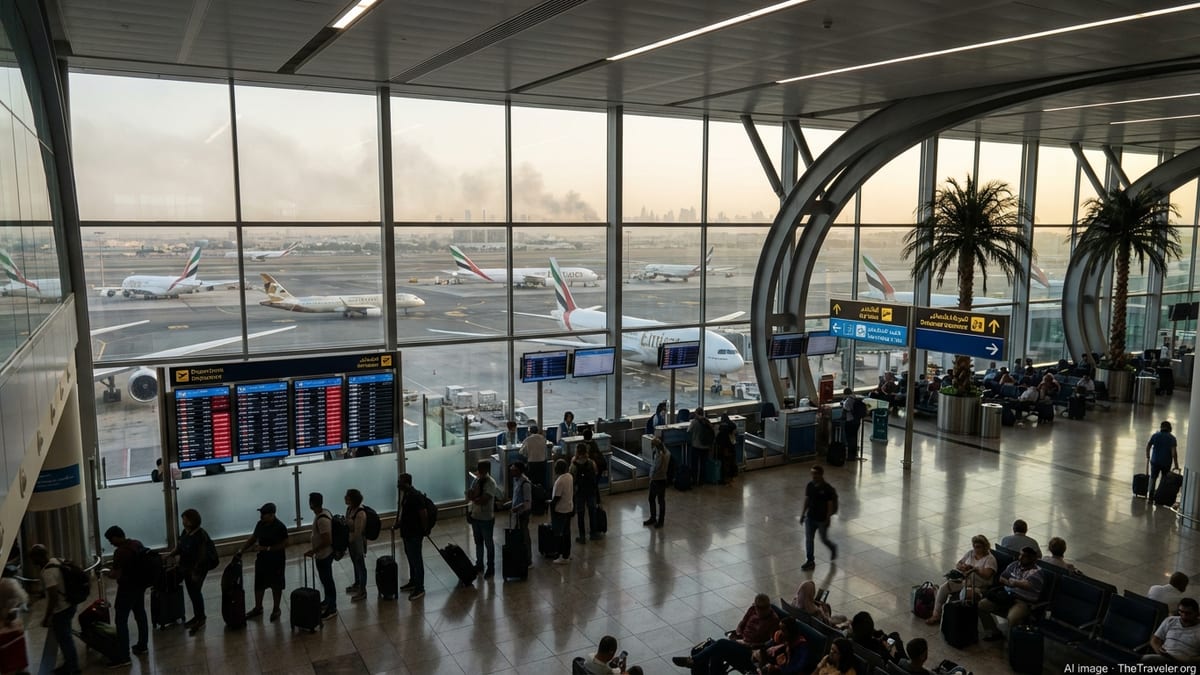
Airspace Disruptions Put Gulf Aviation Under Strain
The latest wave of Iranian drone and missile attacks on Gulf states, including the United Arab Emirates, has led to widespread flight cancellations and diversions, stranding thousands of travelers across the region. Major carriers based in the UAE, such as Emirates, Etihad Airways and flydubai, have been forced to temporarily suspend or severely curtail services as airspace closures and security assessments unfold in real time.
Industry analysts say the pressure on the UAE’s aviation system is unprecedented in the post-pandemic era. Airports in Dubai and Abu Dhabi, among the busiest international hubs globally, have had to juggle grounded aircraft, disrupted crew schedules and surging demand for rerouting as passengers seek alternative paths around the most contested skies.
Although some services are gradually resuming following initial shutdowns, schedules remain volatile. Airlines are prioritising evacuation and repatriation flights for stranded tourists and residents, while commercial frequencies are being rebuilt cautiously in coordination with air defence and civil aviation authorities.
The resulting uncertainty is reverberating well beyond the Gulf. With many long-haul routes between Europe, Asia and Africa traditionally funnelled through Dubai and Abu Dhabi, global connectivity has been shaken, adding to pressure on airline finances and on travellers who had come to view the UAE as a guarantee of seamless transit.
Tourism Boom Meets Geopolitical Shock
The turbulence comes just as the UAE, and Dubai in particular, was riding a powerful tourism upswing. Official data show Dubai welcomed a record 18.72 million international overnight visitors in 2024, surpassing pre-pandemic benchmarks and underscoring its position as a leading global city for leisure and business travel.
Momentum carried into 2025, with nearly 10 million international visitors recorded in the first half of the year and hotel occupancy above 80 percent across the emirate. Abu Dhabi has also been expanding its own visitor proposition, investing heavily in cultural attractions, sporting events and new resort developments across the capital and neighbouring emirates.
That backdrop of rapid growth amplifies the stakes of the current security crisis. Hoteliers and tour operators report a spike in inquiries from would-be visitors about safety, insurance cover and cancellation policies. Some international travel advisories have been tightened, particularly for non-essential journeys to parts of the wider region, prompting a wave of short-term postponements.
Yet bookings have not collapsed. Industry executives say many travellers are taking a wait-and-see approach rather than abandoning trips altogether, pointing to the UAE’s long-standing reputation for security, efficient crisis management and clear communication as reasons to retain confidence, at least for now.
Safety Messaging and Crisis Management in the Spotlight
UAE authorities have moved quickly to reassure residents, tourists and airlines that air defences and civil protection measures remain robust despite the scale of recent attacks. Officials have highlighted that most incoming projectiles have been intercepted before reaching critical infrastructure, with reported damage largely confined to debris rather than direct hits on major airports or tourist districts.
Emergency protocols at Dubai International, Al Maktoum International and Abu Dhabi International airports have been activated to manage surges of stranded passengers and rapidly changing flight plans. Ground teams are working with carriers to rebook itineraries, extend hotel stays where necessary and provide additional support for vulnerable travellers and families.
Communication has become a central tool in maintaining visitor confidence. Tourism bodies, hotel groups and airlines are issuing frequent operational updates through call centres and social channels, while travel agents in key source markets are being briefed on the latest security assessments. The message is calibrated: acknowledging regional risks while stressing that day-to-day life in the UAE’s main tourism corridors continues with heightened vigilance.
Security experts note that the country’s layered defence architecture, combined with strict control of public spaces and transportation nodes, has been a crucial factor in limiting casualties and property damage. Nonetheless, they warn that the psychological impact of repeated alerts, sirens and reports of intercepted drones could erode perceptions of the Gulf as a low-risk travel environment if tensions persist.
Economic Stakes for a Tourism-Driven Future
The timing of the crisis is especially sensitive given how deeply tourism and aviation are woven into the UAE’s long-term economic strategy. Travel and tourism are forecast to contribute a rising share of national output, supported by ambitious agendas to double the size of Dubai’s economy by 2033 and to expand airport capacity to hundreds of millions of passengers annually.
Recent years have seen heavy investment in new hotels, entertainment districts and transport infrastructure, as well as regulatory reforms to liberalise visas and attract talent and high-spending visitors. The country has also championed a forthcoming unified Gulf tourist visa intended to make multi-country itineraries across the region more seamless.
Extended disruption to flight schedules or a sustained perception of insecurity could slow that trajectory. Consultancy estimates suggest that even a modest drop in visitor arrivals or airline traffic would ripple through employment in hospitality, retail, real estate and events, sectors that have flourished on the back of record-breaking tourist inflows.
For now, policymakers are betting that the UAE’s diversification drive, deep financial reserves and track record of rapid recovery from past shocks will allow it to absorb short-term turbulence. But industry leaders acknowledge that if missile and drone attacks on Gulf states continue, operators may be forced to rethink growth assumptions, reprice risk and accelerate investments in additional security and contingency planning.
Balancing Regional Diplomacy and Visitor Confidence
The attacks have also sharpened the UAE’s diplomatic calculus. Long positioned as a relatively neutral trading and travel hub, the country has sought to manage ties with both Western partners and regional rivals while keeping its territory insulated from direct confrontation. The scale of recent Iranian strikes on Gulf infrastructure is now testing that balance.
Within the Gulf Cooperation Council, officials are weighing coordinated responses to what they have described as reckless assaults. Any shift toward a more assertive regional posture could bring political benefits at home but risks deepening confrontation, with consequences for investor and visitor sentiment.
Travel specialists say the next few weeks will be critical. If airspace restrictions ease, attacks subside and evacuation plans give way to normal operations, the narrative may quickly revert to one of resilience, adding another chapter to the UAE’s history of weathering regional storms. If, however, retaliatory cycles intensify, the country’s role as a safe gateway between East and West could come under its most severe test in decades.
For travellers, the calculation is becoming more complex: balancing a strong desire to visit or transit through one of the world’s most popular destinations against a rapidly shifting regional security map. How the UAE navigates that tension will help determine not only the coming tourism season, but the future shape of Gulf aviation itself.