

More news on this day
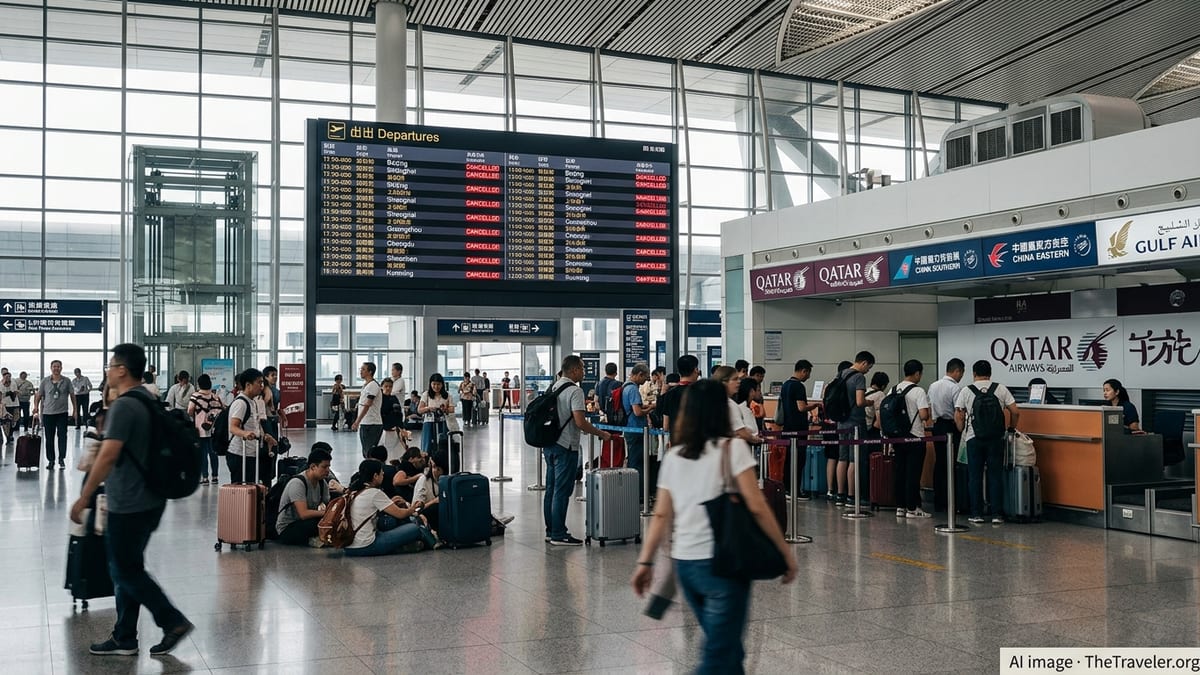
International travelers flying through China are facing mounting disruption as Qatar Airways, China Southern Airlines, Gulf Air, and China Eastern Airlines cancel more than 50 flights serving major cities including Beijing, Shanghai, Guangzhou, Chengdu, Shenzhen, and Kunming, according to flight-tracking data and updated schedules published in recent days.
Get the latest news straight to your inbox!
Middle East Airspace Turmoil Ripples Into Chinese Hubs
Recent airspace closures and heightened security risks in parts of the Gulf region have triggered widespread schedule adjustments, with Chinese gateways now feeling the impact. Publicly available airline notices and flight-tracking platforms show that carriers heavily reliant on Middle East corridors are trimming services or rerouting long-haul operations, cutting into capacity on some of China’s busiest international links.
Qatar Airways, a major connector between China and Europe, Africa, and the Middle East via Doha, has already been operating a reduced and heavily modified schedule as traffic is diverted around sensitive airspace. New adjustments this month include the cancellation of multiple rotations serving key mainland markets, with several departures from Beijing, Shanghai, Guangzhou, and Chengdu removed from timetables over the current scheduling window.
Gulf Air, the flag carrier of Bahrain, has also scaled back services that normally link the Gulf to China via intermediate points. Industry monitoring of schedules indicates that the airline has pulled a series of flights that would typically carry passengers onward to or from Chinese hubs, adding to the overall reduction in connectivity for travelers who rely on multi-leg itineraries through the Middle East.
Although many of the cancellations are framed as temporary schedule changes, the net effect for passengers is a sharp drop in available seats and fewer same-day connections across the China–Gulf–Europe axis, particularly on peak travel days.
Chinese Carriers Cut and Consolidate Key Mainland Routes
Alongside Gulf-based operators, major Chinese airlines are making their own adjustments. China Southern Airlines and China Eastern Airlines, both among the country’s largest carriers, have withdrawn or consolidated dozens of flights on routes touching major cities such as Beijing, Shanghai, Guangzhou, Shenzhen, Chengdu, and Kunming as they recalibrate networks around international disruptions and fluctuating demand.
Recent schedule filings and aviation data suggest China Southern has trimmed frequencies on some long-haul and regional services that feed into its Guangzhou and Beijing operations, while China Eastern has removed a number of departures linked to its Shanghai and Kunming bases. In aggregate, more than 50 individual flights across the four airlines are no longer appearing in the near-term operational program, compared with what was listed only weeks earlier.
These cuts are layered on top of a broader pattern of tactical scheduling that has characterized Chinese aviation since the pandemic. Carriers have been quick to adjust frequencies in response to geopolitical events, evolving bilateral traffic rights, and changing travel restrictions, leaving passengers with a more fluid and less predictable landscape than before 2020.
The latest wave of cancellations underscores how quickly Chinese networks can be reshaped when external shocks hit nearby regions, even if domestic travel within China remains broadly robust.
Major Cities See Disruptions to Long-Haul Connectivity
For travelers, the most visible impact is at China’s major international gateways. Beijing, Shanghai, Guangzhou, Chengdu, Shenzhen, and Kunming have all recorded cancellations or equipment changes affecting routes that connect via Doha and other Gulf hubs, as well as services onward to Europe and Africa.
In Beijing and Shanghai, where Qatar Airways and China Eastern operate important long-haul and connecting services, recent days have brought a series of pulled flights and re-timed departures. Some rotations have disappeared entirely from sales channels for certain dates, while others have been downgraded in capacity, limiting options for both business and leisure passengers looking to connect beyond China.
Guangzhou and Shenzhen, anchors for China Southern in the south, have likewise seen select flights dropped or consolidated. Travelers connecting through these hubs to destinations in the Middle East, Europe, and South Asia are encountering fewer same-day connection opportunities, forcing some to consider overnight layovers or entirely different routings through alternative hubs in East and Southeast Asia.
Kunming and Chengdu, important gateways for western China, are also experiencing knock-on effects. Public data indicates that several services that would normally feed long-haul flights have been thinned out or removed on specific days, creating additional constraints for travelers originating in secondary Chinese cities and relying on one-stop connections.
Stranded Passengers Face Rebooking and Longer Journeys
The human impact of these schedule cuts is visible in the experiences of travelers sharing updates through online forums and social media. Posts from passengers describe last-minute cancellation notices from Qatar Airways and affected Chinese carriers, with some travelers reporting being rebooked on alternative routes via Shanghai, Guangzhou, or third-country hubs at short notice.
Passengers on itineraries involving Beijing or Shanghai have reported being moved to China Eastern or China Southern flights where seats are available, often at inconvenient times or with longer total travel durations. Others describe having to secure entirely new tickets on different airlines when rebooking options proved limited, particularly around weekends and local holidays.
While airline policies typically allow for free rebooking or refunds when a carrier cancels a flight, the sudden clustering of cancellations can lead to long call-center wait times and limited inventory on remaining services. Travelers have reported needing to monitor schedules closely, check in frequently with booking platforms, and remain flexible on dates, departure airports, and even destination choices.
Indirect disruptions are also emerging. With capacity reduced on certain China–Gulf–Europe corridors, some long-haul flights that continue to operate are departing full or close to full, limiting availability for passengers booking at short notice. This tightening of supply may also contribute to higher fares on remaining routes in the coming weeks.
What Travelers Should Watch in the Coming Weeks
Aviation analysts note that the situation remains dynamic, with airlines in the Gulf and China continuing to adjust timetables as airspace restrictions evolve and as demand patterns shift. Publicly available information suggests that schedule changes could continue to appear with relatively little lead time, especially on routes that rely heavily on overflight permissions in sensitive regions.
Travelers planning journeys to or from China that involve Qatar Airways, China Southern, Gulf Air, or China Eastern are being advised in published coverage and travel advisories to monitor their bookings regularly, use airline apps or booking platforms for real-time notifications, and consider backup routings through hubs in East Asia or Europe where additional capacity exists.
Flexible ticket options, including fares that allow date changes without penalties or that offer refundable conditions, may be particularly valuable while schedules remain unsettled. Some passengers are also opting to build in longer connection windows at major hubs to reduce the risk of misconnection if an upstream flight is delayed or rescheduled.
For now, the wave of cancellations highlights how closely China’s international air links are tied to developments far beyond its borders. Even as domestic aviation recovers and new routes are restored, travelers flying into or out of Chinese cities face a landscape where regional tensions and airspace decisions can quickly reshape the map of global connectivity.