

More news on this day
Thousands of air travelers across Saudi Arabia, the United Arab Emirates and Qatar are facing sudden cancellations and rolling delays after a cluster of Saudia, Qatar Airways and FlyDubai services were abandoned or postponed, disrupting key regional and long haul routes at the height of an already fragile travel season.
Get the latest news straight to your inbox!
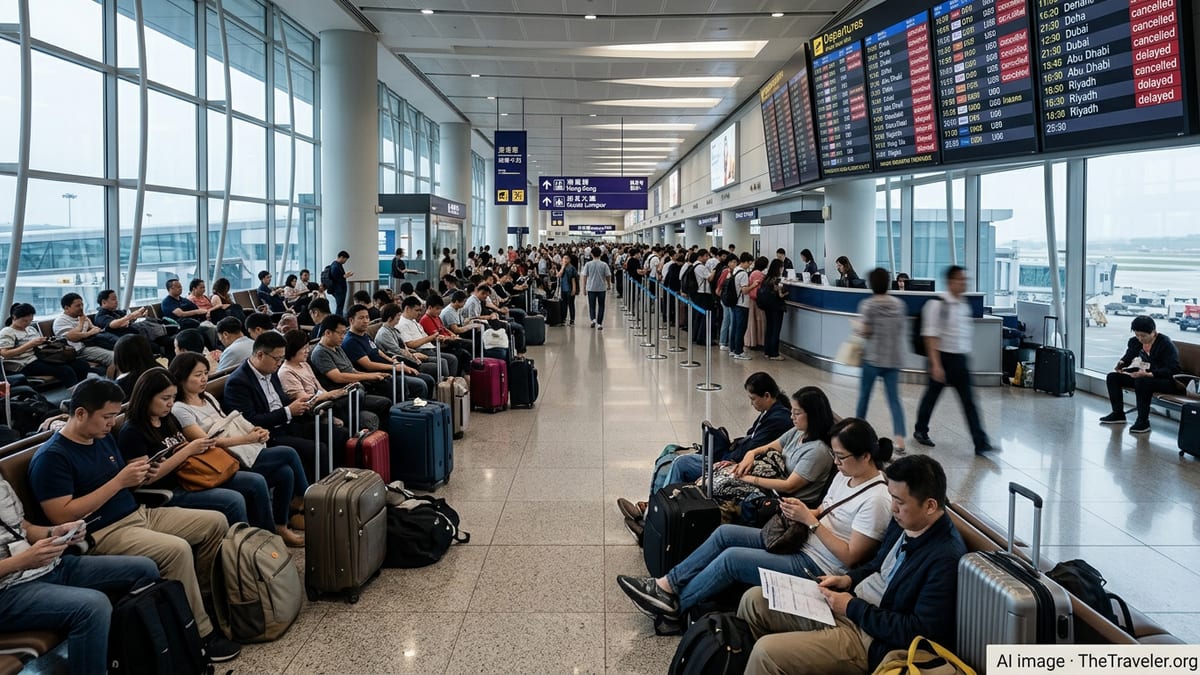
Targeted Cancellations in a Region Already on Edge
Recent operational data compiled by industry trackers and specialist travel media indicates that at least 21 flights operated by Saudia, Qatar Airways and FlyDubai were fully cancelled within a short window, with a further 42 services forced into extended delays. The affected flights span high demand corridors linking Gulf hubs with South Asia, Europe and key secondary cities in the wider Middle East, amplifying the impact far beyond the three countries’ borders.
Published coverage points to a mix of triggers: unstable weather systems over the Arabian Peninsula, ongoing regional airspace restrictions tied to the Iran conflict and congestion at major hubs coping with reduced capacity. In several cases, aircraft and crews were already operating on modified schedules, leaving limited flexibility when storms, rerouting instructions or ground handling bottlenecks emerged.
The concentration of disruption among the three Gulf carriers reflects their role as core connectors for the region. Saudia underpins domestic and religious travel flows in and out of Saudi Arabia, Qatar Airways operates an expansive global network centered on Doha, and FlyDubai anchors short and medium haul links through Dubai and secondary airports in the UAE and beyond.
As a result, a relatively modest number of individual flight cancellations translated into several thousand disrupted passenger journeys, especially where onward connections and return sectors were affected at short notice.
Where Passengers Felt the Disruption Most
Operational snapshots from airport boards and airline schedule feeds show that the heaviest disruption has clustered around major hubs, including Jeddah and Riyadh in Saudi Arabia, Dubai International and Al Maktoum in the UAE and Hamad International in Doha. Some smaller gateways, such as Neom Bay in Saudi Arabia, also appeared on cancellation lists, underlining how the shock has rippled into emerging regional routes.
According to travel industry reporting, multiple Saudia services linking Saudi cities with Gulf neighbors and select Asian destinations were withdrawn from the schedule or left on prolonged ground holds. In parallel, Qatar Airways trimmed or delayed services on certain Europe and South Asia pairings, as the airline continues to operate a reduced program while regional airspace remains constrained.
FlyDubai, which relies heavily on fast turnarounds and dense scheduling at Dubai, has been particularly exposed to bouts of unstable weather and short term capacity caps at its home base. Public statements and customer advisories from the airline in recent days have warned of possible last minute changes for flights touching Dubai and other UAE airports, with thunderstorms and reduced visibility repeatedly cited as operational risks.
The net effect has been crowded terminals, long queues at transfer desks and an uptick in unplanned overnight stays in airport hotels across the three countries, as passengers wait for new departure slots or alternative routing options to open up.
Why Airlines Are Struggling to Keep Schedules Stable
The latest wave of disruption has landed on an aviation system still recalibrating to war related airspace closures over parts of the Gulf. Industry analysis from schedule data providers shows that overall seat capacity in the wider Middle East has been cut significantly since late February, with Qatar Airways and several UAE based carriers operating on sharply reduced timetables while traffic is funneled through narrower corridors.
Publicly available briefings from aviation consultancies suggest that carriers are juggling multiple constraints at once. Flight paths must avoid risk zones, adding time and fuel burn. Aircraft rotations are longer and less predictable. Crew duty limits are tighter as delays accumulate through the day. Even when weather is the immediate cause of a delay or cancellation, the underlying network remains less resilient than in normal times.
For Saudia, a large domestic market and religious travel flows provide some buffer, but sudden regional snarls can still throw off tightly planned departures aligned with prayer times and pilgrimage movements. Qatar Airways continues to manage the fallout from earlier mass suspensions, with sections of its long haul fleet still underutilized or reassigned, while FlyDubai’s low cost model leaves little slack when sectors must be re timed or combined.
Analysts tracking on time performance in the region note that secondary disruptions, such as missed inbound aircraft or delayed technical checks, are increasingly visible in delay codes and airport movement logs, suggesting airlines are frequently reacting to events rather than executing stable long range schedules.
What Travelers Need to Know Right Now
For passengers booked on Saudia, Qatar Airways or FlyDubai in the coming days, industry and consumer guidance converges on one point: do not assume your flight is operating as originally ticketed, even if the booking still appears confirmed in an app or email. Schedules in Saudi Arabia, the UAE and Qatar remain subject to change at short notice, particularly for services crossing contested or weather sensitive airspace.
Travel advisories from airports and carriers in the region consistently recommend checking flight status repeatedly in the 24 hours before departure and again just before leaving for the airport. Many airlines are also encouraging travelers to enable app notifications or SMS alerts, as same day retimings and gate changes have become more frequent during periods of instability.
Published reports indicate that affected passengers are generally being offered standard protections such as free rebooking within a defined window, rerouting on alternative services where space permits and, in the case of long delays or outright cancellations, refunds under the carrier’s conditions of carriage. However, anecdotal accounts from travelers describe long waits at service desks and limited availability on near term replacement flights, especially on busy trunk routes.
Travel planners advise allowing extra connection time, avoiding tightly timed self connections between separate tickets and carrying essential medications, chargers and a change of clothes in cabin baggage in case an unplanned overnight stay becomes necessary.
Potential Next Steps for Gulf Aviation and Travelers
Looking ahead, aviation analysts expect periods of volatility to persist in Gulf air travel as long as regional tensions and airspace restrictions remain unresolved. Recent capacity data shows that airlines based in Saudi Arabia have maintained closer to normal operations than peers in Qatar and the UAE, but all three markets are exposed when weather or security events coincide with peak demand.
Airlines are gradually adjusting networks, deploying smaller aircraft on some routes, consolidating frequencies and experimenting with alternative routings through less congested corridors. Industry media reports suggest that Qatar Airways, Saudia and FlyDubai are all using a blend of tactical cancellations and rolling delays to manage operational strain while preserving as much core connectivity as possible.
For travelers, the immediate priority is flexibility. Choosing tickets with more generous change conditions, keeping itineraries simple and monitoring official airline channels closely will be crucial as the situation evolves. While the specific figure of 21 abandoned flights and 42 postponed services captures only a snapshot of the disruption, it highlights how even limited schedule adjustments in three interconnected Gulf markets can cascade into a much wider wave of travel turmoil.
Until regional skies and weather patterns stabilize, journeys involving Saudi Arabia, the UAE and Qatar are likely to require more patience, contingency planning and real time information gathering than travelers have become accustomed to in recent years.