

Wolseley, a compact prairie town just off the Trans Canada Highway in southeast Saskatchewan, is an easy and worthwhile stop on a road trip across the plains. Known as the “Town Around a Lake” and sometimes the “Town with the Swinging Bridge,” it offers walkable heritage streets, a photogenic lakeshore, and a slow, small-town rhythm that fits neatly into a half-day or full-day break from the highway.
Why Wolseley Belongs on Your Prairie Road Trip
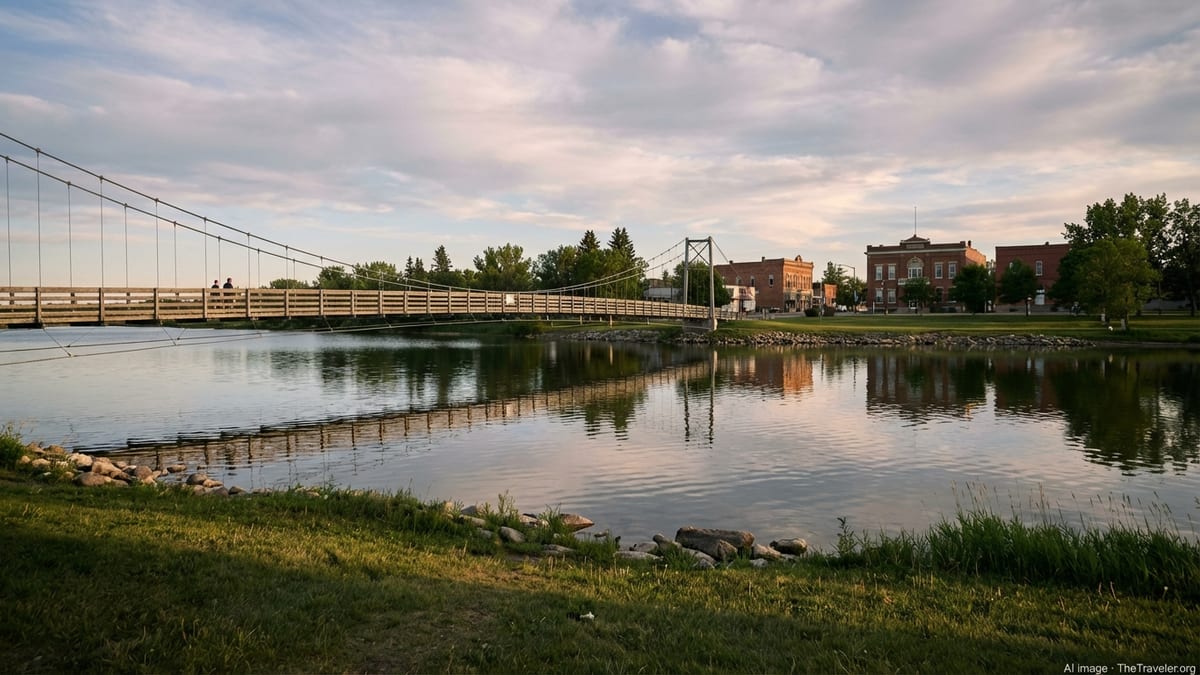
Set along Highway 1 between Regina and the Manitoba border, Wolseley feels immediately more intimate than its location suggests. Instead of a strip of fuel stations and fast food, you find a natural lake at its centre, mature trees shading the shoreline, and century-old brick buildings framing the core of town. For road trippers who have been staring at open fields for hours, the combination of water, architecture, and greenery offers a welcome change of scene.
The town built its identity around Fairly Lake, created when a local creek was dammed in the early 1900s to support railway operations. Today the lake and the parkland that surrounds it define the visitor experience. Walking paths, picnic areas, and a small beach in season make it feel almost like a lakeside resort community on a miniature scale, right in the middle of grain country.
Wolseley is also notable for the sheer number of heritage structures preserved within a small footprint. The historic Town Hall and Opera House, the early courthouse, and blocks of commercial buildings give a sense of how ambitious prairie communities were during the railway era. You can easily explore these landmarks on foot with a simple heritage walking tour, turning a quick coffee stop into a genuinely memorable detour.
Because the town is compact and most visitor highlights cluster around Fairly Lake and the central streets, Wolseley works very well as either a half-day stroll or a fuller one-day pause. The following itinerary assumes you are arriving by car and want to stretch your legs, see the key sights, and still have time to get back on the road before nightfall.
Getting Oriented: When to Arrive and Where to Start
For a half-day visit, aim to arrive in Wolseley by late morning or early afternoon. This timing gives you good light around the lake, allows for a relaxed lunch, and still leaves enough time for a heritage walk and a final lakeside pause before you continue your drive. In summer, when evenings are long, a late afternoon arrival still works, especially if you are mainly interested in golden-hour photos and a leisurely dinner stop.
Most travelers will approach from the Trans Canada Highway, turning off near the service area to reach town in a matter of minutes. The Wolseley Tourist Information Centre, typically open from mid May to September, is a useful first stop in the warmer months. Staff can provide current details on opening hours for attractions such as the Town Hall and Opera House, as well as information on events or seasonal activities.
Parking is straightforward throughout Wolseley, with on-street spots near the lake and the downtown commercial blocks usually easy to find. Because the town is small, you can leave your car in a central spot and explore the rest on foot. Comfortable walking shoes are more important than driving directions here, particularly if you plan to loop the lakeshore paths and cross the swinging bridge.
If you are traveling in winter or shoulder seasons, plan for colder winds across the open prairie and the lake. Even when the water is frozen, the central layout remains the same, and a shorter walking route that concentrates on the heritage buildings is still rewarding, especially for photography and architecture enthusiasts.
Fairly Lake and the Swinging Bridge: Wolseley’s Signature Stroll
Any Wolseley visit should begin or end with time along Fairly Lake. The water is small enough to feel intimate yet large enough to reflect skies that seem to go on forever. A ring of public parkland, grassy areas, and mature trees creates a natural promenade that locals use daily and visitors can easily adopt as their own for an hour.
The star attraction here is the swinging pedestrian bridge that crosses the lake near the heart of town. The original bridge dates back to the early 1900s, and although it has been rebuilt several times after storm damage, it has remained a defining symbol for the community. Today’s version spans roughly 100 metres, moving gently underfoot as you cross, with views back to the lakeshore and town buildings on either side.
For a half-day itinerary, allow at least 45 minutes to one hour for the lakeside section. Start from a convenient parking area near the shore, follow the paths along the water, and plan to cross the swinging bridge at least once in each direction. The perspective changes noticeably with the light: in the morning you may have softer reflections, while late afternoon can bring stronger contrasts and long shadows from the trees.
In summer, you might see families using the small beach area, anglers trying their luck from the shoreline, or paddlers enjoying the calm water. Picnic tables and benches make it easy to pause with a takeaway coffee or a simple snack. Even on a tight schedule, a few minutes of unhurried walking here breaks up a long driving day in a way that fuel stations simply cannot match.
Heritage Core: Town Hall, Opera House, and Courthouse
From the lakeshore, it is only a short walk into the heritage core of Wolseley. The standout building is the Town Hall and Opera House, a multi use structure dating from the turn of the twentieth century that once hosted civic offices, the fire brigade, and live performances. Its brick facade and corner location make it a natural visual anchor in town, and its continued use as an event venue underlines the community’s commitment to preserving its past.
If you have time and the building is open to visitors, consider stepping inside for a quick look at the restored interior. Availability can vary, and tours are often arranged by appointment, so this is one of the few elements of a Wolseley stop that benefits from a quick call or inquiry at the information centre in advance. Even when the doors are closed, the exterior is worth several minutes of careful observation and photography.
A few blocks away, the historic courthouse stands as another reminder of Wolseley’s early importance. Built in the 1890s, it is frequently cited as the oldest courthouse in Saskatchewan still standing. Over the years, local residents and partners have invested time and resources in its restoration, reflecting a broader pattern of heritage conservation throughout town. You can easily include it on a short walking loop that also passes other notable buildings.
As you move between the Town Hall, Opera House, and courthouse, pay attention to the smaller details: dated cornerstones, original brickwork, and the way newer uses have been layered onto older facades. This close-up look at modest but carefully maintained structures helps tell the story of prairie settlement more effectively than a quick drive past modern highway services ever could.
Downtown Wolseley and the Perley Block
No half-day visit to Wolseley is complete without a walk along its compact main commercial streets. Here you will find the Perley Block and other early twentieth century buildings that give the core its character. While the specific mix of shops and services can change over time, the essential experience remains consistent: a string of small businesses housed in historic structures within sight of the lake.
The Perley Block was originally erected in the early 1900s after a significant fire wiped out the previous buildings on the site. Today, its ground floor typically hosts a mix of local enterprises such as financial services, small cafés, or specialty shops, while the upper level has been adapted for residential use. This combination of modern functions within an old shell is typical of how small prairie towns sustain their heritage in practical ways.
Nearby, you may notice other long running outfits like hotels, classic prairie main street banks, or professional offices. Some facades have been updated, while others retain more original detail, but together they convey the layered story of a town that has adapted without erasing its architectural roots. Even if you do not need to shop, walking the length of the commercial strip and pausing to look up at second storey windows and cornices is a worthwhile part of your visit.
Allow at least 30 to 45 minutes for this downtown segment, longer if you plan to sit down for a coffee or browse in any open stores. If you are traveling with a camera, this is a good time to capture images of brick textures, old signage, and the contrast between heritage blocks and the open prairie sky that hangs above them.
Food, Treats, and Practical Stops
One of the pleasures of stopping in Wolseley is trading a generic highway meal for something more local. Availability of specific establishments can change with seasons and openings or closures, so think in terms of categories rather than fixed names: a small-town coffee shop on or near the main street, perhaps a café within a heritage building, and diner-style options close to the highway where truck drivers and local residents mix.
For a half-day visit, it is easy to plan one sit-down meal and one lighter snack. Many travelers choose an early lunch on arrival, followed by an afternoon coffee and pastry. Others prefer to explore first, then settle in for a late lunch once they have crossed the bridge and wandered the main streets. In either case, expect a relaxed pace of service appropriate to a small community rather than the rapid turnover of a city chain.
If you need fuel, basic groceries, or road-trip staples, you will find them in or near the same compact area. Using a quick stop to refuel both car and travelers simplifies the rest of your driving day. Remember that businesses in small towns often keep more limited hours, especially outside peak summer season, so it is wise to plan meals with a bit of flexibility in case an individual café happens to be closed.
Those traveling with children will appreciate the chance to combine a meal stop with time in a nearby park or lakeside playground. Simple routines, such as picking up takeout and eating it at a picnic table near Fairly Lake, are often easier and more memorable than a formal restaurant stop, especially when kids can move around freely while adults enjoy the view.
Building a Half-Day or Full-Day Itinerary
Because Wolseley is small, the difference between a half-day and a full-day visit is less about how many attractions you can pack in and more about the tempo at which you experience them. A half-day stop can comfortably cover Fairly Lake, the swinging bridge, the Town Hall and Opera House exterior, the courthouse, and a short walk along the Perley Block and adjacent streets. This version suits drivers who want a three to four hour break before continuing to a larger centre.
A simple half-day sequence might look like this: arrive in late morning, have an early lunch in town, spend 60 to 90 minutes walking around Fairly Lake and crossing the swinging bridge, then devote another hour to the heritage core and downtown before finishing with a coffee and returning to the highway. Within that framework, you can adjust the order to suit weather conditions and your own preferences.
A full-day stop, by contrast, simply stretches these same elements and adds more time for rest and spontaneous discovery. You might loop the lakeshore more than once at different times of day, seek out interior tours or events at the Town Hall and Opera House if available, or build in longer breaks for reading or sketching by the water. If you are traveling with a dog, a full day allows for more generous walking segments and quiet time so that both people and pets arrive at the next destination less fatigued.
Another way to expand a stay is to treat Wolseley as an overnight base, using its accommodations to break a cross-provincial journey. This approach can combine a slow evening stroll around the lake, a night in town, and a fresh start on the highway in the morning with minimal detours. Regardless of length, the aim is the same: to reframe a stretch of long-distance driving as an opportunity to experience a living prairie community.
Practical Tips for a Smooth Stop
Weather is the most important factor to consider when planning your time in Wolseley. Summers can be warm, and while the lake offers cooling breezes, sunscreen, hats, and water bottles remain essential on sunny days. Shoulder seasons may bring brisk winds and quickly shifting conditions, so packing an extra layer is helpful even for short walks.
Accessibility is generally good around the central parts of town. Streets near the commercial core are paved, and many sidewalks are relatively flat, although some older buildings may have steps at entrances. The lakeside paths vary, with a mix of paved and packed surfaces. Travelers with mobility challenges may wish to preview the area visually on arrival and choose segments that feel most manageable.
As with any small town, it is wise to check for local events that might affect parking or opening hours. Community festivals, markets, or performances at the Town Hall and Opera House can add welcome vibrancy to your visit, but they may also make certain venues busier than usual. The tourist information centre, municipal office, or simple roadside signage often provides clues about what is happening on a given weekend.
Finally, remember that Wolseley is first and foremost a place where people live, work, and go about their daily routines. A friendly greeting, patience with small-town pacing, and respect for private property go a long way. In return, you are likely to receive directions, recommendations, and stories that help transform a practical highway stop into a richer travel memory.
The Takeaway
Wolseley rewards travelers who are willing to turn off the main highway and trade a fast-food break for a slow walk. In a compact radius, it offers a calm lake, a characterful swinging bridge, and a set of heritage buildings that together illustrate the history and resilience of prairie communities. Even a brief visit can shift the mood of a long road trip, replacing monotony with a sense of place.
Whether you spend a focused half-day or stretch your stop into a more leisurely one-day pause, the essentials remain the same: time by the water, time among historic streets, and time simply sitting still before returning to the road. In a province often summarized by its open fields, Wolseley shows how much variety and texture can be found in a single small town.
For many travelers, the strongest memories are not of specific attractions but of simple moments, such as crossing the gently moving bridge at sunset, listening to birds settle along the lakeshore, or noticing how the brick of the Town Hall catches the late light. These quiet details are exactly what makes a modest detour in Saskatchewan feel worthwhile.
On your next prairie drive, consider planning a proper stop instead of another quick refuel. Wolseley’s lake, bridge, and heritage core are waiting only a few minutes from the highway, offering a reminder that some of the best road-trip experiences unfold when you slow down.
FAQ
Q1. How much time do I need for a stop in Wolseley?
Most travelers find that three to four hours is enough for a satisfying half-day visit, while a full day allows for slower pacing and repeat walks around Fairly Lake.
Q2. Is the swinging bridge in Wolseley safe to cross?
The current swinging bridge is a modern structure that flexes slightly underfoot, which is part of its appeal. It is designed for pedestrian use, and visitors of all ages cross it regularly, though those sensitive to motion may prefer to hold the handrail.
Q3. Can I visit Wolseley year round?
Yes, Wolseley is accessible in all seasons. Summer and early autumn are most popular for lakeside walks, while winter visits focus more on heritage buildings and short strolls, with colder temperatures and possible snow underfoot.
Q4. Are there guided tours of the Town Hall and Opera House?
Guided access is sometimes available by appointment or during special events. Because schedules can change, it is best to check with the tourist information centre or local authorities shortly before your visit.
Q5. Is Wolseley suitable for families with children?
Yes. The lakeside paths, swinging bridge, and park spaces offer simple activities that children usually enjoy. Parents should supervise young kids closely on the bridge and near the water.
Q6. Where can I find current information on events in Wolseley?
Seasonal events and special activities are typically promoted locally through community notice boards, the tourist information centre, and municipal communications, so a quick check on arrival is helpful.
Q7. Does Wolseley have places to eat within walking distance of the lake?
There are usually cafés or diner style options within a short walk or drive from Fairly Lake and the main commercial streets. Exact offerings can change, so plan with some flexibility.
Q8. Is the Wolseley stop suitable for travelers with limited mobility?
Many central streets and some lakeside areas are relatively flat and accessible, though the swinging bridge and certain older building entrances involve steps or uneven surfaces. A quick visual check on arrival helps identify the most comfortable routes.
Q9. Can I bring my dog to Fairly Lake and the surrounding paths?
Leashed dogs are commonly seen around small town lakes and walking paths in Saskatchewan. It is courteous to keep pets under control, clean up after them, and respect any posted local regulations.
Q10. Is there overnight accommodation in or near Wolseley?
There are often modest lodging options in town or nearby along Highway 1, which can be used to break up a longer road trip. Availability and style of accommodation may vary by season, so advance checks are recommended.