

More news on this day
Flight disruptions linked to Halifax Stanfield International Airport are rippling across Canada this week, leaving passengers stranded in multiple cities as airlines struggle with weather-related backlogs, tight crew schedules and already stretched networks.
Get the latest news straight to your inbox!
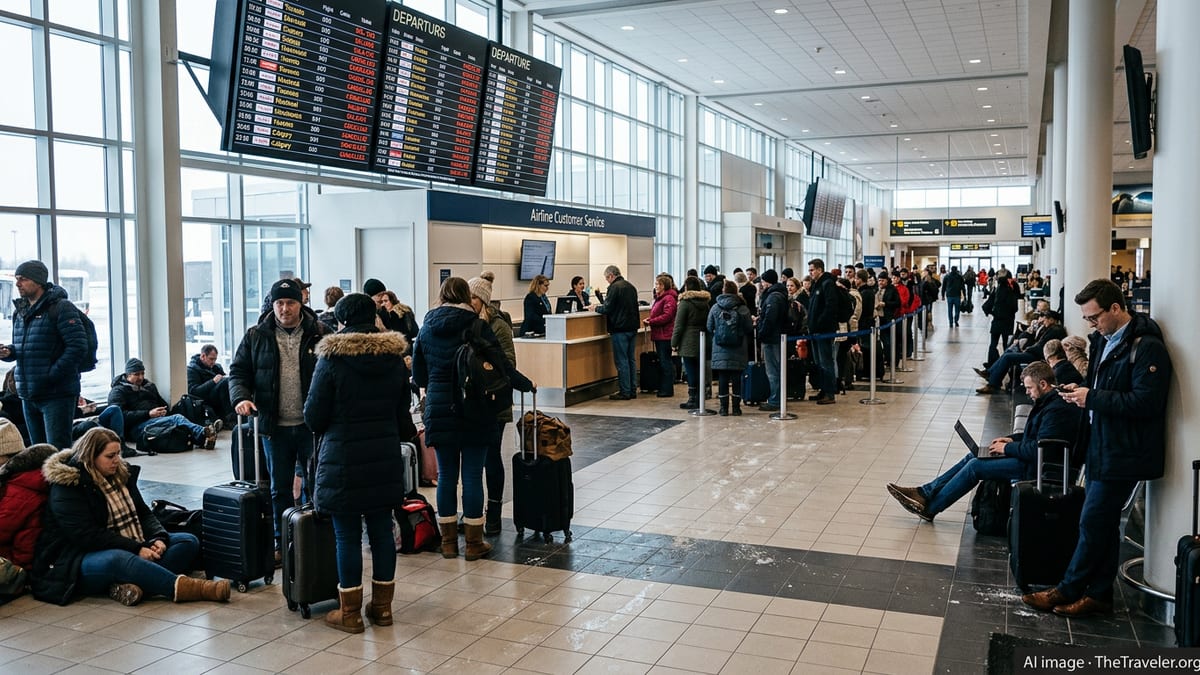
Halifax disruptions ripple through national network
Recent operational data and travel industry coverage indicate that Halifax Stanfield has become a focal point in a new round of schedule disruptions, with dozens of delayed services and several outright cancellations affecting routes to Toronto, Montreal, Ottawa and other Canadian hubs. A travel trade report earlier this week highlighted four cancelled departures and at least 37 delays in a single day involving major carriers such as Air Canada, WestJet, Porter, PAL Airlines and Air Transat.
Although the raw numbers are modest compared with the worst days of winter, the pattern is placing disproportionate strain on travellers who rely on Halifax as Atlantic Canada’s primary gateway. With many flights operating near capacity and some routes reduced or seasonal, even a small cluster of cancellations can cascade across the country, producing missed connections as far away as Calgary and Vancouver.
Publicly available flight trackers on Saturday showed continued knock-on delays on key Halifax links to Toronto Pearson and Montreal Trudeau, two of the country’s busiest connection points. These disruptions contributed to broader national figures that, according to recent analytical summaries, included well over a hundred delayed flights and several dozen cancellations across Canadian airports in the last few days.
For travellers, the effect is highly visible in crowded gate areas, lengthy rebooking lines and last-minute itinerary changes that ripple across entire journeys. With many passengers ticketed on multi-leg itineraries through Halifax, a late arrival or scrubbed departure on the East Coast can easily lead to an unplanned overnight stay hundreds or thousands of kilometres away.
Weather hangover and winter operations fuel delays
The latest turbulence for Halifax travellers is unfolding against the backdrop of a difficult winter for Canadian aviation. A major North American winter storm in late January triggered hundreds of cancellations in Toronto, Montreal, Ottawa and Halifax, while a separate Arctic outbreak in mid-February led to at least 65 cancellations and more than 300 delays across Canadian hubs, according to aviation-focused briefings. Halifax was repeatedly listed among airports facing freezing rain, heavy snow and high winds.
Even as skies clear, winter operations continue to weigh on airline performance. De-icing procedures, runway treatments and air traffic control spacing requirements can reduce capacity for hours at a time, producing backlogs that outlast the immediate weather event. Industry commentary this season has also pointed to lower on-time performance metrics for several Canadian carriers compared with previous winters, underscoring how narrow the margin has become between a smooth operation and widespread disruption.
Halifax’s coastal location makes it particularly sensitive to changing conditions, from freezing rain and wet snow to sudden fog. Local travel advisories published earlier this year described temporary suspensions of aircraft movements at the airport due to ice, with airlines forced to hold or divert flights until conditions improved. Each halt triggers a chain reaction: aircraft arrive out of position, crews approach duty-time limits and later departures must be rescheduled or cancelled altogether.
The cumulative effect is a lingering “weather hangover” that can persist long after the last snowflake has fallen. With many carriers still recalibrating their networks after recent storms and operational challenges, even a localized delay in Halifax can expose weak points in schedules across the country.
Airlines juggle tight fleets, crew duty limits and shifting routes
Canadian carriers serving Halifax are balancing these weather pressures with leaner fleets, evolving route maps and stricter crew duty regulations. Public network updates show that Air Canada, WestJet and Porter have all adjusted domestic and transborder capacity over the past year, in some cases trimming or suspending point-to-point routes and funnelling more traffic through larger hubs.
In Halifax, the result is a network that increasingly depends on a few high-frequency corridors to Toronto, Montreal and Ottawa. Travel industry reports in recent weeks have documented significant disruption figures on those very links, with Air Canada, WestJet and smaller regional operators posting elevated delay and cancellation rates on certain days as winter operations and crew availability intersect.
Crew duty-time rules, designed to protect safety, also play a quiet but decisive role. When an aircraft arrives late into Halifax from another part of the country, pilots and flight attendants can “time out,” forcing the airline to cancel or postpone the next leg. Passenger accounts shared on social platforms over the winter describe same-day cancellations followed by rebookings one or more days later, reflecting how few spare aircraft and crews are available to absorb irregular operations.
Network complexity compounds the issue. Halifax-bound flights often originate in cities affected by their own weather or congestion problems, and any delay at a major hub like Toronto Pearson can quickly echo across smaller stations. As airlines move aircraft to more profitable routes or reduce duplicate services, options for quick reaccommodation on alternative carriers also narrow, leaving travellers with fewer ways around a single disrupted flight.
Travellers face missed connections, mounting costs and limited options
The immediate human impact of Halifax’s latest flight mess is playing out at check-in counters and hotel desks across Canada. Business travellers attempting same-day returns from Toronto or Montreal report being forced to add unplanned overnight stays, while leisure passengers on longer itineraries have seen holidays shortened or connections to international flights missed entirely.
Analysts who track travel disruptions estimate that even mid-level irregular operations can generate millions of dollars in extra hotel nights, meal vouchers and re-routing expenses in a single day nationwide. Mid-February assessments of a previous storm-related disruption pegged corporate travel losses alone in the multi-million-dollar range, with thousands of missed connections on transcontinental routes. With Halifax functioning as a key spoke feeding those long-haul flights, disruptions there can generate outsized costs relative to the size of the market.
Out-of-pocket expenses for individual travellers can rise quickly. While federal passenger protection rules outline circumstances in which airlines must provide compensation or refunds, the distinction between weather-related disruptions and those deemed within a carrier’s control remains a point of confusion. Consumer advocates have repeatedly urged passengers to document delays carefully and to review their rights under Canada’s Air Passenger Protection Regulations when flights are significantly delayed or cancelled.
For those stuck mid-journey, the practical options are often limited. Same-day alternatives may involve detours through less direct hubs or mixed itineraries on multiple airlines, sometimes at additional cost. With Halifax’s schedule already tight and many flights running full, standby lists grow long and seats on remaining departures become scarce, particularly during weekends and school breaks.
Halifax’s role as Atlantic gateway under renewed scrutiny
The current wave of disruptions arrives just as Halifax is being promoted as a strengthened Atlantic gateway in airline marketing materials and airport communications. Recent announcements have touted expanded transatlantic connectivity and new domestic links, highlighting Halifax as a strategic bridge between smaller communities in Atlantic Canada and major hubs in Central Canada and Europe.
For tourism operators and local businesses, reliable air service is critical. As the spring and summer travel season approaches, industry groups are watching closely to see whether the operational stumbles of this winter will carry into peak months. Some tourism-focused publications have already warned that recurring delays and cancellations risk undermining marketing efforts aimed at attracting visitors to Nova Scotia and the wider region.
At the same time, the disruptions are prompting renewed debate about capacity, resilience and competition in Canada’s aviation market. With Halifax heavily dependent on a small number of national carriers and regional partners, any strategic shift in fleet allocation or crew basing can sharply influence the reliability of service. Recent decisions by some airlines to consolidate operations in larger hubs have raised questions about how smaller cities can maintain robust links without becoming chronically vulnerable to system-wide shocks.
For now, publicly available schedules show carriers pressing ahead with plans to rebuild and expand Halifax’s network into the summer of 2026, even as they work through the latest backlog of delayed and cancelled flights. Whether travellers will see smoother journeys through Halifax in the months ahead may depend on a delicate balance of favourable weather, resilient scheduling and renewed investment in the country’s Atlantic gateway.