

More news on this day
Thousands of travelers were left stranded at Doha’s Hamad International Airport this week as a wave of flight cancellations and delays affecting Qatar Airways, FlyDubai, SriLankan Airlines and other carriers triggered one of the most severe aviation disruptions the Middle East has seen in years.
Doha at the Epicenter of Regional Flight Disruption
Hamad International Airport has become the focal point of the latest shock to Middle East aviation, with 536 flight cancellations and four recorded delays in a matter of days, according to industry data and airport monitoring services. The disruption has hit a broad mix of regional and international airlines, snarling connection banks at one of the world’s key long-haul hubs.
Doha’s hub status means that even a brief shutdown quickly cascades through airline schedules worldwide. Qatar Airways, which relies heavily on tightly timed transfer windows at Hamad International, has been forced to ground or reroute large portions of its network. Other carriers including FlyDubai, SriLankan Airlines, Saudia, Etihad and Oman Air have also seen services to and from Doha scrubbed or heavily altered.
The unprecedented scale of cancellations at Hamad has coincided with broader turmoil across Gulf and wider Middle East airspace, where airports from Dubai and Abu Dhabi to Riyadh, Kuwait City and Istanbul are all grappling with rolling schedule changes. The result is a patchwork of closures, partial reopenings and one-off relief flights that have left passengers guessing whether their journeys will operate at all.
Airport authorities in Doha have at times urged passengers not to travel to the terminal unless they have received direct confirmation that their flight is operating, underscoring the uncertainty facing both travelers and airlines as conditions shift hour by hour.
Airspace Restrictions and Security Fears Drive Cancellations
The surge in cancellations and delays at Hamad International and across the region is closely tied to heightened security tensions and temporary airspace restrictions affecting multiple Middle Eastern countries. Authorities have periodically closed or severely limited access to key flight corridors, forcing airlines to suspend services rather than attempt lengthy and operationally complex diversions.
For Gulf superconnectors such as Qatar Airways and FlyDubai, whose business models depend on dense schedules and rapid aircraft turnarounds, those restrictions have quickly become unsustainable. Carriers have opted to cancel entire waves of flights rather than operate skeleton services through uncertain skies, leading to the unusually high count of scrubbed departures and arrivals in Doha.
Even when airspace has been partially reopened, the conditions have often allowed for only limited operations, such as tightly controlled repatriation or relief flights in and out of Hamad International. That has done little to clear the backlog of displaced passengers, many of whom have now been stranded for days without a clear path to their destinations.
Beyond the immediate safety considerations, airlines are also juggling aircraft positioning, crew duty-time limits and the risk of aircraft and staff being stuck out of base. Those operational constraints have amplified the impact of every new closure or restriction, helping to push cancellation totals at Hamad and other regional hubs into the hundreds.
Passengers Endure Long Queues, Confusion and Limited Information
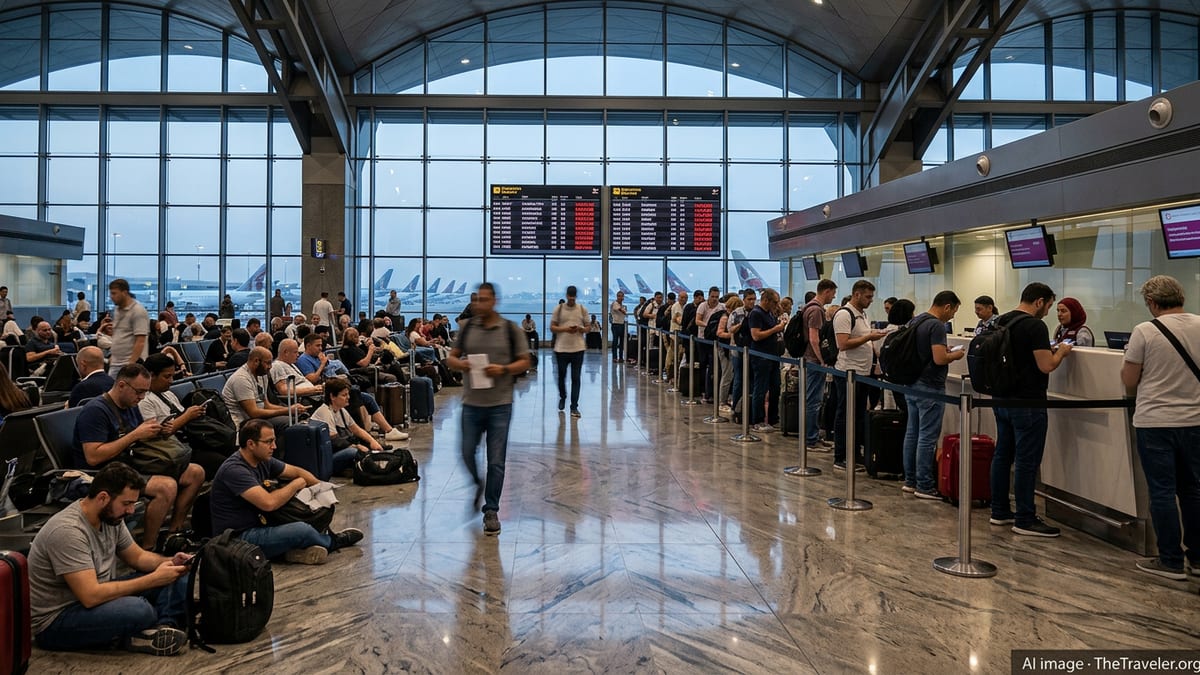
Inside Hamad International’s normally sleek departure halls, the disruption has translated into long lines at airline service desks, crowded seating areas and weary travelers camping out near departure gates. Families with young children, business travelers and tourists alike have been forced to wait through repeated schedule changes and last-minute gate announcements that often culminate in cancellations.
Many passengers report struggling to obtain clear information on when they might be rebooked, particularly when traveling on itineraries involving multiple carriers. With Qatar Airways and FlyDubai cutting back frequencies and partner airlines also constrained, seats on remaining flights are scarce, and re-accommodation options can be limited to departures several days away.
Hotel availability in Doha has tightened as airlines attempt to provide accommodation for stranded travelers, although not all passengers have qualified for lodging or meal vouchers under respective carrier policies. Others have opted to remain at the airport in hopes of securing last-minute seats on any outbound flight that becomes available.
Social media has become a critical outlet for affected travelers, who have posted images of full departure boards filled with red “canceled” notices at Hamad and shared experiences of repeatedly rescheduled flights. While some airlines have boosted call-center staffing and pushed app notifications, the volume of disruptions has made it difficult to provide timely, individualized updates.
Regional Ripple Effects Stretch From Europe to Asia
The operational shock at Hamad International is being felt far beyond Qatar’s borders. Europe-to-Asia and Africa-to-Asia itineraries that rely on a Doha connection have been particularly hard hit, as have routes linking secondary cities in South Asia and Africa with North America and Europe via the Gulf. With so many cancellations focused on hub banks, some city pairs have temporarily lost all same-day connectivity.
Airports across the Middle East have reported their own waves of cancellations and delays, compounding the problem for through-passengers who might otherwise re-route via Dubai, Abu Dhabi, Riyadh or Kuwait City. Coordinated cancellations affecting multiple carriers mean that alternative one-stop options can disappear almost as quickly as they are suggested, leaving travel agents and airline staff with few viable rebooking paths.
The knock-on effects have also reached major European and Asian airports, where aircraft and crews scheduled to operate onward flights from Doha have failed to arrive. That has led to additional cancellations and delays outside the Middle East, often catching travelers unaware of the situation unfolding in Gulf airspace until they reach the check-in counter.
Industry analysts warn that clearing the disruption could take several days even after airspace conditions stabilize, as airlines work to reposition aircraft, reset crew rotations and rebuild their carefully choreographed hub schedules. For passengers, that means lingering uncertainty and the risk of further last-minute changes even as operations gradually resume.
Airlines Pivot to Relief Flights and Recovery Plans
As the scale of the disruption has become clear, airlines and regulators across the region have begun focusing on recovery strategies. Qatar Airways has announced a limited series of relief services to and from Hamad International aimed at repatriating stranded passengers and gradually restoring key long-haul corridors to major European and Asian gateways.
Other Gulf and regional carriers are studying similar measures, prioritizing high-demand routes and destinations with large numbers of displaced travelers. In some cases, airlines are deploying larger widebody aircraft on traditionally narrowbody routes to maximize available seats and clear backlogs more quickly.
Airport operators, meanwhile, are working to adapt terminal operations to irregular flight patterns, including handling concentrated bursts of inbound and outbound traffic as airspace windows open. Ground handlers, security staff and immigration services are all being stretched as they respond to unpredictable traffic flows and larger-than-normal passenger volumes on individual flights.
While the immediate focus remains on getting stranded travelers home, aviation executives are also beginning to assess the longer-term implications of the crisis for Gulf hub strategies and regional connectivity. For now, however, passengers at Hamad International and other Middle Eastern airports remain stranded in large numbers, waiting for the schedules on departure boards to turn from red back to green.