

More news on this day
Hamad International Airport in Doha has become the latest flashpoint in a widening air travel meltdown, as at least 518 flights were cancelled and several more delayed after airspace closures linked to the escalating U.S.-Israel conflict with Iran, leaving passengers stranded from the Gulf to major hubs in the United States.
Airspace Shutdown Turns Doha Into a Global Bottleneck
The abrupt suspension of flights at Hamad International on March 1 followed Qatar’s decision to fully close its airspace as a security precaution after joint U.S.-Israeli strikes on Iran and subsequent regional tensions. Qatar Airways halted operations to and from Doha for much of the day, while ground staff scrambled to redirect or rebook thousands of travelers caught mid-journey through one of the world’s busiest transit hubs.
Aviation data compiled by regional industry trackers indicates that at least 518 flights involving Doha as an origin, destination or overflight were cancelled within roughly 24 hours, with a small number of additional services recorded as delayed. The figures form part of a wider shutdown across the Middle East that has seen more than a thousand flights cancelled into key destination airports, including over 250 into Hamad alone.
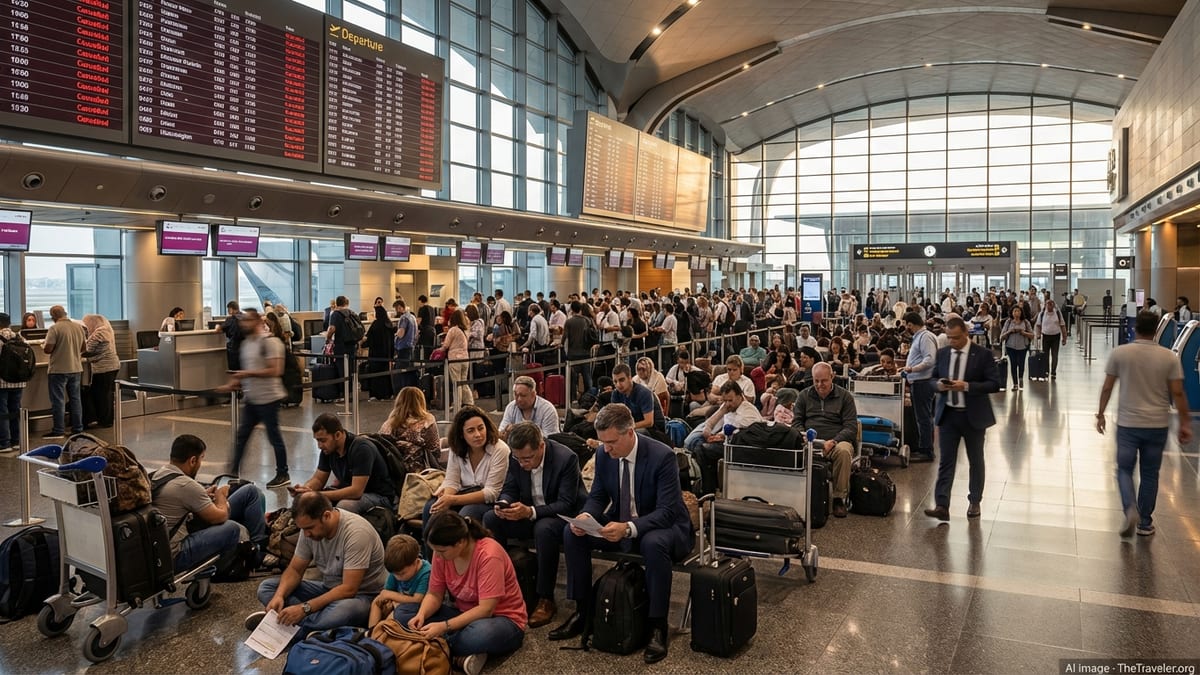
Inside the gleaming terminal, departure boards flipped relentlessly from “scheduled” to “cancelled,” as security announcements urged crowds to remain calm and await instructions from airline staff. With hotels in Doha rapidly filling up, many transit passengers reported being told to remain in the terminal area while airlines assessed alternative routings that would avoid closed skies over Iran, Iraq, Kuwait, Bahrain and neighboring states.
Check-in counters and customer service desks were quickly overwhelmed, with lines stretching deep into concourses that just days earlier had been flowing smoothly at the peak of the winter travel season. Many travelers reported waiting several hours simply to receive confirmation of vouchers, rebookings or standby options that could change again at short notice.
Major Carriers Pull Back as Gulf Hub Network Seizes Up
The paralysis at Hamad coincided with similar shutdowns at Dubai International and Abu Dhabi, turning the usually seamless Gulf hub-and-spoke network into a patchwork of stranded aircraft and displaced crews. Regional giants such as Qatar Airways, Emirates and Etihad moved first to suspend large portions of their schedules, but the shock soon rippled out to a long list of international partners.
Among the hardest hit were codeshare and alliance partners funneling traffic through Doha and Dubai, including Gulf Air, Iberia, American Airlines and British Airways. Many of these carriers rely on Gulf connections to bridge Europe, Asia, Africa and North America; when those links snapped, aircraft and crews were left out of position across multiple continents.
In the United States, flights that would ordinarily pass through Doha or other Gulf hubs were cancelled or heavily rerouted, affecting services from cities such as New York, Chicago, Dallas, Boston and Atlanta. Some long-haul aircraft were forced to return to their points of origin after reaching the edge of the closed airspace, while others diverted to secondary airports in Europe or South Asia to refuel and wait for updated routing clearances.
For carriers already operating on thin margins after several years of volatile fuel costs and shifting demand patterns, the sudden spike in cancellations poses a fresh operational and financial headache. Aviation analysts warn that even a short-lived airspace closure can take days to unwind, as airlines reposition aircraft, recalibrate rosters and work through a backlog of displaced passengers.
Passengers Stranded From Dubai to U.S. Gateways
The disruption has left travelers scattered across a wide swath of the globe, including some who never intended to set foot in the Middle East. Passengers heading from Asia to North America via Doha, for example, found themselves marooned in European and South Asian transit hubs when flights were turned back or diverted as the closures took effect.
In Dubai, crowds built quickly around departure boards at both Dubai International and Al Maktoum airports as cancellations cascaded through schedules to the United States and Europe. Similar scenes played out in Abu Dhabi, Sharjah, Kuwait and Bahrain, with local authorities urging passengers to remain in touch with their airlines and avoid traveling to airports unless they had confirmed departures.
Across the Atlantic, secondary effects began to bite at airports including New York’s JFK, Newark, Chicago O’Hare, Boston Logan, Dallas Fort Worth and Atlanta. Passengers awaiting inbound connections from Doha or Dubai saw their flights quietly scrubbed from monitors, often with limited information about when replacement services might operate. Some travelers attempting to begin multi-leg journeys via the Gulf were stopped at U.S. check-in counters and advised to postpone trips entirely.
Those already en route fared little better. Social media posts showed exhausted families stretched out on terminal floors from Europe to South Asia after their connecting flights to Doha and onward to the United States were cancelled. Many reported confusion over who was responsible for rebooking complicated itineraries involving multiple partner airlines, and whether travel insurance would cover extended hotel stays and missed events.
Limited Delays Mask a Much Deeper Network Shock
On paper, the number of flights listed as formally delayed at Hamad and other regional airports has remained relatively small compared with cancellations, with only a handful of services showing extended departure times rather than outright scrubs. Industry experts say that is because many carriers have chosen to cancel whole rotations early rather than allow rolling delays to ripple further through their schedules.
Behind the limited delay statistics lies a far more complex network shock. Long-haul routes that would normally use the most direct great-circle paths are being forced to detour hundreds of miles south to skirt closed airspace, adding hours to total journey times and significantly increasing fuel burn. That in turn is squeezing aircraft utilization and crew duty limits, factors that can prompt airlines to preemptively cancel later flights to stay compliant with safety rules.
Travel consultants warn that even passengers whose flights are currently operating may face knock-on disruptions in the coming days, as aircraft return late to their hubs and scheduled maintenance windows are pushed back. Some carriers have already hinted that they may need to trim future frequencies on certain routes in order to rebuild resilience into their networks while the conflict remains unpredictable.
For Hamad International, which has invested heavily in marketing itself as a highly reliable premium gateway, the optics are particularly challenging. While the airport and local authorities stress that safety considerations justify the unprecedented shutdown, the scenes of crowds sleeping in departure halls and queuing at service desks are likely to linger in travelers’ memories long after normal operations resume.
Uncertain Timeline Fuels Frustration and Rising Costs
Perhaps the most troubling element for both airlines and passengers is the lack of a clear timeline for the reopening of airspace across the region. Military planners are coordinating closely with civil aviation authorities, but officials have yet to provide firm public guidance on when full commercial traffic can safely resume over Iran and its neighbors, leaving schedules in a constant state of flux.
In the meantime, airlines are offering waivers for itinerary changes, refunds in some cases, and limited accommodation support where local regulations require it. Yet with hotel capacity strained in Doha and other hubs, many travelers have been given little more than meal vouchers and assurances that they remain on waiting lists for future flights that may themselves be subject to change.
Industry economists caution that the financial impact of the crisis will not be limited to the Gulf carriers. U.S. and European airlines relying on onward connections via Doha and Dubai face revenue losses and compensation claims, while higher fuel costs and longer routings could filter through to higher fares on some long-haul markets if the disruption persists.
For now, Hamad International stands as a stark symbol of how quickly geopolitical tensions can upend the finely tuned machinery of global aviation. Until the skies over the Middle East reopen in a predictable and coordinated way, travelers from Dubai to Doha, and from Boston to Dallas and beyond, are likely to face a travel landscape defined by uncertainty, last-minute changes and an acute shortage of reliable alternatives.