

More news on this day
Thousands of travelers have been left in limbo across Qatar and the wider Gulf after Doha’s Hamad International Airport effectively shut down, canceling 287 flights and delaying just one as escalating regional tensions ripple through some of the world’s busiest air corridors.
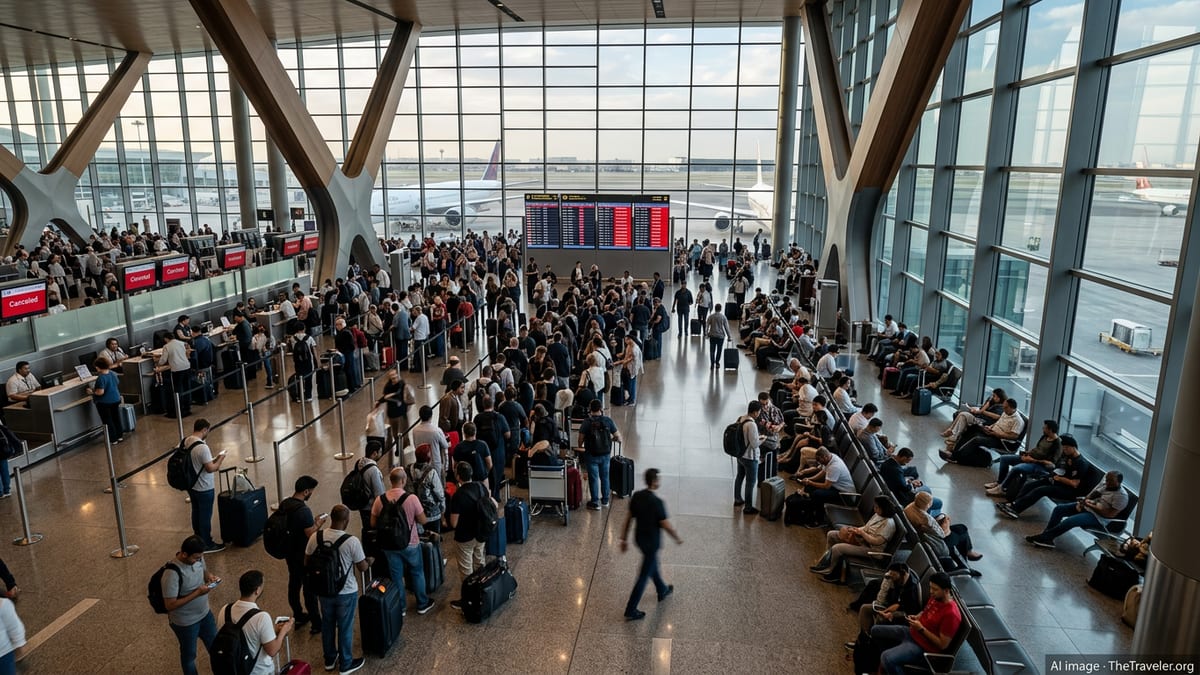
Hamad Hub Grinds to a Halt Amid Regional Conflict
The wave of cancellations at Hamad International comes as Qatar’s airspace remains either closed or heavily restricted in response to intensifying conflict linked to the ongoing U.S. and Israeli campaign against Iran. Data from industry trackers shows that over recent days the Doha hub has logged hundreds of outright cancellations and only a single recorded delay, underscoring how airlines have opted to ground or divert services rather than risk operating through volatile skies.
Qatar Airways, the airport’s dominant carrier, has already suspended regular passenger operations through Doha, leaving aircraft parked at gates and on remote stands while crews and ground staff manage mounting queues of stranded passengers. Airport officials have confirmed that only limited humanitarian, government and emergency movements are being allowed to operate, with normal commercial traffic effectively frozen until security conditions stabilize.
What began as a localized airspace closure has quickly turned into a network shock that aviation analysts compare to the early days of the COVID-19 pandemic. With Hamad International serving as a critical bridge between Europe, Africa and Asia, the sudden shutdown has created a domino effect of missed connections, overbooked alternatives and unplanned overnight stays across multiple continents.
Flydubai, Saudia, Etihad and Oman Air Forced to Reroute
The disruption is not confined to Qatar Airways. Regional carriers that rely on Doha as a feeder or destination market, including Flydubai, Saudia, Etihad Airways and Oman Air, have been forced to rapidly redraw schedules as airspace closures and security advisories spread across the Gulf. Many flights that would normally overfly or connect via Doha are instead being rerouted around restricted zones, adding hours to journey times or being pulled from schedules altogether.
Etihad and Flydubai, already grappling with closures and capacity caps at their home hubs in the United Arab Emirates, have cut back or suspended services into Qatar while they prioritize evacuation and repatriation flights on safer routings. Saudia and Oman Air, facing similar constraints, have shifted some operations to secondary airports and adjusted timetables at short notice, leaving passengers facing rolling changes to their itineraries.
Industry data indicates that across the wider region more than ten thousand flights have been canceled or significantly disrupted since the latest phase of the conflict erupted at the end of February, with Hamad International among the hardest-hit airports. Airlines are warning that the situation remains fluid, with further cancellations possible if airspace restrictions are extended or new security incidents occur.
Stranded Passengers Crowd Doha, Muscat and Riyadh
Inside Hamad International, long lines have formed at transfer desks as transit passengers discover that their onward connections no longer exist. Many travelers have been handed meal vouchers and basic amenity kits while they wait for news of rebooking options that are severely limited by the scale of the shutdown and the knock-on effects at neighboring hubs.
With regular Doha departures suspended, Qatar Airways and its partners have begun operating a small number of relief flights from alternative gateways, including Muscat in Oman and Riyadh in Saudi Arabia. These services are designed to move the most vulnerable or time-sensitive passengers first, but the volume of those stranded far exceeds the seats currently available, leaving thousands still stuck in hotels, airport terminals or temporary accommodation arranged by embassies and tour operators.
Travel agents across Europe, Asia and Africa report a surge in calls from customers trying to bypass the Gulf altogether, seeking last-minute seats on flights that detour via Istanbul, Cairo or European hubs. However, with many of those routes also affected by congestion and airspace constraints, some travelers face journeys that now require multiple stops and detours, if an alternative is available at all.
Government Advisories and Airline Policies Evolve by the Hour
Foreign ministries in North America, Europe and Asia have updated their travel advisories in recent days, urging citizens to avoid nonessential trips through the affected region and, in some cases, to depart high-risk countries while commercial options still exist. Consular staff in Doha have set up help desks at hotels and temporary support centers for nationals who were using Hamad International as a transit point when the shutdown began.
Airlines, meanwhile, are scrambling to adapt their policies on an almost hourly basis. Major Gulf and international carriers have introduced flexible rebooking options, waiving change fees and fare differences for passengers whose itineraries touch Doha and other impacted hubs over the coming days. Some are offering refunds or vouchers, while others are prioritizing re-accommodation on the first available flight, even if it requires routing passengers via distant third countries.
Airport operators and aviation regulators in the Gulf say they are in constant contact with military and security authorities to assess when and how normal operations might resume. For now, however, the guidance remains that travelers should not proceed to Hamad International or other affected airports unless they have received direct confirmation from their airline that a specific flight will operate.
Long-Term Shock for One of Aviation’s Busiest Corridors
Beyond the immediate chaos for passengers, the effective closure of Hamad International raises deeper questions about the resilience of the Gulf’s hub-and-spoke model, which relies heavily on stable airspace corridors over politically sensitive regions. Aviation analysts note that the current crisis has exposed just how quickly a single shock can ripple through global networks, disrupting everything from business travel and tourism to cargo movements between Asia and Europe.
While airlines have weathered previous geopolitical flare-ups, insiders say the scale and duration of the current airspace restrictions are already pushing contingency plans to their limits. Crews and aircraft are out of position, maintenance schedules are under strain and fuel costs are rising on longer rerouted flights, all of which could translate into higher fares and reduced capacity in the months ahead.
For stranded passengers in Doha and beyond, though, the focus remains firmly on the short term: finding a seat out, securing a refund or simply locating a bed for the night. Until airspace across Qatar and its neighbors reopens more fully, Hamad International’s 287 canceled flights and single recorded delay stand as stark markers of how abruptly one of the world’s busiest transit hubs can fall silent.