

More news on this day
Hapag-Lloyd Cruises is reshaping its cold-season offering for adventurous travelers, unveiling a slate of warm-weather expeditions across the western Indian Ocean and African coasts for the winter 2027/28 season.
New Season, New Warm-Climate Expedition Focus
For the first time, Hapag-Lloyd Cruises will dedicate one of its three purpose-built expedition ships, the Hanseatic Nature, to tropical and subtropical waters in winter 2027/28. The move signals a strategic expansion of the German line’s expedition portfolio beyond its traditional polar strongholds and caters to travelers seeking immersive nature experiences without subzero temperatures.
Operating between October 2027 and March 2028, Hanseatic Nature will offer 10 warm-climate expeditions that trace a sweeping arc from West Africa to South Africa and onward into the Indian Ocean. Guests will visit remote islands, coral-fringed atolls and sparsely populated coastlines in regions known for exceptional biodiversity and fragile ecosystems.
Company executives describe the program as an evolution rather than a departure, noting that the brand has tested similar sailings with other expedition vessels in Madagascar in recent years. With the new season, Hapag-Lloyd is formalizing its commitment to year-round expedition cruising that alternates between ice and equatorial heat.
The decision also reflects growing global demand for adventure-style cruising that combines five-star comfort with close-up encounters in lesser-traveled regions. By publishing parts of its 2027/28 schedule earlier than usual, the line aims to capture interest from planners who typically secure complex long-haul voyages several years in advance.
Indian Ocean Premieres: Seychelles, Madagascar and Beyond
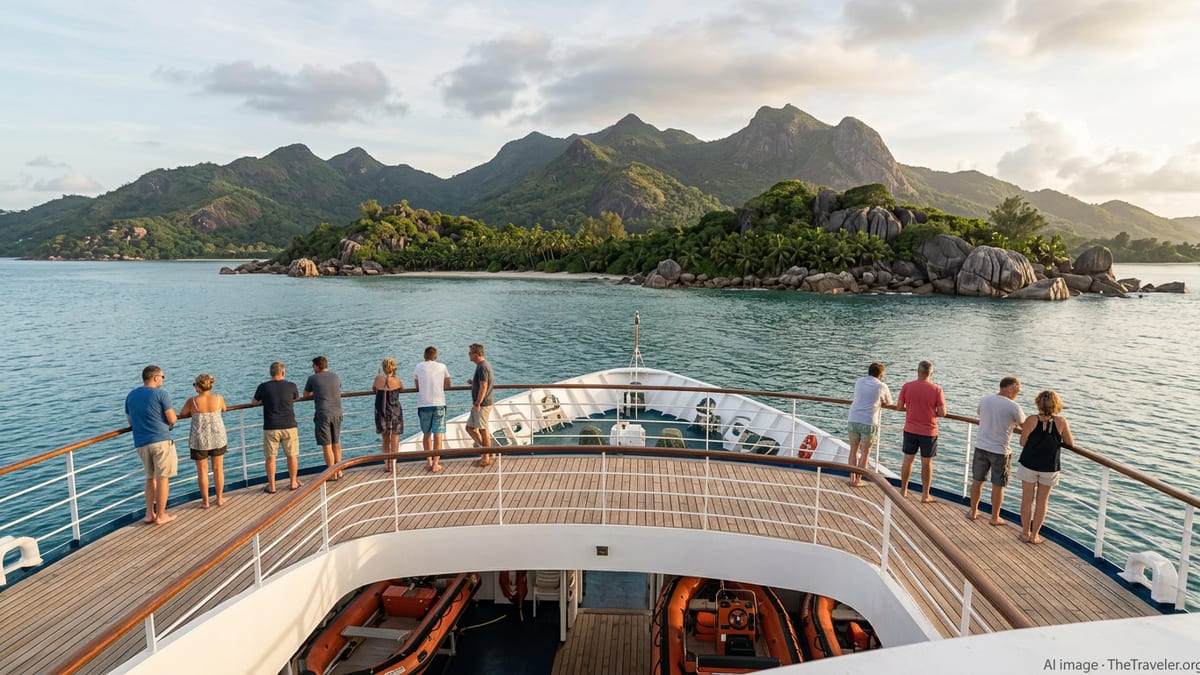
At the heart of the winter 2027/28 program are first-time warm-water itineraries for Hanseatic Nature across the Seychelles, Madagascar and wider Indian Ocean. A headline voyage, marketed as a premiere tropical expedition, will link Mahe and Mauritius in December 2027, threading through some of the Seychelles’ most remote and protected island groups.
In January 2028, a follow-on itinerary turns the spotlight on Madagascar, long prized by naturalists for its high proportion of endemic species. Guests will travel from Mahe to Mauritius via Madagascar, combining coastal calls with zodiac operations that bring small groups into secluded bays, marine reserves and nature-rich landing sites along the island’s wild fringes.
These warm-weather expeditions are designed to mirror the company’s polar operations in structure, with daily landings, expert-led excursions and flexible routing that responds to weather and wildlife conditions. Instead of ice and penguin colonies, guests can expect rainforests, baobab-dotted landscapes, coral reefs and tropical birdlife.
Additional itineraries in the season extend the concept further, with routes that connect Cape Town to the Seychelles via South Africa’s coastline and island nations in the western Indian Ocean. Collectively, the series opens up new combinations for guests who want to pair safari time in southern Africa with a ship-based expedition through Indian Ocean archipelagos.
Expedition Style Without the Deep Freeze
Hapag-Lloyd is positioning the 2027/28 collection as full-scale expeditions that simply happen to take place in warm climates. Zodiac landings in small groups will remain a central feature, allowing guests to step ashore in locations that often lack port infrastructure and are inaccessible to larger ships.
On board, travelers can expect the same emphasis on scientific interpretation and education that underpins the line’s Antarctic and Arctic programs. Expedition leaders, marine biologists and regional experts will deliver briefings and lectures that contextualize the landscapes, species and communities visited along the way.
The company has underscored its intention to tailor these itineraries to environmentally sensitive regions. That includes careful coordination with local authorities and conservation bodies, adherence to strict protocols for landings and wildlife encounters, and operational practices designed to limit the impact of small-ship tourism in remote ecosystems.
For guests, the shift from ice to equator transforms the expedition packing list and daily rhythm. Instead of parkas and sea ice, there will be snorkel gear, tropical humidity and extended daylight hours spent between decks, zodiacs and beaches, all within a familiar expedition framework.
Balancing Polar Frontiers and Tropical Discovery
While Hanseatic Nature heads for warmer waters, Hapag-Lloyd’s two other expedition ships are scheduled to remain in Antarctica over the same winter period. The dual deployment is intended to broaden choice rather than dilute the polar program, giving travelers the option to choose between icebound adventure and tropical discovery within the same season.
Industry observers view the move as part of a broader trend among high-end operators seeking to diversify expedition offerings. Warm-water itineraries can appeal to guests who are intrigued by the expedition concept but hesitant about extreme cold, lengthy flights to embarkation points at the edges of the map, or the physical demands of polar conditions.
For travel advisors, the new program creates opportunities to cross-sell. Clients who have already ticked off Antarctica or the Arctic may now be enticed by a different style of expedition that still emphasizes small ships, flexible routes and access to off-grid destinations. First-time expedition cruisers, meanwhile, may find a tropical itinerary to be a more approachable entry point.
The expanded slate also strengthens Hapag-Lloyd’s competitive position in a market where new expedition capacity continues to come online. By offering contrasting climates and geographies in the same winter season, the line can appeal to a wider spectrum of preferences and travel calendars.
Early Access and Long-Range Planning for 2027/28
Hapag-Lloyd has been progressively rolling out its 2027/28 deployment, making a tranche of late-2027 expeditions open for booking earlier than in past years. The warm-weather program on Hanseatic Nature, announced in early March 2026, fits into this broader push to give travelers more lead time on complex, bucket-list style journeys.
Advance publication is particularly relevant for the Indian Ocean and African coastal routes, where guests often need to arrange long-haul flights, pre- and post-cruise land stays and, in some cases, safari extensions. The line expects strong demand from core German-speaking markets as well as international travelers drawn by the combination of warm climate and expedition format.
As the winter 2027/28 schedule comes into sharper focus, the company is emphasizing continuity with its established expedition DNA. The message to travelers is that expeditions are defined less by latitude and more by mindset, whether the day brings ice floes and glaciers or turquoise lagoons and tropical islands.
For travelers already looking beyond their next holiday season, the newly announced warm-weather expeditions present an opportunity to secure a place on voyages that blend five-star comfort with access to some of the Indian Ocean’s most remote and biologically rich regions, at a time of year more commonly associated with parkas than palm trees.