

More news on this day
A resurfaced video of Royal Caribbean’s Harmony of the Seas maneuvering out of a Florida harbor has gone viral, showing the colossal cruise ship displacing so much water that the sea briefly recedes from a nearby beach before surging back in a dramatic “mini tsunami” effect.
Get the latest news straight to your inbox!
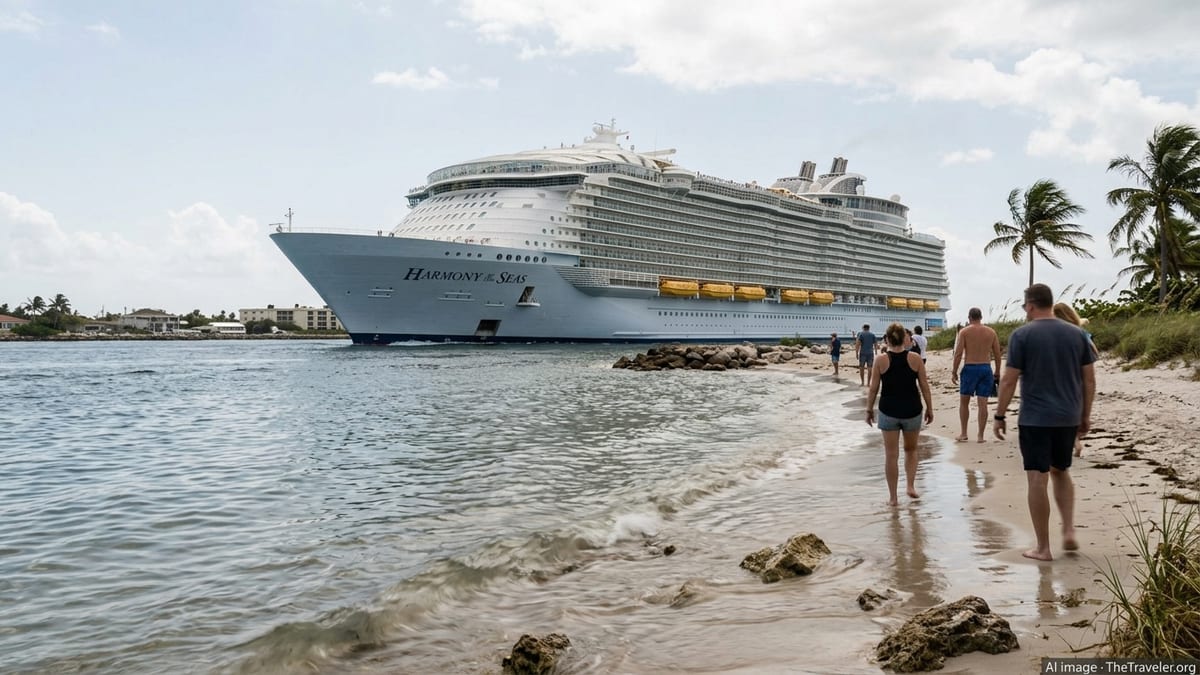
Viral Cruise Clip Captures Extreme Water Displacement
The short clip, widely shared across social media platforms, shows spectators lined along a narrow beach and seawall as Harmony of the Seas glides past in a dredged channel. As the 1,188 foot vessel moves through the confined waterway, the sea level at the shoreline appears to drop away from people’s feet, exposing wet sand and rocks that had been underwater moments before.
As the ship continues forward, the receding water is followed by a sudden, powerful rush back toward shore. The returning surge sends waves slamming into the beach and lower seawall, prompting people to back up from the edge while some attempt to keep their footing against the fast moving water. Viewers online quickly labeled the spectacle a “mini tsunami,” a phrase that has fueled further sharing and debate.
The setting shown in the video matches the approach channel to Port Everglades in Fort Lauderdale, one of the main U.S. departure points for Oasis class ships such as Harmony of the Seas. The narrow, deep cut between breakwaters, bordered by beaches and low lying waterfront, creates a confined environment where large vessel wakes and harbor “surge” can appear especially dramatic from shore.
Although the footage is not new, online reposts and edits have brought it back into circulation, with fresh captions and commentary drawing renewed attention to the scale of modern cruise ships and their impact on coastal waters.
Hydrodynamics Behind the ‘Mini Tsunami’ Sensation
Marine engineers and experienced mariners describe the phenomenon seen in the video as a combination of ship squat, displacement, and harbor surge, rather than a tsunami in the scientific sense. When a very large ship moves through a relatively shallow or narrow channel, it pushes water ahead of its bow and draws water along its sides and underneath the hull, creating a temporary low pressure zone behind and beneath the vessel.
In a constrained harbor channel, that low pressure zone can cause water levels along nearby shores to drop noticeably as water is pulled toward the moving hull. Once the vessel passes, the sea rushes back to fill the void, arriving as a fast moving surge that can look, at beach level, like a sudden flood. Observers on social platforms have pointed out the way exposed seabed in the clip resembles the classic early stage of an actual tsunami, when the ocean pulls away from shore before a major wave arrives.
Unlike tsunamis, which are triggered by large scale geological events such as seafloor earthquakes or landslides and can travel across entire ocean basins, the effect caused by a single ship is highly localized and short lived. The energy involved is tied to the vessel’s size, speed, and the geometry of the harbor or channel, meaning the “mini tsunami” dissipates quickly and does not propagate far along the coast.
Nonetheless, the visual resemblance is striking enough that researchers and harbor authorities have long used terms such as “surge” and “drawdown” to describe the risks that large ships can pose to nearby marinas, small craft, and people at the water’s edge when they maneuver in tight spaces at higher speeds.
Growing Ship Sizes Bring Harbor Surge Into Focus
Harmony of the Seas is among the world’s largest cruise ships, part of Royal Caribbean’s Oasis class, which has repeatedly pushed size records in the industry. The vessel carries thousands of guests and crew and displaces a vast volume of water when underway. In confined approaches such as Port Everglades, that scale makes wake behavior and harbor surge especially important operational considerations.
Publicly available engineering and environmental assessments for major U.S. cruise ports describe how very large passenger vessels can generate significant water level variations in narrow channels. These documents reference “surge effects” that may affect moored boats, fender systems, pilings, and shoreline infrastructure when a ship accelerates or changes course within a restricted harbor area.
Port planners and maritime pilots typically account for these dynamics through speed limits, no wake zones, and procedures that balance safety, schedule demands, and nearby recreational use of the shoreline. However, the viral Harmony of the Seas video illustrates how even normal operations of a modern mega ship can create scenes that surprise casual beachgoers who are unaccustomed to the rapid changes in water level that may accompany a close passage.
The rediscovered footage also arrives at a time when ports across Florida and the wider United States are evaluating channel widths, turning basins, and berth layouts to accommodate a new generation of large cruise vessels. The visual reminder of how much water these ships move is likely to feed into public discussion about where and how such vessels should operate in proximity to popular beaches and waterfront neighborhoods.
Online Reaction Highlights Confusion Over Tsunami Terminology
Social media reaction to the Harmony of the Seas clip has been swift and wide ranging. Commenters have alternated between excitement at the spectacle, concern about safety for people on the beach, and debates over whether the “mini tsunami” label is accurate. Many posts conflate the localized harbor surge with genuine tsunami events, while others push back and emphasize the difference.
The use of tsunami language in headlines and captions is part of a broader pattern in which older or unrelated footage involving waves, flooding, or coastal surges is repackaged online with new claims. Fact checking outlets have repeatedly documented cases where video from past natural disasters is shared during later earthquakes or storms, reinforcing misconceptions about how tsunamis form and behave.
In this case, the Harmony of the Seas video appears to show a legitimate ship generated water level change, but the terminology can still be misleading. Oceanographers note that while comparisons can help convey the power of large ships, repeated casual use of “tsunami” for unrelated events may blur public understanding of the risks associated with actual tsunami warnings.
Even so, the dramatic receding and rushing water captured in the cruise ship clip has proven effective at holding online attention, with reposts across different platforms generating millions of views and sparking discussions not only about ship design and port safety, but also about how viral content shapes perceptions of coastal hazards.
What Beachgoers Should Know Around Busy Cruise Channels
The viral surge footage has renewed interest in basic shoreline safety around major cruise and cargo ports. Maritime guidance aimed at small boat operators and waterfront users in busy harbor entrances advises giving large ships wide berth, both on the water and along adjacent beaches. Because of their deep drafts and limited maneuverability, vessels the size of Harmony of the Seas cannot easily change course or speed to avoid last minute conflicts close to shore.
Harbor notices and local signage in cruise hubs such as South Florida often caution swimmers and paddle craft about strong currents and wake effects near entrance channels. As the resurfaced video illustrates, those currents can at times be powerful enough to knock people off balance in shallow water or to shift loose objects along the beach when a mega ship passes nearby at operational speed.
Experts recommend that visitors pay attention to the timing of cruise ship arrivals and departures, stay clear of rock jetties and seawalls where surges can rebound, and avoid entering the water directly alongside narrow channels used by very large vessels. Such precautions mirror long standing practices in working ports, where tug crews, pilots, and marina operators plan around ship movements to minimize exposure to harbor surge and heavy wakes.
As cruise tourism continues to rebound and new vessels enter service, scenes like the Harmony of the Seas “mini tsunami” are likely to recur in popular coastal destinations. The latest viral wave of attention serves as a reminder that the spectacle of modern mega ships comes with hydrodynamic forces that demand respect from anyone standing at the water’s edge.