

More news on this day
Spring travelers bound for Las Vegas are encountering a more stressful start to their trips as Harry Reid International Airport wrestles with longer security lines, evolving government guidance and the broader turbulence affecting major U.S. gateways, raising concerns for the city’s tourism-dependent economy.
Get the latest news straight to your inbox!
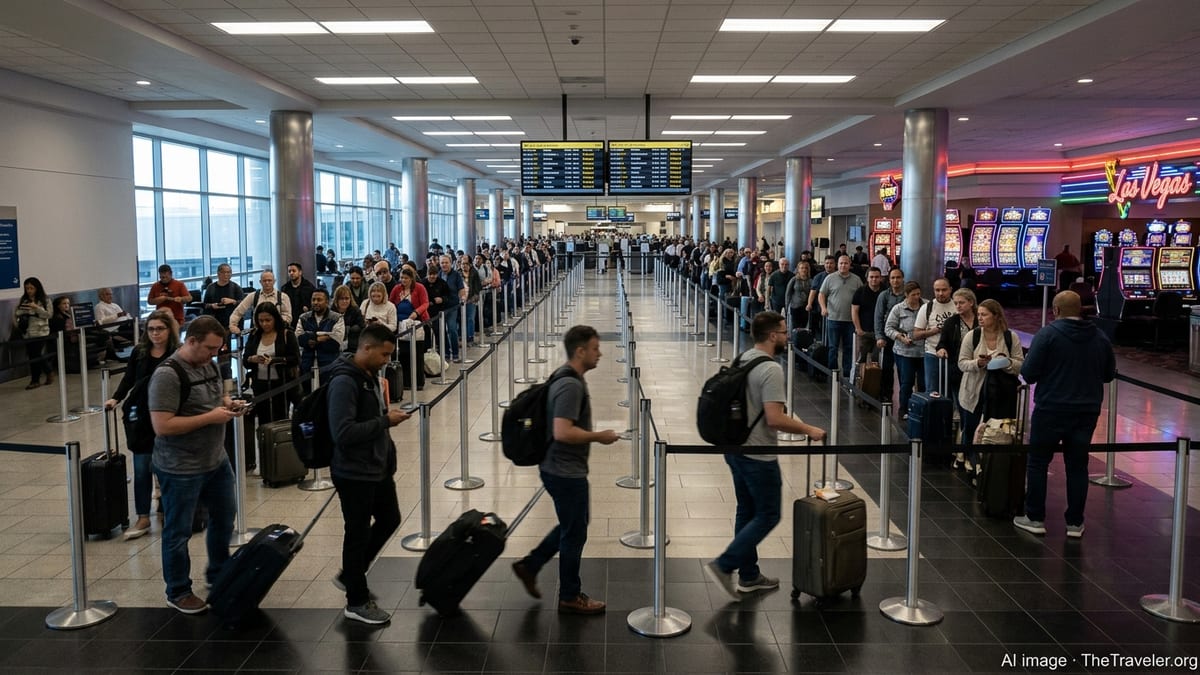
Security Bottlenecks Collide With Peak Travel Season
Published coverage across the United States indicates that a partial federal government shutdown and spring break crowds have pushed security lines at several large airports to multi-hour waits, with travelers reporting missed flights and cascading delays. While the most extreme scenes have been documented at hubs in Texas and Louisiana, Las Vegas is not immune, as Harry Reid International Airport remains among the country’s busiest leisure gateways during peak periods.
Travel industry analyses continue to rank Harry Reid International among the U.S. airports with some of the longest average security wait times, even outside extraordinary events. Guidance recently highlighted by travel outlets suggests that Las Vegas routinely appears in the top tier for checkpoint congestion, reflecting both heavy visitor volume and the airport’s role as a hub for low-cost and domestic carriers serving vacation traffic.
On top of national pressures, Las Vegas is moving through a dense calendar of conventions, major sporting events and weekend getaways, all of which compress departures into sharp morning and late-afternoon peaks. Publicly available information from the airport and third-party wait-time trackers shows that lines can remain modest at off-peak hours but lengthen quickly when multiple flights depart in tight windows, creating a perception among some visitors that conditions have swung from manageable to overwhelming in a matter of days.
These fluctuating patterns have fed frustration on social media, where anecdotal reports alternate between near-empty checkpoints and unexpectedly long queues wrapping through the terminal concourses, underscoring how volatile the situation can be from one hour to the next.
Confusing Guidance Fuels Frustration for Vegas Visitors
Confusion over how early to arrive at the airport has become a flashpoint for Las Vegas tourists. Harry Reid International’s own planning tools recently emphasized a traditional two-hour recommendation for domestic flights and three hours for international departures, in line with long-standing Transportation Security Administration messaging. In the wake of longer lines linked to the federal funding standoff, national travel coverage has cited more conservative advice, encouraging some passengers to budget three hours for domestic and up to four for international flights at the busiest airports.
That disconnect leaves visitors trying to reconcile official airport pages, TSA advisories and airline emails, which do not always match. Some carriers continue to tell customers that two hours is sufficient, while news reports and travel forums increasingly suggest building in much more time, especially during early-morning and Sunday afternoon departure banks popular with vacationers returning home from the Strip.
Third-party tracking sites that aggregate crowd-sourced data paint a mixed picture at Harry Reid International. In recent days, average posted waits around 15 to 20 minutes have appeared alongside cautionary banners acknowledging that the government shutdown may cause sudden spikes. Such tools often show low numbers for Las Vegas at certain times of day, yet traveler accounts describe sporadic surges that leave lines stretching far beyond the immediate security zone.
The result is a shifting sense of risk for tourists who came to Las Vegas for a quick escape. Many travelers are now leaving casinos, shows and restaurants earlier than planned on departure day to hedge against worst-case scenarios at the airport, cutting short valuable time in the city’s entertainment districts.
Impact Spreads to the Strip’s Hotels, Casinos and Attractions
As departure-day stress grows, the effects reach well beyond the terminal. Las Vegas depends heavily on short-stay visitors who aim to maximize every hour on the Strip, and any perceived chaos at Harry Reid International can alter how those hours are spent. Industry observers note that guests who once booked late brunches, final spa appointments or last-minute gaming sessions on the day they flew out are increasingly canceling or shifting those plans earlier.
Publicly available booking data and commentary from travel analysts suggest that some visitors are now extending trips by a night or two to create a buffer against potential flight disruptions, redistributing demand across weekdays but also increasing overall travel costs. Others are shortening stays instead, opting for a tighter schedule to avoid what they view as an unpredictable security environment.
Attractions located off the Strip, which typically rely on visitors squeezing in one more experience before heading to the airport, may be feeling the pinch most acutely. With many travelers choosing to reach the terminal three or more hours ahead of departure, time once spent at museums, immersive exhibits and neighborhood dining districts is now being reallocated to security lines, boarding gates and airport food courts.
Las Vegas resort operators are closely watching these patterns, as ancillary spending on entertainment, dining and retail often makes the difference between a strong and a weak travel season. While current delays at Harry Reid International are part of a nationwide pattern, the stakes are particularly high in a city where almost every tourist dollar eventually passes through a single airport.
Airport Technology Upgrades Tested by Real-World Surges
Harry Reid International has made visible investments in technology aimed at smoothing passenger flow and reducing anxiety around security bottlenecks. In late 2025, the airport rolled out a system that uses artificial intelligence to calculate and display real-time wait times at checkpoints throughout the terminals, giving travelers a clearer sense of how long they might spend in line and which entrances are moving faster.
Airport communications promote these tools as a way to empower passengers, encouraging them to check security checkpoint hours and locations in advance and to arrive with documentation and carry-on items prepared for screening. The system is designed to adapt to shifting conditions, updating digital displays as crowds build or dissipate.
However, the recent combination of a federal funding impasse, staff shortages at some Transportation Security Administration locations and heavy leisure demand has put these systems under pressure. Real-world surges can still outpace the models that power wait-time predictions, leaving posted averages lagging behind on-the-ground reality at the busiest moments.
Observers point out that, while technology can improve transparency, it cannot fully offset the structural constraints of existing checkpoints, staffing levels and terminal layouts. For Las Vegas visitors arriving at the airport with luggage from a weekend on the Strip, the experience ultimately hinges on how well these pieces work together when crowds peak.
How Travelers Can Navigate the Current Disruptions
Travel experts and consumer advocates are steering passengers toward a few practical strategies for navigating Harry Reid International during this turbulent period. Publicly available guidance emphasizes checking multiple sources before departure, including airline apps, airport advisories and real-time security wait-time tools, while also recognizing that conditions can change rapidly.
Many analysts recommend that Las Vegas visitors treat three hours as a baseline window for domestic flights during the spring break and convention-heavy weeks, particularly for early-morning and late-afternoon departures when traffic historically spikes. For international routes, adding at least an extra hour beyond standard advice can provide a cushion for longer check-in lines and document checks.
Enrollment in expedited-screening programs such as TSA PreCheck and CLEAR continues to be highlighted in travel columns as a valuable hedge for frequent Las Vegas visitors, given the airport’s reputation for higher-than-average wait times. At the same time, recent social media threads show that even premium lanes can be reconfigured temporarily when general lines overflow, so no option completely eliminates the possibility of delay.
For the city’s tourism ecosystem, the challenge will be maintaining Las Vegas’s appeal as an easy, spontaneous getaway while the main gateway grapples with national headwinds. As long as security lines and guidance remain unpredictable, visitors are likely to keep shifting their behavior, trimming that last hour at the blackjack table or skipping a final spin on the High Roller in favor of getting to the airport early and hoping their flight home leaves on time.