

 Follow us on Google
Hato International Airport, officially known as Curaçao International Airport, is the main gateway to this Dutch Caribbean island. For many visitors it is their first glimpse of Curaçao’s laid-back pace, sea views and trade winds.
Yet on arrival you will still pass through a fully modern border control and customs process, complete with digital immigration cards, e-gates for eligible travelers and standard customs checks. Understanding how immigration and customs work here, what to do before you land, and what to expect in the arrivals hall can make your entry smoother and faster, especially at busy times of year.
Understanding Curaçao Entry Requirements
Before you even board your flight to Hato International Airport, it is crucial to understand Curaçao’s entry rules for your nationality. Most visitors arriving as tourists can enter visa-free with a valid passport and stay up to 30 to 90 days, depending on their citizenship. Travelers from the United States, the Netherlands and several other countries typically receive generous stay limits, while some nationalities must obtain a tourist visa in advance from a Dutch diplomatic mission. These requirements are enforced by Curaçao’s immigration authorities at Hato, and airline staff usually check basic compliance before allowing boarding.
Your passport must be valid for the entire duration of your stay in Curaçao. Authorities may deny boarding or entry if your document is damaged, expired or reported lost or stolen. For many travelers, a return or onward ticket is also essential. Immigration officers want to see that you plan to leave the island, especially if you are arriving on a one-way ticket, and airlines risk fines if they transport passengers who are refused entry. Having your return booking confirmation available on your phone or printed out is a simple way to avoid delays at the desk.
Some travelers must show additional documents depending on their situation. If you are visiting family or friends, you may be asked for the address where you will stay or an invitation letter. If you are on business or attending an event, it can help to have a conference registration, company letter or similar proof of purpose. Solo travelers and people staying a long time are sometimes asked about funds for their stay. The Curaçao tourism authorities suggest guideline amounts per day for hotel or private stays, and while these are not strict thresholds, they signal the level of financial self-sufficiency immigration officers expect to see.
Health-related entry requirements are relatively straightforward. Curaçao does not require routine vaccines for most travelers, and there are currently no Covid-19 testing or vaccination rules for entry. However, if you are arriving from a country where yellow fever is a risk, you must have an approved yellow fever vaccination certificate issued at least ten days before you land. Airline staff may check this at departure, and immigration officers can request it on arrival. If you are unsure whether your recent travel history triggers this rule, it is wise to confirm before you fly.
Digital Immigration Card and Express Pass
One of the most important steps for a smooth arrival at Hato International Airport is completing Curaçao’s digital immigration card, sometimes called the DI-card or ED-card. This electronic form collects your basic personal details, passport information, flight number and accommodation address. Curaçao’s government recommends that travelers fill it out online before departure rather than waiting until they are on the plane. Doing it in advance reduces congestion on the aircraft and speeds up border checks once you land.
The digital card must be completed for every traveler, including children, and should generally be submitted up to 48 hours before arrival. In practice, some airlines still distribute paper cards on board as a backup, but the online option is linked directly to Curaçao’s automated border management system at Hato. When you arrive, immigration officers or e-gates use this data to validate your entry and confirm details such as length of stay, reason for visit and address on the island. If you have not completed the card in advance, you may be directed to a dedicated area to fill it out, which can add time to your arrival process.
To further streamline immigration at Hato, Curaçao offers an optional fast-track lane linked to what is known as the Express Pass. This service uses a mobile app to pre-verify some of your information before travel so you can use a designated priority lane when you land. It is particularly useful during peak arrival banks when several large flights land close together and queues build up at the regular counters. While the standard lanes are generally efficient, the Express Pass can shave valuable minutes off your wait time, especially if you are traveling with children or have a tight connection to a local ferry or inter-island flight.
Even if you do not use the Express Pass, being meticulous with your digital card details is worthwhile. Double-check that your passport number, date of birth and flight information are accurate. Keep a screenshot or digital confirmation on your phone, as immigration officers sometimes ask to see proof that you completed the form. If your plans change quickly and you switch flights or accommodation, update the information if possible or be ready to explain the change at the desk.
Arriving at Hato: From Aircraft Door to Passport Control
After your aircraft parks at Hato International Airport, you will disembark either via jet bridge or stairs followed by a short walk or bus ride to the arrivals building. The airport has been modernized in recent years and the terminal is compact, so walking distances are relatively short compared with major international hubs. If you are seated near the front of the plane, you may reach immigration within minutes of landing; those at the back should add a little extra time for the aisle shuffle.
On your way to passport control, look for signs directing “Arrivals” and “Immigration.” Curaçao is a multilingual destination, and signage is usually in English and Dutch, sometimes with Spanish as well. The walkways are clearly marked and funnel all arriving passengers toward border control. If you have mobility issues or require assistance, airline staff or ground handlers can provide wheelchairs and escort services; it is best to request this in advance when you book your ticket or during online check-in.
At the entrance to the immigration hall, airport staff may perform an initial check to ensure you have your passport ready and that you have completed the digital card. This is a good time to prepare: put your passport and any supporting documents in your hand, remove headphones and be ready to answer basic questions. Photos and video recordings are typically restricted in the immigration zone, so it is advisable to stow your camera or phone once you approach the desks unless you are retrieving documentation.
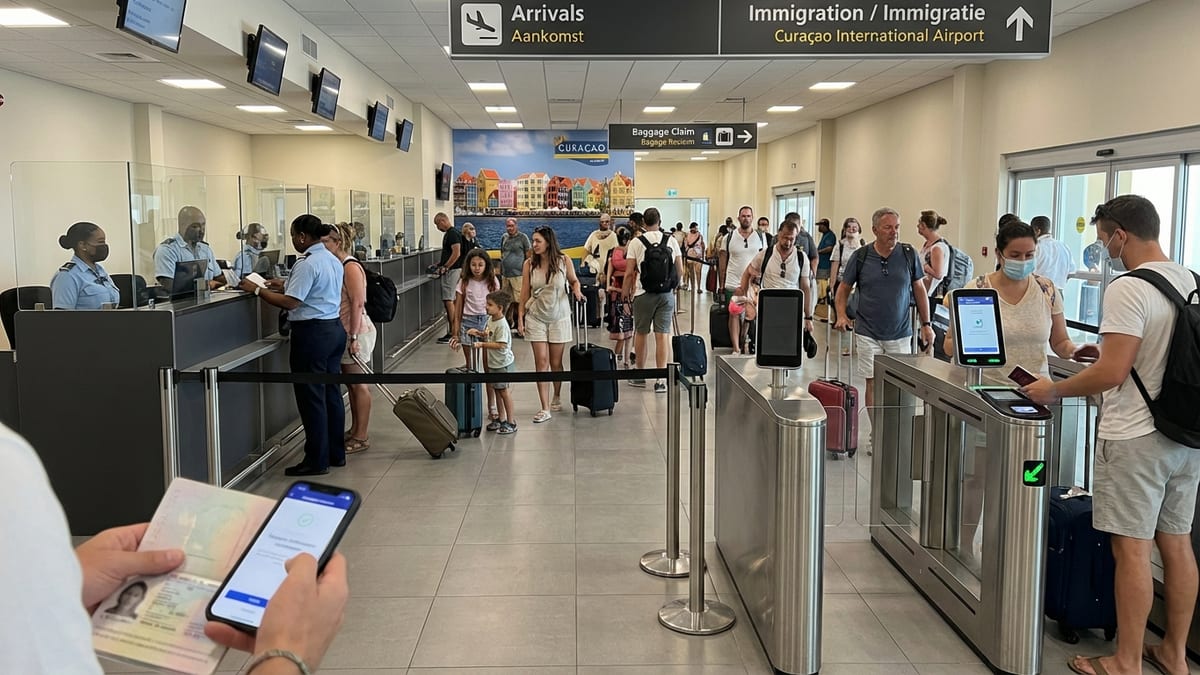
Hato’s immigration area is equipped with a combination of staffed counters and automated e-gates for eligible travelers. When the airport is not particularly busy, queues move quickly. At peak times, especially weekends and holiday periods, lines can grow if several flights arrive at once or some e-gates are temporarily out of service for upgrades. Allowing a realistic buffer of time between landing and onward commitments is important. If you are connecting to another flight from Hato on a separate ticket, treat it like a normal international arrival with full immigration and customs checks before recheck or departure.
Using E-Gates and Regular Immigration Counters
Curaçao has invested in automated e-gates at Hato International Airport to reduce waiting times for eligible passengers. These gates are designed for travelers with modern biometric passports from certain countries, including many European Union states, the United States and Canada, who are at least 18 years old. The system scans your passport, captures your facial image and cross-checks your details with the digital immigration card and border control databases. When everything matches and no issues are flagged, the gate opens and you proceed to baggage claim without seeing a human officer.
In recent seasons, Hato’s e-gates have undergone upgrades to meet newer international standards. During these works, some gates may be temporarily offline, which can lead to longer lines than usual. If you arrive during such a period, airport staff typically guide passengers to whichever gates and counters are operational. Being flexible and following staff directions is the best approach. Even when all e-gates are running, the airport may route some passengers directly to manned counters depending on flight loads, family composition or system performance at the time.
To use the e-gates efficiently, remove hats, sunglasses and masks before you step into the booth so that the camera can clearly capture your face. Hold your passport open at the photo page and place it exactly where instructed on the reader. Follow the on-screen prompts patiently and wait without moving until the system completes its checks. If the gate does not recognize your document or face, do not worry. You will be redirected to a staffed immigration counter, where an officer will handle your entry in the traditional way.
At the regular immigration counters, the process is familiar to most international travelers. You hand over your passport, answer a few questions about your stay and sometimes present your return ticket, hotel reservation or proof of funds. Officers may ask about the length of your visit, where you are staying, whether this is your first time in Curaçao and what you plan to do on the island. Honest, concise answers are best. Have any supporting papers ready to avoid rummaging through your bag under pressure. If you are traveling as a family or couple, you will often be processed together at the same counter.
Customs Procedures: Green and Red Channel Explained
Once your passport is stamped and you have collected any checked luggage, you move on to Curaçao’s customs control at Hato International Airport. Customs is separate from immigration and deals with what you are bringing into the country rather than your right to enter. This part of the arrival process is structured around two corridors known as the green and red channels. These are standard in many airports around the world and are used in Curaçao to quickly separate passengers who have goods to declare from those who do not.
Choosing the green channel means that you are declaring you have nothing to declare beyond your normal personal belongings and duty-free allowances. This typically covers your clothes, personal electronics, limited amounts of tobacco and alcohol within the permitted thresholds and souvenirs for personal use. Customs officers may still conduct random checks in the green lane, but most passengers simply walk through and exit into the public arrivals area. It is important to remember that selecting the green channel is itself a legal declaration; if you are found with undeclared goods that exceed allowances, you may face fines or confiscation.
The red channel is for travelers who know they are carrying items that may be subject to import duty, are restricted or could be prohibited. Examples include larger quantities of alcohol and tobacco, high-value electronics and luxury goods, commercial merchandise, significant cash amounts or items that may fall under wildlife protection rules. If you are unsure whether an item requires declaration, it is always safer to choose the red route and ask. Customs officers in Curaçao generally appreciate honesty and are used to answering questions about duties and exemptions. Declaring something does not automatically mean you will pay tax; in some cases, you may be within a duty-free allowance or qualify for an exemption.
Travelers with pets, unusual equipment or professional gear should pay special attention to customs requirements. Bringing animals usually involves advance paperwork and health certificates, and you may need to meet local veterinary or quarantine conditions. For photographers, filmmakers and remote workers entering with multiple cameras, drones or specialized tools, declaring them properly can prevent issues when you leave the island and need to prove that your equipment is not newly purchased in Curaçao. Customs maintains detailed guidance on what is permitted and what must be declared, so checking these rules before travel is wise, especially if you plan to arrive with atypical baggage.
Arrival Tips: Timing, Queues and Baggage
Hato International Airport is relatively small by global standards, which often works in travelers’ favor. When flights are well spaced, formalities can be completed quickly. However, like any leisure destination with distinct high seasons, Curaçao experiences busy arrival waves, particularly on weekends, holidays and during peak months such as July, August and December. During these times, several wide-body aircraft can land close together, filling immigration and baggage claim areas for an hour or two at a time.
While you cannot control the exact timing of your arrival, you can set realistic expectations. If your flight lands within one of these peak windows, plan for up to an hour from aircraft door to clearing customs, especially if you are seated toward the back and have checked luggage. If you are arriving during quieter afternoon hours on a weekday and travel with hand baggage only, you may be outside the terminal in far less time. The presence or temporary unavailability of e-gates can also affect the pace. Keeping a flexible mindset and allowing a buffer in your onward plans is the best way to prevent stress.
At baggage claim, carousels are close to the immigration exits and well signposted. Screens show your flight number and belt assignment. If your bags take time to appear, use the opportunity to reorganize your documents and freshen up before customs. Lost or delayed baggage is handled via the ground services desks in the arrivals hall; keep your luggage tag receipts safe until you exit the airport in case you need to file a report. If you are connecting onward by domestic or regional air, know that you will normally need to reclaim and recheck your baggage after customs, as there is no sterile transit system for most regional connections.
For those concerned about jet lag or traveling with children, prepare snacks, water and small entertainment items in your carry-on, since there may be limited options before you clear formalities. The terminal is air-conditioned, but Caribbean humidity can still feel intense after you leave the aircraft, so dressing in layers and having easy access to essentials such as a light jacket or medication can make the journey from gate to curb more comfortable.
Money, Security and Local Transport After Customs
The arrivals area beyond customs at Hato International Airport is your first point of contact with local transport operators, rental car agencies and relatives or hotel representatives. Once you pass the green or red channel, you will exit into a public hall where people wait to meet arriving passengers. If you arranged a transfer with your hotel or a tour operator, look for your name or the property’s name on a signboard. It is prudent to confirm ahead of time exactly where your driver will stand, particularly during busy arrival periods when the space can feel crowded.
Cash machines are normally available in or near the arrivals hall, dispensing local guilders and sometimes US dollars, which are widely accepted on the island. Using an ATM on arrival can be more convenient than carrying large amounts of foreign currency, although you should still inform your bank about international travel to avoid card blocks. Currency exchange services may also be present, but rates are sometimes less favorable than using a card or withdrawing cash. Major credit cards are widely accepted in Curaçao’s hotels, restaurants and tourist attractions, but having small cash notes is useful for tips, small shops and public transport.
When it comes to security, Hato is generally orderly and well policed. Still, the usual precautions apply, as in any international airport. Keep valuables secure and avoid leaving bags unattended while you orient yourself. If you need time to arrange transport, move a little away from the main exit doors and crowds to a quieter corner of the hall. Official taxi stands and recognized rental car counters are preferable to unlicensed drivers who might approach you directly. If anything feels off or you are unsure about an offer, it is perfectly acceptable to decline and walk to the clearly marked taxi area instead.
Road connections from the airport into Willemstad and the main resort areas are straightforward, and driving distances are short. Depending on traffic, most journeys to central hotels take between 15 and 30 minutes. If you are renting a car, remember that you will drive on the right-hand side of the road, and local driving styles can be more relaxed than in North America or Europe. For taxis, agree on an approximate fare or ensure that the meter is used before setting off. Some properties also arrange shared shuttles that wait for multiple passengers; these can be economical but may involve slightly longer travel times due to multiple stops.
The Takeaway
Arriving at Hato International Airport is the beginning of your Curaçao experience, and a bit of preparation goes a long way toward making that first hour on the island smooth. Understanding visa requirements and stay limits for your nationality, completing the digital immigration card ahead of time, and carrying confirmation of your accommodation and return flight help you breeze through border checks. If you are eligible for the e-gates or the Express Pass, these tools can further reduce your time in queues, particularly during high season.
On the ground, familiar concepts like green and red customs channels, clear signage and compact terminal design work in your favor. By honestly choosing the right customs lane, knowing what you are allowed to bring, and preparing for possible checks with high-value or unusual items, you minimize any risk of surprises. Once through, you will find transport, cash and services within a short walk, allowing you to pivot quickly from travel mode to vacation mode.
Ultimately, Curaçao’s entry procedures are modern and fairly streamlined compared with many destinations. Travelers who arrive with complete documentation, realistic expectations about timing, and a relaxed attitude toward short waits typically find the process straightforward. Handle the formalities with a little care and patience, and Hato International Airport becomes a brief, efficient stop on your way to the island’s beaches, culture and warm Caribbean hospitality.
FAQ
Q1. Do I need a visa to enter Curaçao through Hato International Airport?
Most tourists from North America, Europe and several other regions do not need a visa for short stays, provided they hold a valid passport and meet general entry conditions. Some nationalities, however, must obtain a tourist visa in advance from a Dutch diplomatic mission. Always check current rules for your specific passport before you travel.
Q2. How long can I stay in Curaçao as a tourist?
In many cases visitors are permitted to stay up to 30 to 90 days, subject to the policies that apply to their nationality. Some citizens, including Dutch and American nationals, may be eligible for longer stays within a given 365-day period. The immigration officer at Hato confirms your allowed stay when you arrive and stamps your passport accordingly.
Q3. What is the digital immigration card and when should I complete it?
The digital immigration card is an online form that records your personal, passport and travel details for Curaçao’s border authorities. You should complete it before departure, ideally within 48 hours of your arrival time. Having it done in advance speeds up processing at Hato and allows you to use e-gates if you are eligible.
Q4. Who can use the e-gates at Hato International Airport?
The e-gates are generally available to adult travelers with biometric passports from certain countries, including many European Union states, the United States and Canada, who have completed the digital immigration card. Eligibility criteria can evolve, so if the e-gate does not accept your passport or you are traveling with children, you may be directed to a staffed counter instead.
Q5. What should I expect at customs when I arrive?
After collecting your luggage you will see a green channel for passengers with nothing to declare and a red channel for those carrying goods that may be subject to duties or restrictions. If you stay within standard duty-free allowances and have only personal belongings, you can usually walk through the green lane. If you are unsure about an item, choose the red channel and ask a customs officer for guidance.
Q6. Are there any health-related entry requirements for Curaçao?
There are currently no routine Covid-19 testing or vaccination requirements to enter Curaçao. However, travelers arriving from countries with a risk of yellow fever transmission must show proof of yellow fever vaccination given at least ten days before arrival. Standard travel health precautions are recommended, and you should consult your doctor about routine or optional vaccines before your trip.
Q7. How long does it usually take to clear immigration and customs at Hato?
Processing times vary with flight schedules and season. During quiet periods, travelers with hand luggage only can sometimes clear immigration, baggage and customs in well under an hour. At busy times such as weekends and peak vacation months, or if some e-gates are offline, it can take longer, especially if several large aircraft arrive at once. Planning for up to an hour from aircraft door to exit is a sensible rule of thumb.
Q8. What documents should I keep handy when I reach the immigration desk?
Have your passport open at the photo page, a confirmation that you completed the digital immigration card, your return or onward ticket and the address of your accommodation. If you are visiting friends or relatives, bring their address and contact details. Evidence of sufficient funds for your stay and any relevant health certificates can also be useful if an officer asks for them.
Q9. Can I get local currency or arrange transport easily after I clear customs?
Yes. ATMs and transport options are available in or near the arrivals hall. You can usually withdraw local currency and sometimes US dollars from cash machines, and official taxis and rental car counters are located just beyond customs. Confirm any agreed taxi fare or meter use before departing, and meet pre-booked drivers in the designated reception area.
Q10. What should I do if I have problems on arrival, such as lost luggage or passport issues?
If your luggage is missing, report it immediately at your airline’s ground handling desk in the baggage claim or arrivals area, using your baggage tag receipts as reference. For passport or entry problems, immigration or airport police can direct you to the relevant authority. Travelers in difficulty can also contact their embassy or consulate, which in Curaçao is typically located in Willemstad and can provide advice and, in serious cases, consular assistance.