

More news on this day
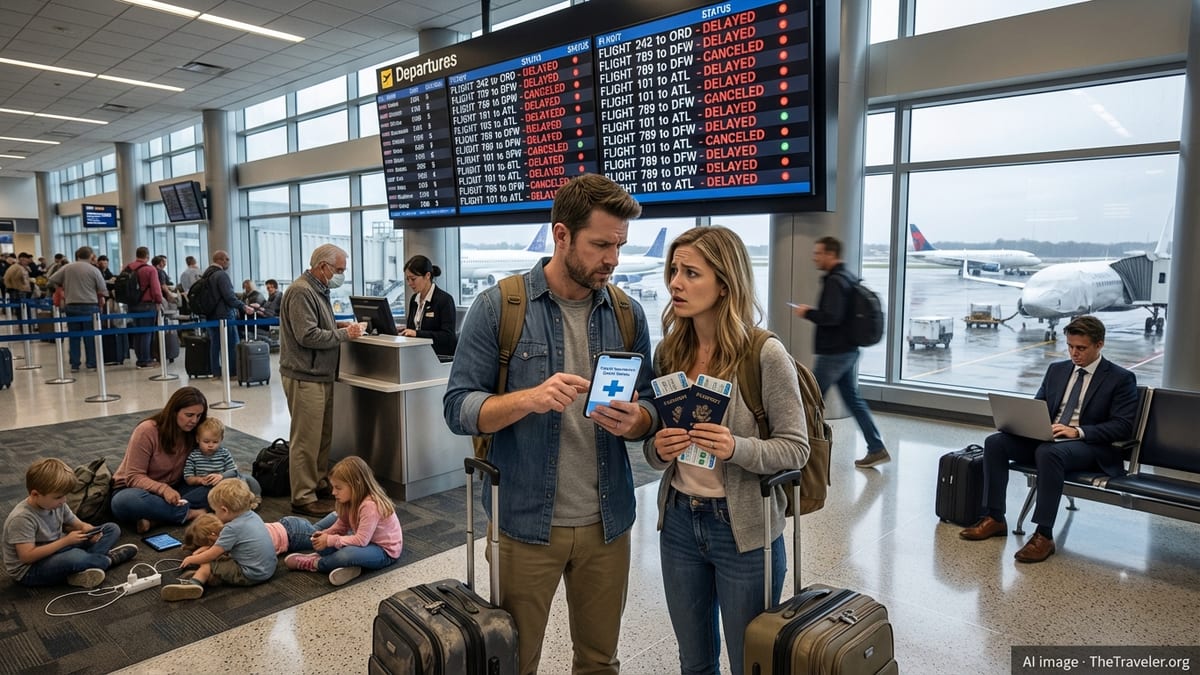
As Americans map out 2026 trips amid government shutdowns, aviation glitches and lingering health threats, surveys and industry data show traveler anxiety increasingly centered on two issues: what happens if they get sick far from home, and whether their flights will actually operate on time.
Health Risks Abroad Move Back to the Top of the List
While emergency rooms have emptied from the worst days of the pandemic, health security has quietly reclaimed its place as a leading concern for U.S. travelers heading overseas. Travel insurers and assistance providers report that medical crises once considered rare now drive a disproportionate share of calls, from sudden cardiac events on cruise ships to respiratory infections and injuries at remote resorts.
Public health officials note that 2025 saw a patchwork of regional outbreaks, including resurgent measles clusters in Europe and Asia and periodic spikes in Covid and influenza that triggered short-notice entry restrictions and testing rules. For travelers planning 2026 vacations, the possibility of getting caught in a fast-changing health protocol, or needing hospital care in a country with unfamiliar systems and high out-of-pocket costs, has become a central part of trip planning.
Insurers say that is translating into a clear behavioral shift. Comprehensive policies with higher medical limits and built-in telehealth consultations are selling briskly, particularly among families and older travelers. Assistance hotlines are fielding more pre-trip calls about vaccine recommendations, access to English-speaking doctors and whether local hospitals can stabilize serious trauma before a medical evacuation is arranged.
Within the United States, travelers are increasingly weighing domestic hospital capacity and regional health risks when choosing destinations. Mountain and desert regions popular for adventure travel continue to see a rise in search interest for evacuation coverage, reflecting worries about injuries far from major medical centers.
Flight Disruptions Become a Chronic Worry
On the aviation side, disruption is no longer perceived as an occasional nuisance but as a structural feature of modern air travel. Data compiled by compensation firm AirHelp show that nearly one in four passengers departing U.S. airports in 2024 experienced a delay or cancellation, affecting roughly 236 million people. Industry analysts say the absolute number of disrupted passengers rose again in 2025 as planes flew fuller and schedules grew tighter.
The United States has been hit by a series of high-profile events that have hardened traveler expectations of chaos. The CrowdStrike-linked IT outage in July 2024 triggered days of cancellations, including more than 7,000 flights on one major carrier alone, and left more than a million passengers scrambling to rebook. In November 2025 and early 2026, airlines and airports contended with a combination of winter storms, an urgent inspection program for Airbus aircraft and staffing constraints tied to a federal government shutdown, leading to thousands more cancellations and missed connections.
Globally, disruption has spread across markets. A November 2025 analysis from the Airline ImPax Report found that more than 580,000 flights worldwide were disrupted in a single month, driven by aircraft groundings, operational meltdowns at European carriers and large-scale schedule failures in India. For travelers, that has reinforced the sense that no region is immune and that a single weak link in an airline or airport system can cascade worldwide.
Government data in the United States show that airlines have improved their average on-time performance compared with the darkest days of 2022, but travelers say statistics offer little comfort when a single weather event, staffing gap or IT failure can strand them overnight without clear recourse.
Policy Shifts and Government Turmoil Add to Uncertainty
Regulatory decisions and political standoffs are compounding traveler unease. During the current partial U.S. government shutdown that began on February 14, 2026, the Department of Homeland Security briefly moved to suspend trusted traveler programs such as TSA PreCheck and Global Entry, before reversing course on PreCheck following a public outcry. Global Entry remains suspended, creating new unpredictability around border wait times for millions of frequent travelers.
Meanwhile, recent guidance from the U.S. Department of Transportation clarified that airlines are not required to cover hotel or meal expenses when delays or cancellations stem from aircraft recalls, even when thousands of passengers are affected by sudden inspections or software fixes. While refunds remain mandated for canceled flights, the announcement underlined a patchy compensation landscape in which only disruptions deemed within an airline’s control trigger meaningful benefits.
Abroad, regulatory responses to disruption have been inconsistent. Authorities in India ordered probes, fare caps and refund mandates after tens of hundreds of flights were canceled in December 2025 when a major carrier failed to adapt to new crew rest rules, while European regulators have continued to lean on longstanding passenger-rights frameworks that guarantee compensation for many delays. For international travelers trying to connect the dots, the result is a sense that protections vary widely by jurisdiction and by the exact cause of a disruption.
The combination of shifting rules and slow-moving reforms has left consumer advocates warning that 2026 could see a widening gap between traveler expectations and what airlines and governments are actually obligated to deliver when something goes wrong.
Geopolitics, Technology Risks and Safety Perceptions
Beyond day-to-day delays, deeper structural risks are also filtering into traveler calculations for 2026. Aviation safety data from industry groups show that flying remains extraordinarily safe in statistical terms, with only a handful of fatal accidents among tens of millions of flights in 2024. Yet a series of high-casualty incidents, including a major crash in India in 2025 and conflict-zone shootdowns highlighted in recent safety reports, have kept aircraft accidents on the front pages and stoked public concern.
Electronic warfare and cyber risk are another emerging anxiety. Investigations into navigation disruptions at major U.S. airports and growing reports of GPS jamming and spoofing in conflict regions have underscored how dependent global aviation has become on vulnerable satellite signals. Technology reporters and security analysts note that while new, more resilient GPS satellites are coming online, ground systems and backup procedures are still catching up, opening potential windows for outages.
At the same time, travelers are wrestling with the safety implications of increasingly automated systems on aircraft and in air-traffic control. While experts stress that automation has sharply reduced accident rates over the long term, the same digital complexity that enables efficiency has also created new failure points, from software-induced angle-of-attack problems to global IT outages tied to a single vendor update.
All of this has fueled a subtle but noticeable rise in safety-related questions to airlines and travel agents, particularly on long-haul international routes and in regions where geopolitical tensions are high or infrastructure is aging.
How Travelers Are Adapting Their 2026 Plans
Confronted with a long list of known and emerging risks, travelers are not staying home so much as changing how they move. Recent consumer surveys by booking platforms and luggage services show that fears of delays and cancellations are prompting many Americans to travel lighter: a large majority now say they avoid checking bags whenever possible, both to dodge fees and to simplify rebooking when flights are disrupted.
Flexible trip planning has become a mainstream strategy. Travel agents report that clients are more willing to pay extra for refundable hotel rates and changeable airfares, add a buffer night at the start of cruises or tours, and purchase separate policies that specifically cover missed connections and additional accommodation costs. Some are deliberately building longer layovers into itineraries to reduce the risk that a single delay will break a complex chain of flights.
On the health front, demand is rising for plans that bundle medical coverage, telemedicine access and clear evacuation benefits, especially for trips to remote regions or countries with high private medical costs. Travelers are also paying closer attention to the financial stability and assistance capabilities of insurers, looking for providers that can coordinate care and transport rather than simply reimburse bills after the fact.
Industry analysts say that for 2026, the defining mood among global travelers is not panic but wary pragmatism. With health emergencies and flight disruptions now seen as baked-in risks rather than rare shocks, the focus is shifting toward mitigation: building resilience into every itinerary, reading the fine print and assuming that at least some part of the journey will not go according to plan.