

Health insurance has become a central planning issue for foreigners considering medium or long term residence in Thailand. While Thailand offers relatively affordable and high quality private healthcare by regional standards, costs for serious treatment are substantial and can be financially disruptive without adequate coverage. At the same time, Thai immigration rules increasingly link long stay permission to specific health insurance conditions. Understanding the structure of the Thai health system, typical treatment costs, and the main insurance options available to expatriates is essential for informed relocation decisions.
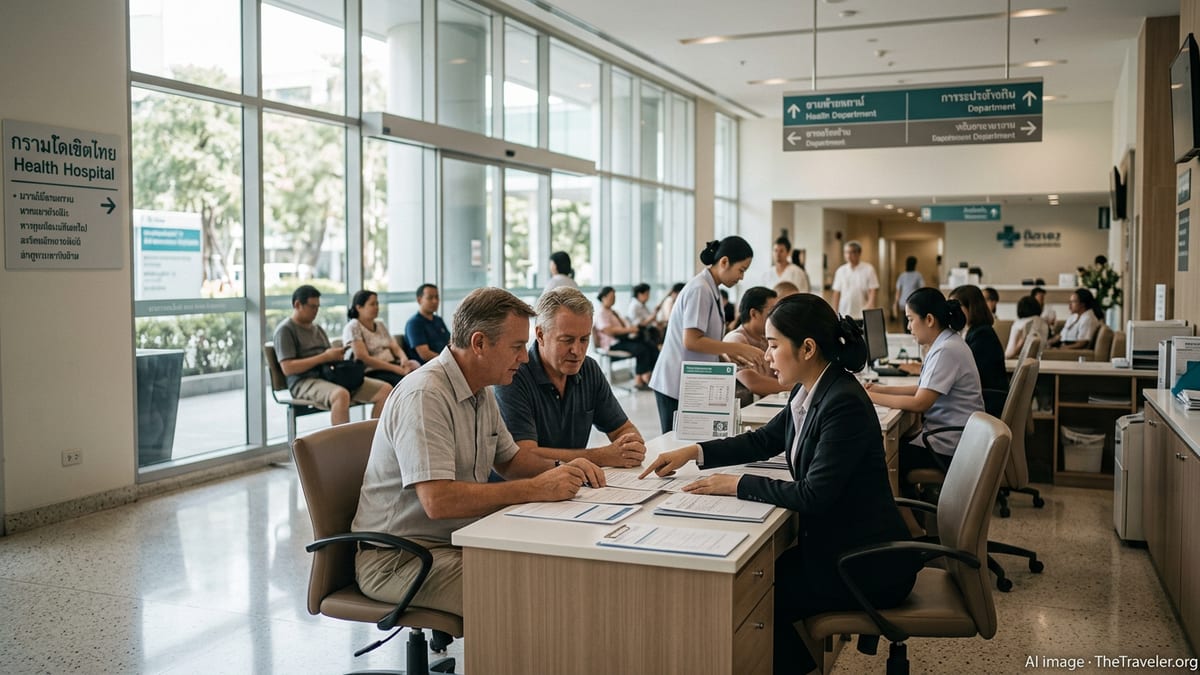
Context: Healthcare Spending and Out of Pocket Risk in Thailand
Thailand combines a tax funded universal coverage scheme for citizens with a large and commercially developed private hospital sector that serves both locals and foreigners. Total health expenditure is estimated at around 4 to 5 percent of GDP, significantly below most Western economies, which typically range from 8 to more than 10 percent of GDP. This lower macro level spending does not prevent good clinical outcomes in many areas, but it does translate into heavier reliance on out of pocket payments and private insurance when using major private hospitals.
Per capita health spending in Thailand is a small fraction of typical figures in North America, Western Europe or advanced East Asian economies. Public data place current health expenditure per person in the low hundreds of US dollars annually, compared with several thousand dollars in high income countries. This gap explains why day to day care can seem inexpensive to new arrivals while major interventions still create serious financial exposure absent insurance.
Out of pocket expenditure remains a significant share of total health spending. For insured expats using private facilities, common outpatient visits may cost the equivalent of 30 to 100 US dollars, while a simple inpatient procedure can reach several thousand dollars. More complex events such as intensive care or cancer treatment can quickly rise into the tens of thousands of dollars. Without planned coverage, these amounts can exceed the budgets of retirees or remote workers who selected Thailand on the basis of low general living costs.
Public schemes such as the Universal Coverage Scheme, Social Security Fund and Civil Servant Medical Benefit Scheme do not generally extend to foreign residents unless they are formal employees contributing to social security. Even when limited access exists through employment, coverage tends to focus on public hospitals and basic services. As a result, private or international health insurance is the main risk management tool for most long stay expatriates, and an increasingly explicit requirement for certain visa categories.
Visa Linked Health Insurance Requirements Relevant to Expats
While this article does not provide a full visa overview, several common long stay visa routes now carry explicit health insurance conditions that directly shape expat coverage decisions. For retirement style Non Immigrant O A visas, Thai regulations require proof of health insurance from a Thai or approved foreign insurer covering the entire permitted stay. The minimum mandated benefits include inpatient coverage of at least 400,000 Thai baht per policy year and outpatient coverage of at least 40,000 baht, with some insurers marketing plans that significantly exceed these floors to match rising medical costs. ([immigration.go.th](https://www.immigration.go.th/wp-content/uploads/2022/02/Guideline-on-Non-Immigrant-O-A-Visa.pdf?utm_source=openai))
For certain long term stay frameworks aimed at wealthy retirees or professionals, including specific long term resident categories, authorities have introduced minimum international health insurance requirements expressed in US dollars. These typically require medical coverage of at least 50,000 dollars for treatment in Thailand, with the policy valid for the full intended period of residence. Similar minimums have also appeared for newer digital nomad oriented visas or destination programs, where officials want to ensure that remote workers and long stay visitors will not become uncompensated burdens on the health system if hospitalised. ([terms.law](https://terms.law/Thai/banking/health-insurance-requirements.html?utm_source=openai))
The rules on whether policies must be issued by local insurers or can be underwritten overseas differ between visa categories and even between embassies and immigration offices. For the Non Immigrant O A retirement visa, the immigration guideline explicitly allows both Thai and non Thai insurers, but requires that policy details be accessible to immigration through an electronic verification platform used by Thai regulators. In practice this has led many retirees to select Thai based products specifically advertised as visa compliant, often with coverage levels of 3.5 million baht or more. ([immigration.go.th](https://www.immigration.go.th/wp-content/uploads/2022/02/Guideline-on-Non-Immigrant-O-A-Visa.pdf?utm_source=openai))
Prospective expats evaluating relocation should therefore treat health insurance not only as a financial risk question but also as a compliance factor. Some long stay options have no formal insurance requirement, but those that do can significantly narrow product choices, especially for older applicants or those with pre existing conditions. Given the pace of regulatory change during 2024 and 2025, it is prudent to assume that future reforms may further tighten the link between immigration status and demonstrable health coverage.
Main Categories of Health Insurance Available to Expats
Foreign residents in Thailand typically choose between four broad types of health insurance: local Thai private medical insurance, international expat health insurance, employer provided group cover, and short term travel style policies. Each class has distinct advantages, limitations and suitability depending on length of stay, age, health profile and mobility plans.
Thai private medical insurance is sold by domestic insurers and regional subsidiaries. These products are priced in baht, structured around local hospital networks and regulated by the Thai Office of Insurance Commission. Entry ages commonly extend to around 60 to 70 years, with some specialised senior products offering entry to around 80, although benefits and underwriting become tighter at higher ages. Annual coverage limits range widely, from the regulatory minimums for visa compliance up to 20 million baht or more for premium plans. ([insurance-thailand.com](https://insurance-thailand.com/oic-approved-insurance-thailand/?utm_source=openai))
International expat health insurance is offered by global providers that cover treatment in multiple countries, often including optional modules for worldwide or region specific coverage. These plans are generally denominated in major currencies such as US dollars or euros and feature higher overall annual limits, sometimes 1 million dollars or more. They may offer more predictable coverage if the expatriate plans to travel frequently or relocate again, and can include evacuation, repatriation and elective treatment outside Thailand. Premiums are higher than for purely local policies, reflecting broader geographic risk and higher claim costs in other jurisdictions.
Employer provided group cover is most relevant for expatriates employed by multinational firms or large Thai companies. Participation in such schemes can relax underwriting constraints because risk is pooled and some pre existing conditions may be accepted or covered after a waiting period. Benefits can range from basic inpatient only cover in Thai hospitals to comprehensive global major medical plans. However, coverage usually terminates with employment and may not be portable for retirees or freelancers.
Short term travel and visitor policies, including those marketed for tourists, may meet minimum requirements for temporary visas but are generally unsuitable for residents. They typically focus on emergency care and time limited treatment, carry low maximum benefits relative to long term needs, and often exclude routine outpatient visits or chronic disease management. Over reliance on travel style cover for an ongoing relocation exposes expats to serious gaps, especially once a medical issue ceases to be considered an acute emergency.
Typical Benefits, Premium Ranges and Policy Structures
Premium levels for expat health insurance in Thailand vary widely by age, coverage limit, hospital access and whether the insurer is local or international. For a relatively healthy person in their thirties choosing a Thai local plan with an annual inpatient limit around 1 to 3 million baht, premiums can be in the hundreds of US dollars per year. Equivalent international plans with regional or worldwide coverage can cost several times more, particularly if outpatient, maternity or dental benefits are included.
For retirees and older residents, costs escalate sharply. Local Thai plans aimed at retirement visa holders with limits around 3.5 million to 5 million baht often show annual premiums in the low to mid thousands of US dollars for applicants in their seventies, with higher costs or outright rejection for those in their eighties. International plans with high global limits can exceed that range substantially. These figures are indicative, as actual premiums depend on individual underwriting, optional deductibles and co payments.
Most comprehensive policies in Thailand follow a modular structure that prioritises inpatient coverage as the core. Standard components include hospital room and board up to a daily cap, surgical fees, intensive care, diagnostics, and emergency treatment. Many plans then offer optional outpatient riders covering GP and specialist consultations, physiotherapy and prescribed medications. Additional riders may include maternity, wellness check ups, vision or dental, although these are less common on retirement oriented policies and often come with significant waiting periods.
Waiting periods and exclusions are central to risk assessment. Pre existing conditions are frequently excluded indefinitely or covered only after several years without claims. Certain high cost conditions, such as cancer, cardiovascular disease or organ transplants, may have separate sub limits or require upgraded plans. Policies can also contain specific exclusions for mental health, congenital conditions, infertility, HIV treatment or injuries related to high risk activities. Expats need to evaluate not only headline coverage limits, but also the internal structure of benefits and the definition of pre existing conditions and chronic illness.
Comparing Local Thai Plans and International Expat Insurance
The choice between local Thai health insurance and international expat insurance hinges on trade offs among price, geographic flexibility, regulatory alignment and long term security. Local plans are generally more affordable for coverage within Thailand and are explicitly designed to match Thai hospital billing practices. They are also the segment most directly shaped by immigration requirements for retirement and long term visas, with several insurers marketing visa compliant products that automatically interface with immigration databases.
However, local plans may not provide any cover outside Thailand or may limit overseas protection to short emergency trips. They can also be subject to non guaranteed renewal or benefit changes, especially at high ages. Some policies allow insurers to raise premiums sharply or reduce coverage when claims history worsens. For globally mobile professionals or expats who expect to travel frequently to countries with higher healthcare costs, these constraints can be significant.
International expat insurance, by contrast, prioritises portability. A single policy can continue if the insured later moves from Thailand to another country, which is attractive for careers involving multiple postings. Coverage limits are typically high enough to handle serious treatment in expensive jurisdictions, and evacuation benefits can pay for medically necessary transfer to another country. On the downside, premiums are substantially higher and these products may not always appear on embassy lists of recommended or pre approved insurers, potentially complicating visa documentation. Prospective residents should confirm whether an international policy will satisfy a specific visa linked requirement or if a parallel local plan is still needed for compliance.
An intermediate strategy sometimes used by expats is to hold a Thai local plan optimised for visa compliance and routine treatment in Thailand, supplemented by a separate global medical or evacuation product that activates for serious illness requiring treatment abroad. This layering can control costs while still protecting against very high value scenarios, but it introduces additional complexity around overlapping coverage and claims coordination.
Key Exclusions, Age Limits and Underwriting Considerations
Age and health status play a decisive role in access to health insurance in Thailand. Many Thai insurers set maximum entry ages between 60 and 70 years for standard products, with specialised senior plans allowing new entrants up to around 75 or 80. Even when policies advertise lifetime renewal up to 90 or 100, this typically applies only to insureds who joined before the upper entry age and maintained continuous coverage. International expat insurers may accept older applicants but with higher premiums, stricter underwriting and more extensive exclusions.
Underwriting usually requires detailed health questionnaires and, for older applicants, medical reports or test results. Any disclosed pre existing condition is likely to be either excluded, subject to a surcharge or covered only after a long waiting period. Conditions not disclosed can later be grounds for claim denial if insurers determine that symptoms or diagnosis existed before policy inception. For expats relocating to Thailand after retirement, this creates a window of vulnerability if chronic conditions are already present but not yet fully documented.
Common exclusions in both local and international policies include cosmetic treatment, non prescribed wellness services, injuries from intoxication or illegal activities, and experimental or unproven therapies. Some Thai products also exclude psychiatric treatment, certain back problems, or degenerative conditions except after long waiting periods. Maternity benefits are typically unavailable to older applicants and when available often carry waiting periods of 10 to 12 months.
Prospective expats should examine policy wording regarding premium adjustments and continuity. Increases of 8 to 12 percent per year in the absence of major claims are not unusual, and larger jumps may occur when transitioning to higher age bands or after significant hospitalisation. Understanding whether premiums are community rated or heavily experience rated, and whether the insurer reserves the right to non renew individual policies, is crucial to evaluating long term sustainability of coverage in Thailand.
The Takeaway
Health insurance for expats in Thailand is both a financial safeguard and, in many cases, a condition for lawful long term residence. Thailand’s relatively low aggregate health spending and strong private hospital sector make day to day medical care accessible, but costs for serious illness or surgery can still be substantial in relation to typical expat budgets. At the same time, immigration authorities now attach explicit minimum coverage requirements to several retirement and long stay visa categories.
Core decisions for prospective residents include whether to rely on Thai local health insurance, international expat insurance, or a structured combination of both. Local policies offer cost effective protection for treatment in Thailand and align closely with visa rules, but may limit overseas coverage and become harder to maintain at advanced ages. International plans offer portability and high global limits at a premium price and with more complex interaction with Thai immigration regulations. Across all options, careful attention to age limits, pre existing conditions, exclusions and premium escalation patterns is necessary.
For individuals evaluating relocation to Thailand, health insurance planning should be treated as a front loaded exercise rather than a post arrival adjustment. Securing appropriate coverage at a younger age or before major health events can materially improve insurability and benefit terms. Those approaching or beyond typical retirement age need to assess realistically whether visa compliant coverage is available at an acceptable cost, and what residual financial risk remains. Properly structured health insurance can turn Thailand’s healthcare environment into an asset for expats rather than a source of uncertainty.
FAQ
Q1. Is health insurance legally mandatory for all expats living in Thailand?
Health insurance is not yet legally mandatory for every foreign resident, but it is a formal requirement for several common long stay visa categories, especially retirement focused visas and some long term resident schemes. Expats on visas without an explicit insurance condition are still strongly advised to maintain cover due to the high cost of serious treatment in private hospitals.
Q2. What minimum coverage is required for Thai retirement visas?
For the Non Immigrant O A retirement visa, current regulations require health insurance with at least 400,000 baht of inpatient coverage and 40,000 baht of outpatient coverage per policy year, valid for the full visa period. Many insurers sell products with higher limits to reflect real hospital costs and to provide a safety margin over the regulatory minimum.
Q3. Can expats use foreign health insurance policies to satisfy Thai visa rules?
Some visa categories allow health insurance from non Thai insurers as long as the policy meets specified coverage thresholds and is valid for treatment in Thailand. However, certain embassies and immigration offices expect policies to be from insurers registered on Thai regulator lists or integrated verification platforms. Applicants should confirm acceptance criteria for their specific visa route before relying solely on an overseas policy.
Q4. How expensive is private health insurance for retirees in Thailand?
Premiums for retirees vary widely by age, health status and coverage level. As a broad indication, Thai local plans designed for retirement visa compliance with several million baht of annual coverage often cost in the low to mid thousands of US dollars per year for applicants in their seventies, while comprehensive international expat plans can be higher. Individual underwriting results and optional deductibles can move premiums up or down.
Q5. Are pre existing medical conditions covered by Thai health insurers?
Most Thai health insurers treat pre existing conditions cautiously. Many policies exclude them entirely, impose permanent or long term exclusions on related treatment, or agree to cover them only after extended waiting periods and with surcharges. Full and accurate disclosure during application is essential, and expats with significant medical histories may find product choice limited.
Q6. Does Thai public health insurance cover foreign residents?
Thailand’s main public schemes primarily cover citizens and permanent residents. Foreigners formally employed in Thailand may gain access to the Social Security Fund’s medical benefits through payroll contributions, which provide treatment in designated public hospitals. However, this coverage is usually not sufficient as a sole solution for expats who wish to use private hospitals or need broader benefits.
Q7. Is travel insurance enough for expats living long term in Thailand?
Travel insurance products are designed for short stays and emergencies, with limited benefit periods and narrower scope of cover. For long term residents, these policies generally do not provide adequate protection for chronic conditions, ongoing outpatient care or non emergency surgery. They may also be refused as evidence for visa linked insurance requirements. Long stay expats should therefore secure dedicated health insurance rather than relying on travel cover.
Q8. What are typical exclusions in expat health insurance policies in Thailand?
Common exclusions include non medically necessary cosmetic procedures, experimental treatments, injuries from illegal activities, self inflicted harm and some high risk sports. Many policies also restrict or exclude psychiatric treatment, substance abuse, congenital disorders and fertility related procedures. The exact list varies by insurer, making detailed review of policy wording essential before purchase.
Q9. How do premium increases work for Thai health insurance?
Premiums typically rise with age and can also increase due to inflation, higher medical costs or the insurer’s overall claims experience. Annual adjustments of around 8 to 12 percent are commonly reported, with larger jumps when moving into older age bands or after significant claims. Policies may reserve broad rights for insurers to change premiums, so expats should factor long term affordability into their planning.
Q10. What practical steps should prospective expats take before relocating?
Prospective expats should first clarify their intended visa pathway and associated health insurance conditions, then obtain indicative quotes from both Thai and international insurers based on age and medical history. It is advisable to secure cover before relocation if possible, collect medical records to support underwriting and claims, and assess remaining out of pocket risk relative to savings. This preparation allows a more realistic judgment on whether long term residence in Thailand is practical from a health insurance perspective.