

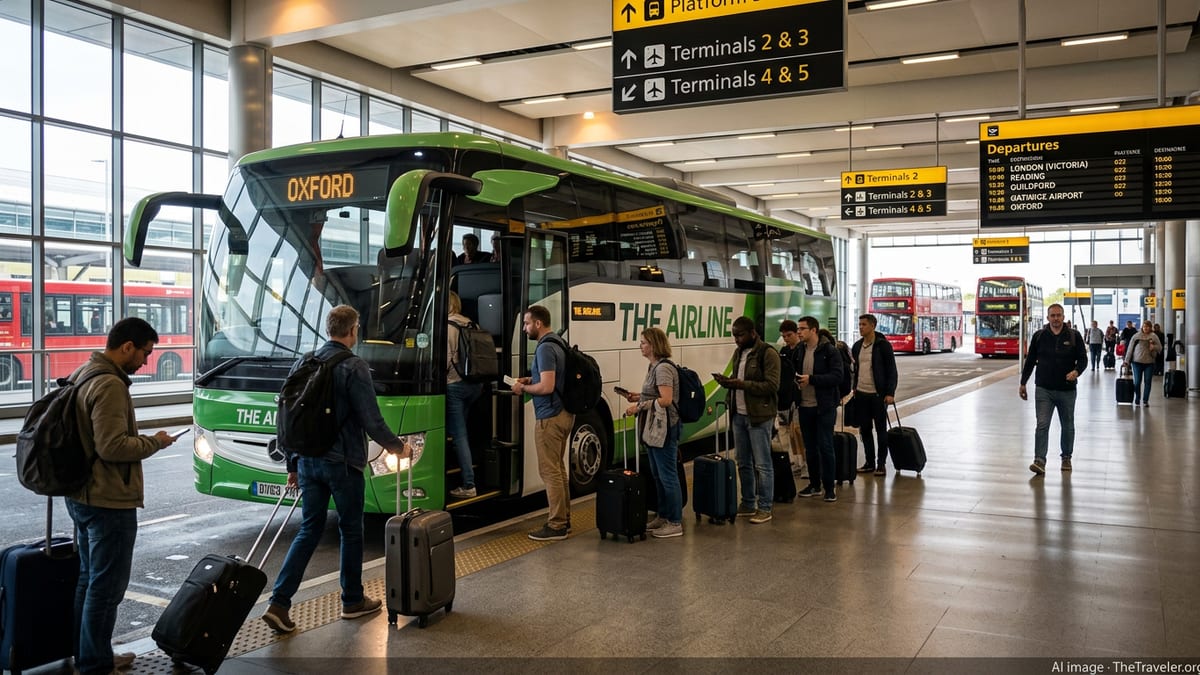
Understanding Heathrow’s Bus & Coach Layout
Before picking a route, it helps to understand how buses are organized at Heathrow. Most services use Heathrow Central Bus Station, a large underground hub between Terminals 2 and 3 that is linked to the terminals by covered pedestrian walkways and lifts. Long distance coaches such as National Express, RailAir services and Oxford bound coaches generally depart from numbered bays here, while local Transport for London buses use separate stands at one end of the concourse.
Terminals 4 and 5 have their own smaller bus stations at ground level, connected to the terminal buildings by short covered walks and signposted lifts. Many long distance services stop at Terminal 5 on the way to or from the Central Bus Station, which is important if you are arriving or departing from that terminal and do not want to change.
In real terms, this means that if you land at Terminal 2 or 3 and need a coach to Oxford, Reading or central London, you will follow the “Buses & Coaches” signs into the Central Bus Station and look for the correct stand number on departure screens. If you land at Terminal 5 and your coach stops there, you simply exit arrivals, follow the bus signs outside, and board at the T5 coach stands without going via Central.
Heathrow also has numerous local London bus routes that call at the airport villages and nearby suburbs rather than central London. For example, routes to Hounslow, Uxbridge, Slough and Kingston all run from stands at Central Bus Station and at individual terminals, which can be useful if you have booked a hotel in west London or near the M4 corridor.
Budget Options to Central London by Bus
If you are trying to get into central London as cheaply as possible, the most economical option in 2026 is usually not a coach but the London Underground’s Piccadilly line or a standard London bus. A Tube ride from Zone 1 to Heathrow costs a flat contactless fare of a little under 6 pounds, with trains every few minutes and journey times of around 50 to 60 minutes into central stops such as Piccadilly Circus or King’s Cross.
The very cheapest bus based option is the night bus N9, which runs between Heathrow and central London during overnight hours. This is a regular London bus rather than a coach, and the fare is the standard London bus fare, paid by contactless or Oyster card. It is particularly useful for late night and early morning arrivals, for example landing at Terminal 3 around 1:00 a.m. and heading to a budget hostel near Trafalgar Square.
During the day, there is no direct local London bus from Heathrow to the West End, so the journey involves a change. A common combination is a local bus from Heathrow to Hammersmith or Shepherd’s Bush, then a second bus into the West End or the City. In practice, this is slow and involves handling your luggage while changing buses on busy streets, so most travelers headed for central London will either pay for the Underground or opt for the Elizabeth line or Heathrow Express trains instead.
Nevertheless, local buses are very useful if you are staying in west London neighborhoods like Hounslow, Hayes or Southall. For example, route 285 runs between Heathrow and Kingston via Feltham, and route 111 links the airport with Hounslow. In those cases you tap in with a contactless card or Oyster, pay the flat London bus fare, and travel time is typically 30 to 50 minutes depending on traffic.
Coach Services from Heathrow to Central London
While trains and the Underground dominate the Heathrow to central London market, there are still coach based options that suit some travelers, particularly those with heavy luggage or those heading to specific points such as London Victoria Coach Station. National Express historically operated frequent services between Heathrow and Victoria, typically via the M4 and central London streets. In recent years many travelers have shifted to rail based options, but seasonal or limited coach journeys can still be available, so it is worth checking timetables if you strongly prefer a coach or are continuing by coach from Victoria to elsewhere in the UK.
Coach journey times from Heathrow to Victoria are highly variable, as they depend on M4 and central London traffic. Off peak the trip can take around 60 to 70 minutes, but in rush hour it can easily stretch to 90 minutes or more. For instance, a mid afternoon coach on a weekday may make fast progress to Hammersmith but then crawl through Kensington and Victoria due to congestion and traffic signals.
Prices for Heathrow to London coach services are often similar to or slightly higher than the cost of a Tube ticket, but remain far cheaper than a metered taxi, which can cost many times more depending on traffic and time of day. Coaches usually offer more generous luggage space than the Underground, which is attractive for long haul passengers with multiple checked bags, strollers or sports equipment.
Another pattern some travelers use is combining a long distance coach with a local London bus. For example, a traveler from Birmingham might arrive at Heathrow on a through coach, then take a local bus or the Underground from the Central Bus Station to a hotel in Earl’s Court or Kensington, avoiding the need to transit through Victoria altogether.
Heathrow to Oxford by Coach
Oxford is one of the most popular destinations reachable directly from Heathrow by bus. Dedicated airport coaches branded for the Oxford route operate frequent services between Heathrow and Oxford city center, serving stops at the Central Bus Station and often Terminal 5. Coaches typically run up to several times per hour at busy times of day, including early morning departures aimed at business travelers and late evening services for those arriving on evening flights.
Typical journey time between Heathrow Central Bus Station and Oxford’s Gloucester Green bus station is around 80 to 90 minutes, although heavy traffic on the M25 or A40 can lengthen this. For example, a coach leaving Heathrow around 5:00 p.m. on a Friday may take closer to 100 minutes due to commuter traffic into west London and outbound traffic toward the Midlands. Services usually display “Oxford” prominently on the front and have luggage bays underneath for large bags.
One way fares for the Heathrow to Oxford coach are commonly in the mid twenties in pounds when bought on the day, with advance purchase and return tickets sometimes offering better value. A typical traveler scenario might be a student arriving from North America with two large suitcases and a carry on. They walk from Terminal 3 to the Central Bus Station, purchase a ticket from the driver or a staffed desk, stash their luggage in the hold, and ride directly to central Oxford without changing at London rail stations.
These coaches are designed for airport passengers, so they usually have onboard Wi Fi, power outlets, and comfortable high back seats. Many also stop at key locations such as Oxford’s Thornhill Park & Ride or other intermediate stops, which can be useful if your accommodation is in the eastern suburbs rather than right in the city center.
Heathrow to Reading, Guildford, Woking and Watford by RailAir and Other Coaches
For towns to the west and south west of London, dedicated coach links often provide a more straightforward route than going into central London by train and back out again. RailAir branded coaches, operated in partnership with main line train companies, connect Heathrow with Reading, Guildford, Woking and Watford. These services are designed to link seamlessly with train services for onward journeys across the South West, South Wales, the South Coast and the Midlands.
The core RailAir route RA1 runs between Reading railway station and Heathrow, stopping at Terminals 2, 3 and 5. As of mid 2020s, coaches typically run at least every 20 to 30 minutes throughout most of the day, with early morning departures starting around 4:00 a.m. from Reading and late evening departures from Heathrow. The journey time is usually around 40 minutes in light traffic, though peak time congestion on the M4 can make it closer to an hour.
Other RailAir routes link Heathrow with Guildford and Woking to the south and with Watford Junction to the north west, again coordinating with national rail timetables. For example, a traveler from Portsmouth might take a train to Guildford, connect directly onto a RailAir coach to Heathrow Terminal 5, and then fly to Europe without ever traveling into central London. Similarly, someone from Birmingham could travel by train to Watford Junction and board a coach from there straight to Heathrow.
Ticketing for RailAir is flexible. You can often buy a combined rail plus coach ticket that covers the entire trip from your origin station to Heathrow. In practical terms, that means buying a single ticket from, say, Bath Spa to Heathrow Bus, which includes the train to Reading and the RailAir coach onward. Families may benefit from group offers in which additional adults and children travel at discounted or zero fares, making the coach transfer significantly cheaper than a taxi for a group of four.
Heathrow Buses to Surrounding Towns and Orbital Routes
Heathrow is also connected by bus and coach to many towns around the outer London and Home Counties belt that are not obvious airport destinations but can be very practical if you are visiting friends or staying in suburban accommodation. Green Line services, for example, run an orbital route around the north and western outskirts of London, linking Heathrow Central Bus Station with places like Watford, St Albans and Harlow without passing through central London.
Regular London bus routes serve nearby centers such as Uxbridge, Hounslow, Slough, Hayes, Harrow and Kingston. For instance, travelers staying at a budget hotel near Hounslow East station often use a short bus ride from Heathrow followed by the Underground into central London, balancing a cheaper hotel with slightly longer travel times. These buses often run every 10 to 15 minutes during the day, with reduced frequencies at night.
For accommodation clustered around the airport itself, such as hotels on Bath Road north of the runways, there is a mixture of free local buses and paid hotel shuttle services. Certain standard Transport for London routes along Bath Road are free within the Heathrow free travel zone, meaning you can ride between some hotels and the terminals without paying a fare when boarding and alighting within that zone. However, this free zone policy has been reviewed over time, so it is sensible to check current information when you travel.
Airport hotel shuttles, often known by brand names specific to Heathrow, link the main terminals with many major chain hotels in the area. These shuttles charge a modest fee per journey and run to fixed timetables, which is helpful if you arrive late at night or with large amounts of luggage and do not want to navigate public bus stops in the dark.
Practical Tips: Tickets, Payment and Luggage
Payment methods vary slightly between local buses and long distance coaches. On London buses serving Heathrow, you cannot pay with cash. Instead, you tap in with a contactless bank card, phone wallet or Oyster card at the reader as you board. There is no need to tap out, and the fare is capped daily and weekly, which is useful if you are staying in London and expect to make several journeys.
On long distance coaches such as National Express, Oxford airport coaches and RailAir services, you can usually purchase tickets online in advance, from ticket machines or desks at Heathrow, or directly from the driver if seats are available. Advance online purchase can offer lower fares and guarantees a seat on busy departures, although in practice many airport coaches have spare capacity outside peak holiday periods. It is common for travelers arriving on long haul flights to buy an open dated or flexible ticket so they can board the next available coach after clearing immigration and collecting luggage.
Luggage allowances on airport coaches are generally generous, with at least one large suitcase and one small case in the hold plus a cabin bag allowed on board. For example, a couple arriving from Asia with two large checked bags each can expect to place all four in the underfloor hold of an Oxford or Reading coach without extra charges in most circumstances. Oversized items such as bicycles, skis or musical instruments may need prior arrangement and may be refused if there is insufficient space.
As for finding the right stop, Heathrow’s terminals are well signed in English with clear pictograms. Color coded signage directs you toward “Buses & Coaches,” and departure screens at the Central Bus Station list services by destination, time and stand number. It is worth allowing an extra 10 to 15 minutes to find your stand if it is your first time at Heathrow or if you are changing terminals before catching a coach.
The Takeaway
Using buses and coaches from Heathrow is a practical, often economical way to reach London and a wide range of nearby cities. For budget focused travelers going into central London, the Underground or a night bus remains the cheapest choice, while those with heavy luggage or a desire for a direct door to city link may prefer coaches to places like Oxford, Reading, Guildford, Woking or Watford.
Realistically, the best option depends on your priorities. A solo backpacker might tap onto a local bus or Tube train for a handful of pounds, accepting a longer ride into town. A family of four heading to Oxford with multiple suitcases will likely find the dedicated airport coach worth the extra cost for its direct routing, luggage space and arrival right in the city center. Business travelers connecting to main line trains in Reading or Woking can use RailAir buses to avoid the need to pass through central London terminals.
Whichever route you choose, planning ahead makes the experience smoother. Check the latest timetables close to your travel date, factor in time for airport formalities and potential motorway traffic, and consider whether pre booking a ticket will save money or give peace of mind. With a little preparation, Heathrow’s bus and coach network can be a straightforward and stress reducing start or finish to your journey.
FAQ
Q1. What is the cheapest bus or coach option from Heathrow to central London?
The lowest cost option that behaves like a bus is usually the night bus N9, which charges the standard London bus fare paid by contactless or Oyster, but it only runs overnight. During the day, coaches to central London are generally more expensive than the Underground but cheaper than taxis.
Q2. How long does the coach from Heathrow to Oxford take?
Typical journey times between Heathrow Central Bus Station and Oxford are around 80 to 90 minutes. At busy times, especially weekday evenings, the trip can take closer to 100 minutes due to motorway and approach road traffic.
Q3. How often do coaches run between Heathrow and Reading?
RailAir services between Reading railway station and Heathrow usually run at least every 20 to 30 minutes for much of the day, with early morning and late evening departures designed to connect with long haul flights. Exact times vary by day and season, so always check a current timetable.
Q4. Can I pay cash on London buses from Heathrow?
No. London buses at Heathrow do not accept cash. You need to pay with a contactless bank card, a mobile payment such as Apple Pay or Google Pay, or an Oyster card when you board.
Q5. Do Heathrow airport coaches have space for large luggage?
Yes. Long distance airport coaches serving destinations such as Oxford, Reading and Guildford are equipped with large underfloor luggage holds. Passengers typically place big suitcases in the hold and take smaller bags on board, which is more comfortable than using standard city buses or trains with limited luggage racks.
Q6. Is it better to pre book my coach ticket before flying to Heathrow?
Pre booking can secure a lower fare and a confirmed seat, which is helpful during peak holiday periods or on early morning departures. However, many travelers with flexible arrival times buy tickets on arrival at Heathrow so they are not tied to a specific coach in case of flight delays or long queues at immigration.
Q7. Which bus should I use for hotels on Bath Road near Heathrow?
Many airport hotels along Bath Road are served either by local Transport for London buses or by dedicated hotel shuttle services. Local buses are usually cheaper and sometimes fall within a free travel zone near the airport, while hotel shuttles typically charge a modest per person fee but drop you closer to the lobby. The best option depends on your hotel’s exact location and your luggage.
Q8. How early should I arrive at Heathrow Central Bus Station before my coach departs?
Arriving 15 to 20 minutes before your scheduled departure is usually enough to find the stand and load your luggage calmly. At very busy times, such as the Friday before a bank holiday, allowing 30 minutes provides extra buffer in case there are queues for boarding or you need to purchase a ticket at the desk.
Q9. Are buses from Heathrow accessible for passengers with reduced mobility?
Most London buses and modern airport coaches serving Heathrow are low floor or have lifts, and offer spaces for wheelchairs or mobility aids. Still, features and space can vary between operators, so if you have specific needs it is wise to contact the coach company in advance to confirm accessibility details for your chosen service.
Q10. What happens if my flight is delayed and I miss my booked coach?
Policies differ by operator. Some coach companies allow you to board the next available service on the same day if there is space, while others require you to change your booking in advance or pay a fee. Flexible tickets usually offer more freedom to travel on a later coach if your flight is delayed.