

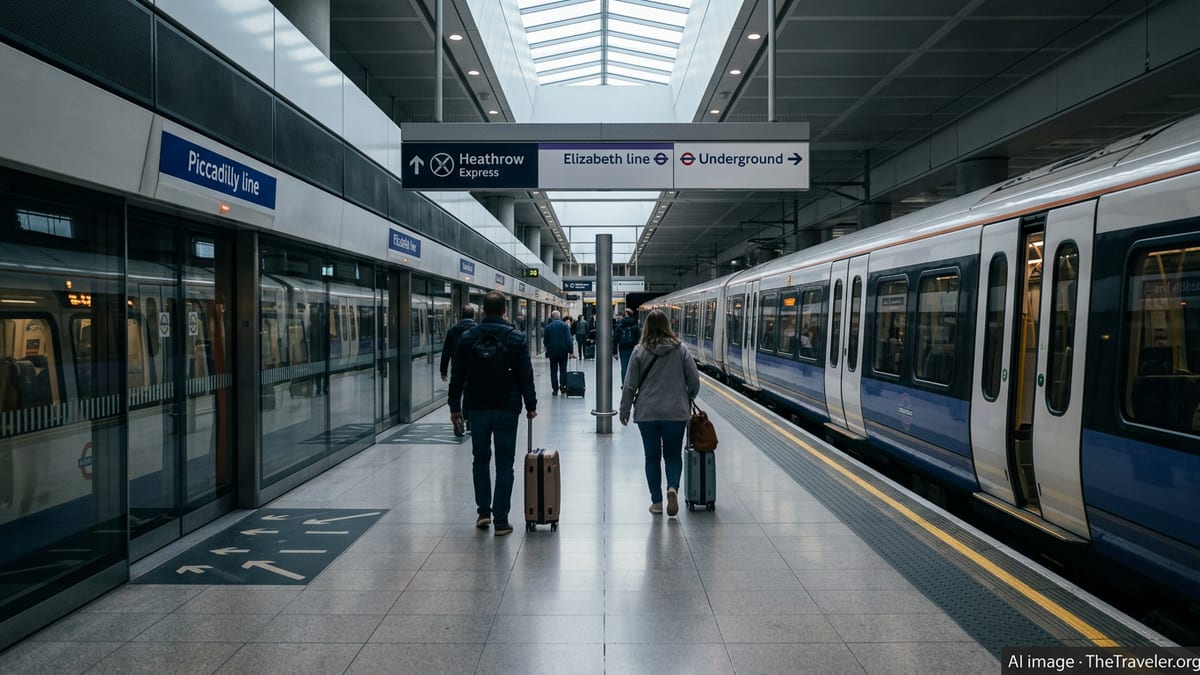
Overview: Your Rail Options from Heathrow in 2026
Heathrow has three main rail options into London: the Heathrow Express, the Elizabeth line, and the London Underground’s Piccadilly line. All three can be reached by following the “Trains” or “Underground” signs from any terminal, and all accept contactless bank cards and Oyster for payment. The key differences come down to journey time, price, and where exactly you want to end up in London.
The Heathrow Express is the premium non-stop train to London Paddington, taking about 15 minutes from Heathrow Central (for Terminals 2 and 3) and around 21 minutes from Terminal 5. It is usually the fastest option, but also by far the most expensive per person. It suits business travelers and anyone who values time and comfort over cost.
The Elizabeth line is the newer purple-branded railway that runs through central London, stopping at key stations such as Paddington, Bond Street, Tottenham Court Road, Farringdon, Liverpool Street, and Canary Wharf. It is slower than the Heathrow Express but still fast and significantly cheaper than the Express, especially if your hotel or apartment is near one of its central stops.
The Piccadilly line on the London Underground is the budget option. It runs directly from Heathrow to central Underground hubs such as Earl’s Court, South Kensington, Green Park, Piccadilly Circus, and King’s Cross St Pancras. It is the slowest of the three but usually costs less than one third of the Elizabeth line fare to Zone 1 and is easily the cheapest rail choice for most visitors on a tight budget.
Heathrow Express: Fastest Route to Paddington
The Heathrow Express is a dedicated airport train linking Heathrow Terminals 2 and 3 and Terminal 5 with London Paddington. Trains run roughly every 15 minutes throughout the day. The journey from Paddington to Heathrow Central is scheduled at about 15 minutes, and to Terminal 5 at about 21 minutes, which makes it the fastest public transport option between the airport and central London rail connections.
Standard one way fares at the station are among the highest airport rail fares in Europe. The latest public price list for 2026 indicates that a flexible standard class single bought on the day can cost in the region of several tens of pounds per person, with Business First even higher. However, advance purchase discounts can lower this substantially. For example, buying an advance single online or via the Heathrow Express app around 30 days before travel can reduce the price to roughly the mid-teens per person off peak, though exact offers vary by time and demand.
In practical terms, the Express is worth considering if you are short on time, arriving late at night for an early meeting, or connecting to long distance trains from Paddington to cities like Bath, Cardiff, or the Cotswolds. A business traveler landing at Terminal 5 at 08:00 on a weekday might reasonably pay the premium for a fast, comfortable, non-stop ride into Paddington, where there are taxi ranks and Underground connections on the Bakerloo, Circle, District, and Elizabeth line platforms.
Families and leisure travelers, especially groups, should crunch the numbers before choosing the Express. A family of four paying walk up fares could easily spend well over one hundred pounds on a single journey from Heathrow to Paddington, whereas the same group using the Piccadilly line might pay under twenty five pounds in total, even at the new 2026 fare levels. If your final destination is not near Paddington, any time saved on the Express may be cancelled out by the need to change trains or take a taxi from Paddington to your hotel.
Elizabeth Line: Direct to the West End, City, and Canary Wharf
The Elizabeth line has quickly become the default choice for many visitors because it combines reasonable speed with through services to the West End, the City of London, and Canary Wharf. Trains from Heathrow Terminals 2 and 3 and Terminal 5 usually run every few minutes at peak times, with journey times of roughly 30 minutes to Paddington, about 35 minutes to Tottenham Court Road, and around 40 to 45 minutes to Liverpool Street and Canary Wharf depending on the stopping pattern.
As of March 2026, Transport for London has introduced higher “special” fares for Heathrow journeys on the Elizabeth line compared with a normal Zone 6 to Zone 1 Underground fare. The published figures indicate that a contactless or Oyster single from Zone 1 to Heathrow on the Elizabeth line now costs in the mid-teens, with widely reported examples quoting about £15.50 for a central London to Heathrow single. That is substantially more than the Piccadilly line, but still noticeably cheaper than the full Heathrow Express fare.
The Elizabeth line is particularly attractive if you are staying in or near Paddington, Bond Street, Tottenham Court Road, Farringdon, Liverpool Street, Whitechapel, Canary Wharf, or further east in areas like Stratford. For instance, a visitor with a hotel near Tottenham Court Road can ride directly from Heathrow Terminal 3 to Tottenham Court Road without changing trains, stepping out close to major shopping streets and the British Museum. Someone working in Canary Wharf can go straight from Terminal 5 to Canary Wharf station, staying on a single train.
Payment is straightforward. There is no need to prebook tickets for typical Heathrow journeys. You simply tap in at the yellow card readers with a contactless bank card, phone wallet, or Oyster card at Heathrow, and tap out at your destination station. The fare is automatically calculated. Daily caps apply to most Elizabeth line travel across London, but Heathrow journeys attract specific supplements that mean a single ride to or from the airport can be similar in price to the full day cap for Zones 1 to 6. In other words, you will not usually save much by trying to “game” the system; it is better to assume you will pay close to the advertised Heathrow supplement whenever you take the line to or from the airport.
Piccadilly Line: Cheapest Rail Option from Heathrow
The Piccadilly line on the London Underground is the workhorse route between Heathrow and central London. All Heathrow stations for the Underground are in Zone 6. Trains run from Heathrow Terminal 2 and 3, Terminal 4, and Terminal 5 into central London, typically every few minutes at busy times. The journey to central London usually takes around 45 to 60 minutes, depending on where you get off and the time of day.
In terms of cost, the Piccadilly line is the clear winner. Recent fare announcements for 2026 indicate that a single from Zone 1 to Heathrow on the Piccadilly line will be just under £6, with official examples quoting £5.90 for a Zone 1 to Heathrow journey using contactless or Oyster. That is roughly one third of the Elizabeth line Heathrow fare and a fraction of the Heathrow Express price. The standard daily cap for travel between Zones 1 and 6 using Oyster or contactless is considerably lower than the Heathrow Express cost, so even combining your airport trip with several Underground rides within central London should keep your total daily spend at a reasonable level.
A concrete example illustrates the saving. Imagine you land at Terminal 3 at midday, take the Piccadilly line to King’s Cross St Pancras, then ride the Underground four more times around Zones 1 and 2 during the afternoon and evening. Your total spend on pay as you go will be limited by the relevant daily cap for Zones 1 to 6. Do the same pattern of travel with the Heathrow Express plus separate Underground fares in central London and you could easily pay double or more.
The main downside of the Piccadilly line is crowding and journey time. At peak commuter times, trains can be very busy, and finding space for large suitcases can be tricky. The older parts of the line also have fewer escalators and lifts than the Elizabeth line, so it can be less comfortable for travelers with mobility issues or heavy luggage. However, for many tourists arriving outside rush hour, it remains a sensible and budget friendly choice.
Terminals, Stations, and How to Find the Right Train
Heathrow has multiple terminals and several different train platforms, which can be confusing if it is your first visit. Terminals 2 and 3 share a central rail and Underground hub known simply as Heathrow Terminals 2 & 3. From here, you can access the Heathrow Express, Elizabeth line, and Piccadilly line platforms via clearly signed walkways. The walk from arrivals to the train area usually takes about 5 to 10 minutes.
Terminal 5 has its own station on both Heathrow Express and the Elizabeth line, as well as an Underground station for the Piccadilly line. When you come through customs into the arrivals hall at Terminal 5, follow the signs for “Trains” for Heathrow Express and Elizabeth line, and “Underground” for the Piccadilly line. The platforms are all within the same general station complex beneath the terminal, reached by escalators and lifts.
Terminal 4 has a separate Underground station on the Piccadilly line and is linked to the rest of the airport by the free Heathrow rail shuttle on the Elizabeth line tracks between Terminal 4 and Heathrow Central (for Terminals 2 and 3). If you need to move between terminals before heading into London, note that transfers between Heathrow stations on the Elizabeth line within the airport zone are free. You tap in and out as normal, but your fare statement will show a zero charge for these airport-only legs.
Inside the terminals, color coding helps. Look for purple for the Elizabeth line, dark blue for the Piccadilly line, and Heathrow Express signage usually using the service’s own branding. Ticket machines and information boards near the station entrances show current fares and approximate journey times. If you are unsure, staff at the station gates can advise you on the fastest or cheapest route to your specific address.
Fares, Contactless Payments, and Daily Caps
For most visitors in 2026, the easiest way to pay for Heathrow trains is with contactless bank cards or mobile wallets. Tap the same card or device at the yellow card readers when you enter and exit the gates. The system automatically calculates the correct fare and adds any Heathrow supplement where relevant. You do not need to buy paper tickets in advance for typical airport to city journeys if you are using public transport.
On the Piccadilly line, a single between Heathrow (Zone 6) and Zone 1 costs in the region of £5 to £6, with recent official examples mentioning £5.90 after the March 2026 fare adjustment. On the Elizabeth line, the same Zone 1 to Heathrow trip attracts a higher “special” fare that takes the total into the mid-teens, around £15.50 from central London to the airport. These Heathrow supplements mean a single ride on the Elizabeth line can be close to or above the normal daily cap for Zones 1 to 6.
The daily cap for Zones 1 to 6 travel with Oyster or contactless is designed to protect regular users from paying more than a certain amount in one day. However, because Heathrow journeys now carry notable supplements, your first trip of the day from Heathrow to central London may use up most of the cap amount, leaving only a small extra charge for subsequent Underground or Elizabeth line rides within London. The important point is that the cap is applied automatically; you do not need to request anything special, but you must always use the same card or device for all your taps that day.
Heathrow Express uses its own fare structure. While you can tap in with contactless at some gates, those charges are handled separately from Transport for London’s caps and pricing. If you choose the Express, treat it as a premium add on that will not be “capped” together with your Tube or Elizabeth line journeys. Travelers who expect to make several inner London trips during their stay often combine a lower cost Piccadilly or Elizabeth line journey from the airport with capped daily travel on the Underground and buses in Zones 1 and 2.
Which Train Should You Choose? Real World Scenarios
With three choices on the table, it helps to consider real world examples to decide what is best for you. Imagine a solo business traveler landing at Heathrow Terminal 5 at 07:30 on a Monday and needing to be near Paddington by 08:30. Here, the Heathrow Express makes sense. The non-stop 21 minute ride into Paddington plus a short walk or taxi could comfortably meet the schedule, and the cost can often be justified as a business expense.
Now consider a couple arriving at Terminal 3 around midday, staying in a hotel near Covent Garden. The Elizabeth line offers a strong balance: they can ride from Heathrow Terminals 2 and 3 to Tottenham Court Road in roughly 35 minutes, then walk or take a short Underground hop to Covent Garden. They avoid changing trains at Paddington and enjoy modern trains with luggage space and step-free access at key stations. The fare is higher than the Piccadilly line but still far lower than the Express.
For a family of four arriving on a Saturday afternoon and staying in an apartment near King’s Cross St Pancras, the Piccadilly line is very likely the best value. They can take a direct Tube from Heathrow Terminals 2 and 3 to King’s Cross St Pancras in about 55 minutes, paying under £6 per adult and less for children with appropriate discounts or free travel for younger kids. Even allowing for a bit of crowding and a longer ride, the total savings compared to four Heathrow Express tickets can easily cover a day of sightseeing costs.
Finally, imagine a traveler catching an early morning train from Paddington to southwest England. If they are leaving central London for Heathrow, an Elizabeth line train from Canary Wharf or Liverpool Street to Heathrow in about 45 minutes might be ideal. If they are heading in the opposite direction, connecting from a late inbound flight at Terminal 5 to an onward Great Western service from Paddington, the Heathrow Express remains the most time efficient link.
The Takeaway
By 2026, Heathrow’s rail options offer a clear set of trade offs. The Heathrow Express delivers unmatched speed and comfort to Paddington, at a premium price. The Elizabeth line offers a strong middle ground, with direct trains to key central and eastern London districts and fares that sit between the Express and the Underground. The Piccadilly line continues to be the solid budget option, connecting the airport to a wide sweep of central London for a modest cost.
If you value every minute and are heading to or from Paddington, the Heathrow Express is hard to beat. If you want a modern, relatively fast train that drops you in the West End, the City, or Canary Wharf without changing, the Elizabeth line is likely your best choice. If you need to keep costs down or are traveling as a family or group, the Piccadilly line will usually save you the most money while still getting you where you need to go.
Whichever option you choose, using contactless or Oyster keeps things simple, and paying attention to station signs in the terminal will make sure you end up on the right platform. Take a moment in arrivals to consider where you are staying, how much luggage you have, and whether your priority is speed, simplicity, or savings. With that in mind, Heathrow’s rail network can be an efficient and even enjoyable start to your time in London.
FAQ
Q1. What is the fastest train from Heathrow to central London?
The Heathrow Express is generally the fastest option, taking about 15 minutes from Heathrow Central and around 21 minutes from Terminal 5 to London Paddington.
Q2. How much does the Elizabeth line cost from Heathrow to central London in 2026?
As of March 2026, a contactless or Oyster single from Zone 1 to Heathrow on the Elizabeth line is typically in the mid-teens per person, with widely cited examples around £15.50.
Q3. How much does the Piccadilly line cost from Heathrow to central London?
On the Piccadilly line, a single between Heathrow in Zone 6 and Zone 1 generally costs just under £6 with contactless or Oyster, with recent official figures of about £5.90.
Q4. Does the daily cap apply if I use the Elizabeth line to or from Heathrow?
Yes, daily caps still apply, but Heathrow journeys on the Elizabeth line include special supplements, so a single trip can use up most of the Zone 1 to 6 cap amount.
Q5. Can I use the same contactless card on Heathrow Express and the Underground?
You can tap in with contactless for Heathrow Express at some gates, but its fares and any charges are separate from Transport for London caps and Underground pricing.
Q6. Which train should I take if I am staying near Covent Garden?
The Elizabeth line to Tottenham Court Road followed by a short walk or quick Underground hop is usually the most convenient balance of speed and simplicity.
Q7. What is the best option for a family on a budget?
The Piccadilly line is usually best for families or groups watching costs, as it offers the lowest per person fare directly from Heathrow into central London.
Q8. Is there step free access from Heathrow terminals to the trains?
Yes, Heathrow terminals have lifts and escalators down to the Heathrow Express, Elizabeth line, and Piccadilly line platforms, making rail travel accessible with luggage.
Q9. Do I need to buy train tickets in advance from Heathrow?
For the Piccadilly line and Elizabeth line, advance purchase is not necessary; you can simply tap in with contactless or Oyster. The Heathrow Express offers advance discounts but does not require advance booking for travel.
Q10. How do I transfer between terminals before taking a train into London?
You can use the free rail shuttle on the Elizabeth line tracks between Terminal 4 and Heathrow Central, or the free transfer between Heathrow Central and Terminal 5, then board your chosen service into London.