

More news on this day
Europe’s biggest hubs are racing into a pivotal 2026, as Heathrow joins Prague, Copenhagen, Aalborg and other airports in a high-stakes contest to abandon legacy infrastructure, scale up green technologies and prove that flying can be faster, cleaner and more passenger-friendly than the old-school terminals travellers love to hate.
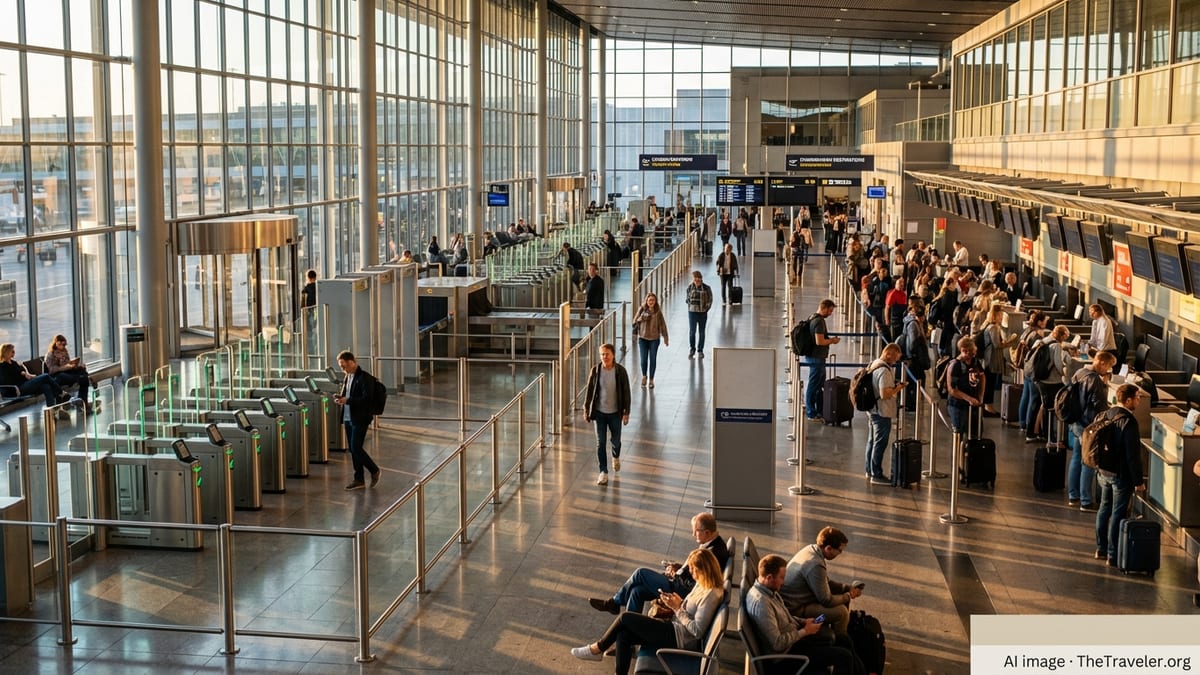
Heathrow Locks In a 2026 Turning Point
London Heathrow, still Europe’s busiest international hub, is preparing for what executives describe as a make-or-break phase in 2026 as it rolls out its latest wave of security upgrades, biometric trials and operational efficiencies ahead of the decade’s mid-point. While much of its long-term capacity growth is tied to regulatory processes, the airport is under intense pressure from carriers and corporate travel buyers to match or beat the service innovations emerging across northern Europe.
Industry analysts say Heathrow’s strategy now hinges less on new runways and more on squeezing smarter performance from existing infrastructure: automated border checks, advanced CT scanners at security, streamlined transfer flows and tighter on-time performance targets. With airlines like British Airways and Virgin Atlantic pushing premium and long-haul products, Heathrow’s competitiveness increasingly rests on how quickly it can turn passengers from curb to gate without adding to congestion or emissions.
The spotlight on 2026 reflects growing concern that if Heathrow’s transformation lags, global carriers could gradually shift growth to rival hubs touting faster processes and greener credentials. That risk is sharpening a zero-tolerance attitude toward “old-school” airport pain points such as queues, opaque disruption handling and carbon-intensive ground operations, which corporate travel managers say are becoming decisive in route and hub selection.
Prague Balances Biometric Ambition With Privacy Backlash
In Prague, the race to redefine flying has taken a different twist. Václav Havel Airport Prague is pressing ahead with an expansion blueprint that includes a new Pier D, extra contact gates, upgraded lounges and an eventual rail link to the city centre by 2030, with key enabling works front-loaded before and around 2026. Airport management has framed the plan as essential to winning more long-haul routes, particularly to North America and East Asia, and cutting transfer times for intra-European passengers.
The airport is also preparing for the EU’s new Entry/Exit System, which will introduce biometric border kiosks and automated checks from 2026. Officials insist these systems will shorten queues and create a more seamless experience between Terminals 1 and 2, positioning Prague as a more attractive Schengen gateway for both leisure and business travellers.
Yet Prague has simultaneously become a test case for the limits of airport surveillance. In late 2025, Czech authorities ordered the shutdown of a police-run facial-recognition camera network at the airport after regulators found it breached data protection and emerging AI rules. That ruling forces Prague to redesign its digital strategy around stricter consent and transparency standards, even as it seeks to compete with hubs that lean heavily on biometrics. For passengers, the tug of war underscores how the next generation of “smart airports” will be judged not only on speed and efficiency, but also on how they handle civil liberties.
Copenhagen Bets on Net-Zero Operations and Smoother Security
Copenhagen Airport, celebrating its centenary with record traffic in 2025, is entering 2026 with a clear pitch: greener, faster and more predictable than traditional hubs. The airport has committed to reaching net-zero emissions from its own operations by 2030, targeting a 90 per cent cut from 2019 levels through electrified ground equipment, renewable power contracts and a switch to bio-based fuels in heavy vehicles.
At the same time, Copenhagen is deep into a multi-year investment programme that is reshaping the passenger journey. A new generation of security lanes equipped with CT scanners is being rolled out, allowing travellers to keep electronics and liquids in their bags while scanners generate detailed 3D images for staff. Early phases of the project opened in 2025, and by 2026 the airport expects most passengers to use the upgraded lanes, reducing bottlenecks and positioning Copenhagen as a benchmark for hassle-free security.
Terminal enhancements, expanded route networks and a focus on transfer passengers are part of a broader strategy to consolidate Copenhagen as northern Europe’s primary hub. For corporate travel planners weighing alternatives to Heathrow and Frankfurt, the mix of climate targets and time-saving technology is becoming a central selling point, especially as companies put decarbonisation and employee wellbeing at the heart of their travel policies.
Aalborg Emerges as a Testbed for Green Flying
Further north, Aalborg Airport is punching above its weight in the 2026 showdown by positioning itself as a national proving ground for low-carbon aviation. In January 2026 the regional hub secured top-tier Airport Carbon Accreditation, achieving Level 3+ status and reaching carbon neutrality for its own operations. Airport leadership has linked that milestone to a wider roadmap that includes net-zero operations by 2030 and full climate neutrality, including air traffic, by mid-century.
Aalborg’s role is set to grow from March 2026, when Denmark’s first dedicated “green domestic route” connecting Aalborg and Copenhagen is due to start operating with a minimum 40 per cent blend of sustainable aviation fuel. The project, backed by the Danish government and industry partners, is intended as a template for scaling up SAF use across the country’s domestic network and, eventually, on key international routes.
Beyond fuel, Aalborg is rolling out a series of practical initiatives that directly change the on-the-ground experience: extensive LED lighting upgrades across terminals, aprons and runways, expanded charging infrastructure for electric vehicles in car parks and taxi ranks, and a plan to transition ground service equipment to all-electric where technically feasible. Combined with route expansions, including seasonal links to Scandinavian ski resorts through early 2026, the airport is increasingly marketed as a “living lab” where travellers can see the future of aviation unfold on everyday flights.
A High-Stakes Contest to Redefine the Hub Model
Taken together, the moves at Heathrow, Prague, Copenhagen and Aalborg highlight a sharper competitive landscape in which airports are no longer judged simply on size or retail options, but on how credibly they can reinvent the fundamentals of flying. Operational efficiency, digital border systems, on-time performance and climate impact are converging into a single value proposition for airlines and passengers alike.
For corporate travel buyers and frequent flyers, the 2026 milestone is emerging as an informal scorecard year. Airports that can demonstrate measurable gains in curb-to-gate times, transparent data governance and concrete emissions cuts are likely to win new routes and transfer traffic, while laggards risk being labelled as relics of an era when queues, paper processes and unchecked pollution were accepted costs of global mobility.
The race is far from settled. Heathrow’s scale gives it unmatched connectivity but leaves little margin for missteps, Prague must reconcile privacy rulings with its biometric ambitions, Copenhagen is navigating record growth while overhauling core systems, and Aalborg is betting that early leadership in sustainable fuel and carbon-neutral operations will pay off in influence far beyond its immediate catchment. What is clear is that by the end of 2026, travellers will have a clearer view of which European hubs are truly breaking with the old-school airport model and which are still talking about transformation more than delivering it.