

More news on this day
Hundreds of travellers were stranded at London Heathrow Airport on Monday as 228 flights were delayed and 48 were canceled, triggering a fresh wave of disruption for European carriers and passengers flying between London, Oslo, Paris and other major hubs.
Stormy Skies Over Europe Create New Heathrow Flashpoint
The latest wave of disruption at Heathrow comes at the tail end of an already turbulent week for European air travel, marked by winter storms, low visibility and knock-on operational issues across the continent. Live operations data on Monday showed Heathrow bearing the brunt of delays and cancellations, with dozens of inbound and outbound services backed up on the tarmac or held at origin airports.
While London’s primary gateway is no stranger to congestion, the sheer scale of Monday’s disruption stood out. The combination of 228 delayed flights and 48 outright cancellations effectively stalled a substantial portion of the airport’s short and medium haul schedule, forcing airlines to juggle aircraft and crews and leaving travellers facing hours of uncertainty in crowded terminals.
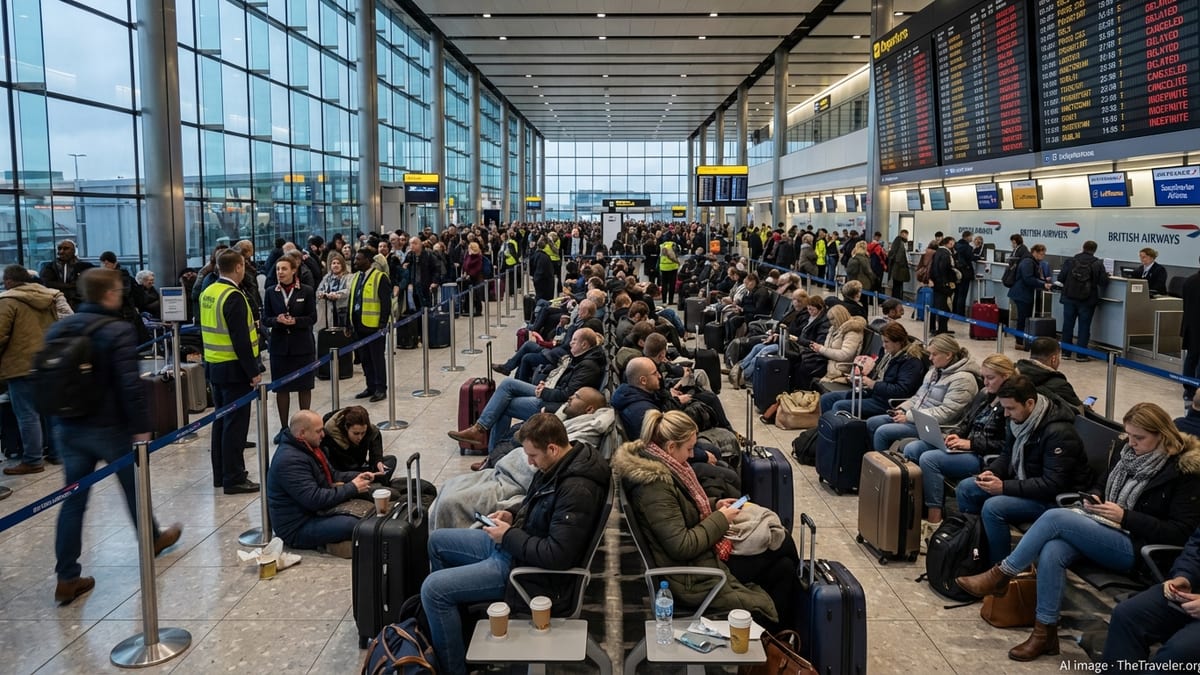
Passenger frustration was palpable in departure halls where flight information screens flicked constantly between “delayed,” “gate closed” and “cancelled” notices. Queues snaked past check in islands and out into public concourses as passengers sought rebooking options, meal vouchers and somewhere simply to sit and wait.
Flagship European Carriers Struggle to Maintain Schedules
The worst of the disruption fell on a roster of major European airlines that rely heavily on Heathrow and other north European hubs for business and leisure traffic. Services operated by Air France, Lufthansa, Finnair, KLM and Swiss all reported multiple delays and cancellations, compounding wider pressures already felt across their networks in recent days.
For Air France, a run of weather related restrictions in Paris in the past week, combined with Monday’s issues in London, meant that several Heathrow Charles de Gaulle rotations were heavily delayed or consolidated. Lufthansa, which had already been managing delays at Frankfurt and Munich amid winter conditions, saw several London bound and London originating services canceled or pushed back by several hours.
Finnair, KLM and Swiss each faced their own operational headaches as aircraft and crew went out of position. Short haul services that normally enable tight connections through hubs in Helsinki, Amsterdam and Zurich instead arrived late into London, creating a domino effect that disrupted onward journeys to Scandinavia, southern Europe and beyond.
Ripple Effects Felt in Oslo, Paris and Key European Hubs
Although Heathrow was the focal point of Monday’s disruption, the effects were quickly felt in Oslo, Paris and other key airports across northern and western Europe. Airlines adjusted schedules at Oslo Gardermoen and Paris Charles de Gaulle as they attempted to absorb missed connections and reposition aircraft that had been delayed or grounded in London.
In Oslo, services operated by SAS, KLM, British Airways and Air France had already been under strain in recent days due to snow showers, low cloud and congested airspace. Monday’s Heathrow related delays compounded that pressure, adding further hold ups to departures bound for the United Kingdom and continental Europe and leaving passengers facing longer connection times and missed meetings.
Paris, which has contended with its own weather related cuts to capacity over the past week, saw additional knock on delays and a handful of cancellations as aircraft scheduled to operate London links failed to arrive on time. The combined effect reinforced how closely interlinked Europe’s hub airports have become, with a bad day in London quickly translating into a challenging day in Oslo, Paris, Amsterdam, Frankfurt and Brussels.
Passengers Face Long Queues, Uncertain Timelines and Mixed Communication
Inside Heathrow’s terminals, scenes were reminiscent of other recent European travel meltdowns, with long lines at airline service desks and passengers sprawled on the floor near power sockets and check in zones. Many travellers reported waiting hours to speak to airline agents, particularly at peak morning and late afternoon periods when disruption was most intense.
Some passengers with connecting itineraries via Oslo and Paris described being rebooked multiple times as airlines struggled to find available seats to key business and leisure destinations. Others opted to abandon flights altogether in favor of rail links or overnight stays in London, wary that further delays could leave them stranded late into the evening.
Communication remained a major source of frustration. While most airlines pushed updates through mobile apps and email alerts, inconsistent information between gate screens, websites and call centers left some passengers unsure whether to remain airside, return to check in or attempt to rebook independently. Ground staff did their best to explain the situation, but the scale of disruption stretched resources thin.
Operational Pressures Expose Thin Margins in Winter Schedules
The latest Heathrow disruption highlights how vulnerable European air travel remains to a mix of adverse weather and operational bottlenecks, especially during the winter season. Airlines operate to tightly calibrated schedules and staffing plans in January and February, often with less spare capacity than in peak summer months. When storms or low visibility force air traffic control restrictions or extended de icing, even small delays can quickly escalate.
Industry analysts note that Europe’s major hubs have spent recent years rebuilding capacity after the pandemic, but that staffing and infrastructure still lag behind demand at certain pinch points. Ground handling teams, air traffic controllers and maintenance crews are all working harder in winter conditions, and any breakdowns or shortages can readily cascade across multiple airports and carriers.
At Heathrow, where runway capacity is among the tightest in Europe, even temporary throughput reductions can leave dozens of aircraft waiting for departure slots. Once delays reach several hours, airlines often cancel flights altogether to avoid further congestion later in the day, focusing on preserving long haul services and key business routes instead.
Airlines Race to Recover Networks and Protect Long Haul Operations
As the disruption unfolded, airlines moved quickly to protect their most strategically important services. Long haul flights to North America, Asia and the Middle East from London, Paris and other European hubs were prioritized for available aircraft and crews, in some cases at the expense of shorter intra European segments that were more easily rebooked.
Carriers such as Air France, Lufthansa, Finnair, KLM and Swiss began issuing travel waivers for affected routes, allowing passengers to shift travel dates or reroute via alternative hubs without additional change fees. Where possible, airlines also upgauged certain flights to larger aircraft to accommodate stranded travellers, though capacity remained tight on many popular corridors.
Despite these efforts, operational recovery is expected to take at least another full day. Aircraft and crews remain out of position as they work their way back into regular rotations, and analysts warn that flight punctuality across Europe is likely to remain fragile while winter weather and residual backlogs persist.
Advice for Travellers Navigating the Disruptions
For travellers due to fly into or out of Heathrow, Oslo, Paris and other affected hubs over the next 24 to 48 hours, airlines and airports are urging a cautious and well informed approach. Passengers are advised to check flight status frequently using official airline channels before leaving for the airport, and to allow extra time for check in, security and potential last minute gate changes.
Those with tight connections, particularly on itineraries linking London to Oslo or Paris for onward long haul flights, are being encouraged to consider voluntary rebooking where possible. Travel agents report that some customers are opting to switch to earlier departures or alternative routings through less congested hubs to reduce the risk of misconnected journeys.
Consumer groups remind passengers that European regulations may entitle them to care, assistance and in some cases compensation, depending on the cause of the disruption and the specific circumstances of each flight. Even where compensation is not guaranteed, airlines typically provide meal vouchers, hotel accommodation and rebooking options when delays and cancellations extend late into the day.
Heathrow and European Hubs Under Pressure to Demonstrate Resilience
The latest crisis adds to mounting scrutiny on how major European airports manage severe weather, staffing gaps and system strain at busy periods. Heathrow in particular has faced criticism in the past for being slow to recover from major incidents, and Monday’s disruption is likely to prompt further questions about resilience and contingency planning.
Airport executives and airline partners are expected to review the handling of the latest episode, examining how early weather forecasts and air traffic control restrictions were communicated, and whether more pre emptive cancellations might have reduced on the day chaos for passengers. Similar reviews are expected at Oslo and Paris, where the knock on effects highlighted the importance of coordinated planning across borders.
For now, travellers and the aviation industry alike will be hoping that the coming days bring calmer skies and smoother operations. But with winter still in full force across northern Europe, and schedules already stretched, Monday’s Heathrow crisis serves as a stark reminder of how quickly the continent’s interconnected air travel system can seize up when conditions turn against it.