

More news on this day
Thousands of passengers were stranded at London Heathrow Airport on March 5 as at least 47 flights operated by British Airways, Emirates, Qatar Airways, El Al and Etihad on core Middle East and Eastern Mediterranean routes were cancelled, with many more delayed amid continuing airspace closures and operational disruption across the region.
Heathrow Becomes Flashpoint in Europe’s Wider Flight Disruption
Operational data from European aviation analysts on Thursday showed London Heathrow among the hardest-hit airports in a fresh wave of cancellations and delays rippling across the continent. England, France, Germany, the Netherlands and Switzerland together recorded more than 200 cancellations and hundreds of delays, with Heathrow alone logging 43 cancellations and 113 delayed services across its schedule.
While low-cost carriers and European flag airlines contributed to the overall total, flights touching the Middle East and Eastern Mediterranean emerged as a particular weak point. Routes linking Heathrow with Dubai, Abu Dhabi, Doha, Tel Aviv and other regional hubs saw disproportionate disruption, reflecting the knock-on impact of ongoing airspace restrictions following recent military escalation in the region.
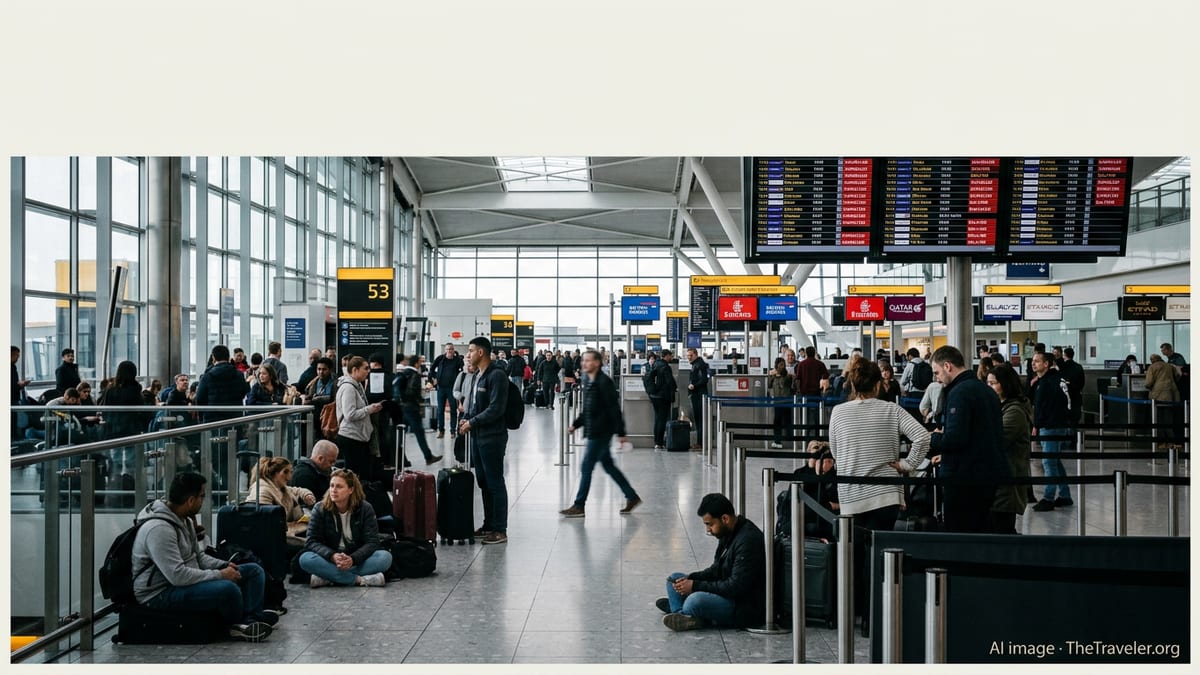
By mid-afternoon, airport departure boards in Heathrow’s Terminals 3 and 5 showed long lines of red “cancelled” and “delayed” notices next to services operated by British Airways, Emirates, Qatar Airways, El Al and Etihad Airways. Aviation data providers said at least 47 cancellations could be directly tied to schedules involving these five carriers at Heathrow and other major London airports, with further changes likely into the evening.
Passengers reported lengthy queues at airline service desks, packed seating areas around departure gates and a shortage of same-day alternatives on long-haul routes as carriers struggled to reconfigure their networks in real time.
Middle East Airspace Closures Ripple Into London
The latest Heathrow disruption stems largely from the rolling impact of airspace closures across parts of the Middle East since late February, after strikes and escalating regional tensions prompted authorities in several countries to shut or heavily restrict key flight corridors. That forced airlines to either suspend operations entirely on some routes or accept long diversions that complicated crew and aircraft rotations.
Core hubs in Dubai, Abu Dhabi, Doha and Tel Aviv have each faced periods of curtailed operations in recent days, prompting thousands of cancellations and delays as long-haul carriers sought to protect safety while preserving what elements of their networks they could still operate. London, as a major gateway for traffic between Europe and these hubs, has become one of the most visible points where those decisions play out for travelers.
British Airways has already trimmed or suspended services from Heathrow to destinations such as Tel Aviv and Bahrain as a precaution, while allowing passengers booked through mid-March on Middle East routes to rebook travel dates without a change fee. Emirates and Etihad, both heavily dependent on flows through their Gulf hubs, have in recent days moved between complete suspension and limited operations on selected city pairs while advising travelers to check status frequently.
Qatar Airways has similarly warned that flights connecting through Doha remain subject to late changes, even as it begins to operate a handful of relief services on specific routes. El Al, Israel’s flag carrier, has continued to adjust its Heathrow schedule based on evolving security and airspace guidance around Tel Aviv, with some flights consolidated or cancelled at short notice.
Passengers Face Long Queues, Patchy Information and Scarce Alternatives
For travelers on the ground at Heathrow on Thursday, the broader geopolitical context mattered less than immediate questions about where they would sleep, how quickly they could be rebooked and whether they were entitled to compensation. Social media posts and passenger reports described crowded scenes in the check-in halls and at transfer desks, with some customers queueing for several hours to speak with airline agents.
Many long-haul passengers connecting through Heathrow from North America and Europe to the Gulf and beyond found themselves stranded midway through their journeys, with limited rerouting options as multiple carriers cut back on frequencies simultaneously. Some travelers reported being offered hotel accommodation and meal vouchers; others said they were told to self-arrange overnight stays and claim reimbursement later.
Travel rights advocates noted that under UK and EU regulations, passengers departing from Heathrow on any carrier, or flying into Heathrow on a UK or EU airline, are entitled to certain forms of assistance in the event of long delays or cancellations, including refreshments and, when necessary, overnight accommodation. However, eligibility for fixed cash compensation can be more complex when disruptions are linked to security situations or government-imposed airspace closures considered beyond an airline’s control.
With phone lines jammed and call centre waiting times stretching into hours, many stranded passengers turned to airline apps and online rebooking tools, although high demand meant that spare seats on alternative services were quickly snapped up. Some travelers opted to abandon long-planned trips entirely, seeking refunds instead of later departures.
Airlines Rework Schedules as Disruption Threatens to Extend
Behind the scenes, carriers most exposed to the Middle East corridor are engaged in constant operational triage, balancing safety considerations, regulatory constraints and commercial pressures. Emirates and Etihad have been publishing rolling updates on their curtailed schedules, repeatedly stressing that all flights remain subject to last-minute change while airspace restrictions remain in force.
Qatar Airways, which routes virtually all of its long-haul traffic through Doha, has issued a broad travel waiver for affected dates and encouraged travelers to postpone trips or reroute where feasible. El Al has focused on adjusting frequencies and consolidating services to major European gateways, including London Heathrow, to maintain a minimum level of connectivity while avoiding positioning aircraft and crews into uncertain airspace conditions.
British Airways, meanwhile, continues to re-time or reroute certain services to the Gulf and Eastern Mediterranean region, sometimes deploying larger aircraft on surviving flights to accommodate rebooked passengers whose original departures were cancelled. Industry analysts said that even if the immediate security crisis abates quickly, airlines are likely to spend days, if not weeks, unsnarling displaced aircraft, crews and passengers.
Slot constraints at Heathrow add another layer of complexity. With limited ability to add extra services at short notice, airlines must often choose between cancelling future flights to free up capacity for stranded travelers or asking customers to accept long delays and connections through secondary hubs elsewhere in Europe.
What Travelers Should Do If Their Heathrow Flight Is Affected
With disruption still unfolding, travel experts are urging passengers due to fly through Heathrow on British Airways, Emirates, Qatar Airways, El Al or Etihad in the coming days to take a proactive approach. That means monitoring flight status repeatedly in the 24 hours before departure, rather than assuming a green “on time” label will remain unchanged.
Passengers on affected routes are advised to log in to their booking profiles or airline apps as soon as an alert appears, since digital channels often present rebooking or refund options more quickly than overburdened call centres and airport counters. Those booked on critical journeys, such as business trips or family events, may also wish to explore alternative routings via less affected European hubs, even if that involves additional stops.
Travel insurance policies vary widely, but some comprehensive plans, including “cancel for any reason” upgrades, may provide broader flexibility for those who decide not to travel into or through regions linked to the current crisis. Policyholders are encouraged to read the fine print and contact insurers promptly to clarify coverage before making major changes.
For now, Heathrow remains operational, but the day’s 47 cancellations tied to British Airways, Emirates, Qatar Airways, El Al and Etihad on key Middle East and regional routes underscore how quickly geopolitical shocks can reverberate through global aviation. With airspace decisions still shifting and airlines adjusting timetables on a rolling basis, travelers are being warned to expect continued uncertainty in the days ahead.