

More news on this day
Hundreds of passengers were left stranded at London Heathrow Airport on March 5 as at least 47 flights operated by British Airways, Emirates, Qatar Airways, El Al and Etihad were cancelled, with many more delayed, amid continued Middle East airspace closures that are rippling across European hubs.
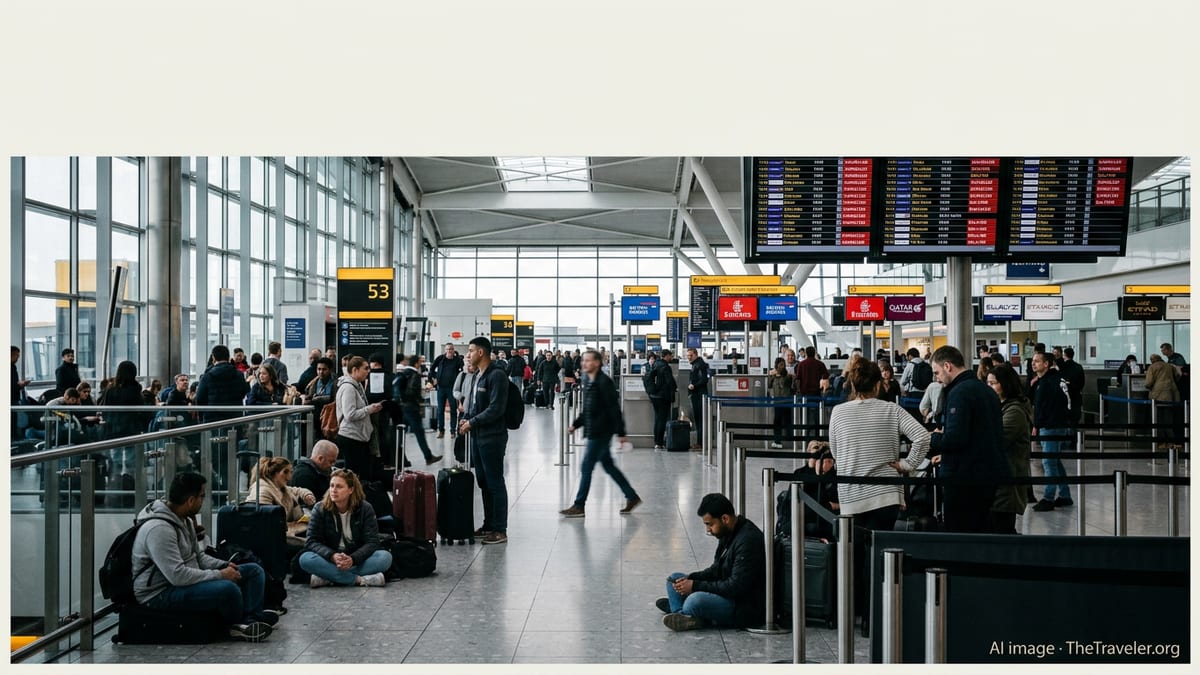
Heathrow Hit Hard as Middle East Conflict Disrupts Schedules
Operational data for Thursday shows London Heathrow recording 43 cancellations and 113 delays overall, placing it among Europe’s most affected airports as carriers struggle to route around closed airspace over Iran, Israel, Iraq, Qatar, Kuwait, Bahrain and parts of the wider Gulf region. Although disruption is spread across multiple airlines, long haul services linking Heathrow with Dubai, Abu Dhabi, Doha and Tel Aviv have borne the brunt.
Industry analytics used by passenger rights groups indicate that of the cancellations and long delays logged at Heathrow, at least 47 involved services operated by British Airways, Emirates, Qatar Airways, El Al and Etihad. Many of these flights were either bound for, or arriving from, Middle Eastern hubs where operations remain significantly curtailed after last week’s escalation in the Iran conflict.
Passengers reported crowded departure halls and growing queues at transfer desks as rolling cancellations were posted on departure boards throughout the morning and early afternoon. Several travelers said they had already been rebooked multiple times in recent days as schedules in Dubai, Doha and Abu Dhabi shifted, only to face fresh disruption when arriving in London.
Gulf Giants Slash London Services as Airspace Stays Shut
Emirates and Etihad, based in Dubai and Abu Dhabi respectively, have cut deep into their London schedules after authorities in the United Arab Emirates implemented a temporary shutdown of most traffic and then moved to a limited restart. Data compiled on March 5 shows Emirates canceling more than thirty services across Europe, including multiple Heathrow rotations, as it concentrates scarce slots on evacuation and essential connections via its Dubai hub.
Etihad continues to suspend all regular flights to and from Abu Dhabi until at least the morning of March 6, forcing the cancellation of its daily Heathrow services and leaving passengers to seek space on other carriers or wait for operations to resume. The airline has urged travelers not to proceed to the airport unless they have received confirmation that their flight is operating and has highlighted flexible rebooking and refund options.
Qatar Airways, which has paused most services to and from Doha during the worst of the airspace closures, is operating only a skeleton schedule into Europe. Limited Heathrow arrivals and departures are scheduled, but several of Thursday’s London rotations were cancelled, creating gaps in the complex web of one-stop connections that normally funnel passengers between Asia, Africa and Europe through Qatar’s capital.
British Airways and El Al Trim Routes Amid Security Concerns
British Airways has already halted its direct services to Tel Aviv and Bahrain earlier this week and is now facing additional tactical cancellations as it reroutes flights that would typically overfly the most affected Middle Eastern corridors. On March 5, the flag carrier accounted for a significant share of Heathrow’s cancellations and delays, including several long haul departures that required flight crew and aircraft to be reallocated at short notice.
El Al’s London operations, normally focused on the busy Tel Aviv route, remain sharply reduced as Israel’s airspace has been repeatedly closed and reopened for limited windows since late February. At least one El Al service into Heathrow was cancelled on Thursday, with other flights subject to extended ground holds while operators coordinated revised routings and security clearances.
Aviation analysts say the combination of outright airspace closures and longer diversion routes is straining crew scheduling rules and aircraft rotations across European networks. Even flights that are ultimately able to operate are often leaving hours behind schedule, which in turn disrupts onward connections and creates additional pressure at congested hubs such as Heathrow.
Knock On Effects Across Europe Compound Passenger Frustration
The problems at Heathrow formed part of a broader wave of disruption across Europe, where more than a thousand flights were either cancelled or delayed on March 5 at major airports including London City, Gatwick, Amsterdam Schiphol, Paris Charles de Gaulle, Zurich, Frankfurt and Munich. Gulf carriers Emirates, Etihad and Qatar Airways, together with European partners such as British Airways, Air France, KLM and Swiss, all reported significant operational impacts.
With Dubai, Doha and Abu Dhabi still operating well below normal capacity, airlines are forced to cancel full rotations rather than risk aircraft and crew becoming stranded outside their home bases. This has led to clusters of cancellations on high frequency routes such as London to Dubai and London to Doha, where passengers are being consolidated onto a smaller number of services or rerouted via alternative hubs in Europe and North America.
Travel industry observers note that the sheer scale of the disruption leaves limited slack in the system to absorb displaced passengers. Hotels near Heathrow and other major hubs reported an uptick in last minute bookings as travelers were issued meal and accommodation vouchers under European air passenger protection rules or turned to their travel insurance to cover extra nights.
Airlines Offer Waivers but Warn of Continuing Disruption
As the crisis extends into a second week, airlines have rolled out a patchwork of flexible booking policies in an effort to ease passenger anxiety. British Airways is allowing affected customers due to fly between London Heathrow and a range of Middle Eastern destinations to change their travel dates at no additional charge within a defined window, while Emirates, Qatar Airways, Etihad and El Al have each introduced rebooking or refund options for journeys scheduled during the period of airspace closures.
Despite these measures, many travelers are finding it difficult to secure suitable alternatives due to the limited number of available seats and the ongoing uncertainty around when normal traffic patterns will resume. Some passengers reported being offered routings that add twelve hours or more to their journeys, often involving multiple stops and overnight layovers far from their original path.
Airport and airline officials have urged passengers with upcoming flights involving Heathrow and any Middle Eastern connection point to monitor their booking status closely, use official apps and customer service channels, and consider postponing non essential journeys. With airspace restrictions still in place and military tensions in the region unresolved, there is little expectation among industry experts that operations at London Heathrow will return to a stable schedule in the coming days.