

More news on this day
Days of flight disruption centered on London Heathrow have cascaded across Europe, leaving passengers stranded in hubs from Paris to Frankfurt as airlines scramble to reset schedules after a fresh bout of operational chaos.
Get the latest news straight to your inbox!
Fresh Turmoil at Europe’s Busiest Hub
Recent data from flight-tracking and travel-industry reports for early April 2026 point to Heathrow as one of Europe’s most affected airports for delays and cancellations, compounding an already fragile spring travel season. On April 6 alone, published disruption tallies show Heathrow recording more than one hundred delayed departures and a cluster of cancellations, placing it among England’s hardest-hit hubs.
The disruption has not occurred in isolation. A pan-European cyber incident affecting aviation software from April 4 onward triggered widespread IT slowdowns at airports across the continent, according to specialist travel and visa advisories. Heathrow, already operating at near-capacity under normal conditions, has struggled to absorb schedule changes and aircraft rotations as systems reverted to manual processes.
Coverage in financial and business outlets also highlights the continuing impact of last year’s power-related shutdown at Heathrow, which led to a full-day suspension of operations and the cancellation of more than a thousand flights. Analysis suggests that the airport, its airline partners and investors are still contending with the operational and financial aftershocks of that episode, even as new shocks emerge in 2026.
Publicly available performance dashboards and airline advisories indicate that the result for travelers has been a series of rolling delays on both short-haul and long-haul services, with late-arriving aircraft disrupting subsequent rotations and pushing congestion into peak periods.
Knock-On Strain Across Continental Europe
The chaos at Heathrow has quickly spilled into other major European gateways, where missed connections and diverted aircraft have produced secondary waves of delay. Travel analysis for April 4 to 7 shows that Paris Charles de Gaulle, Frankfurt, Copenhagen and other hubs reported surges in late and cancelled flights as carriers attempted to re-route passengers who would ordinarily travel via London.
According to published coverage of the April cyber incident, airport ground systems handling check in, baggage and departure control were among those affected in several countries. While air traffic control and navigation remained intact, the slowdown on the ground translated into lengthier turnaround times, keeping aircraft out of position and generating further disruption for flights that never touched Heathrow itself.
European consumer-rights platforms that monitor air travel disruption report that hundreds of flights across the region were delayed or cancelled on April 6, with more than 1,600 services affected across key hubs. Many of the worst bottlenecks were concentrated on routes linking the United Kingdom with continental cities, where Heathrow functions as both an origin point and a vital transfer node.
Rail disruption in and around London over the Easter period has added further complexity. Engineering work on the West Coast Main Line and interruptions to Elizabeth line services limited some passengers’ ability to reach Heathrow, leading to missed departures even where flights operated close to schedule.
Passengers Stranded from Athens to Zurich
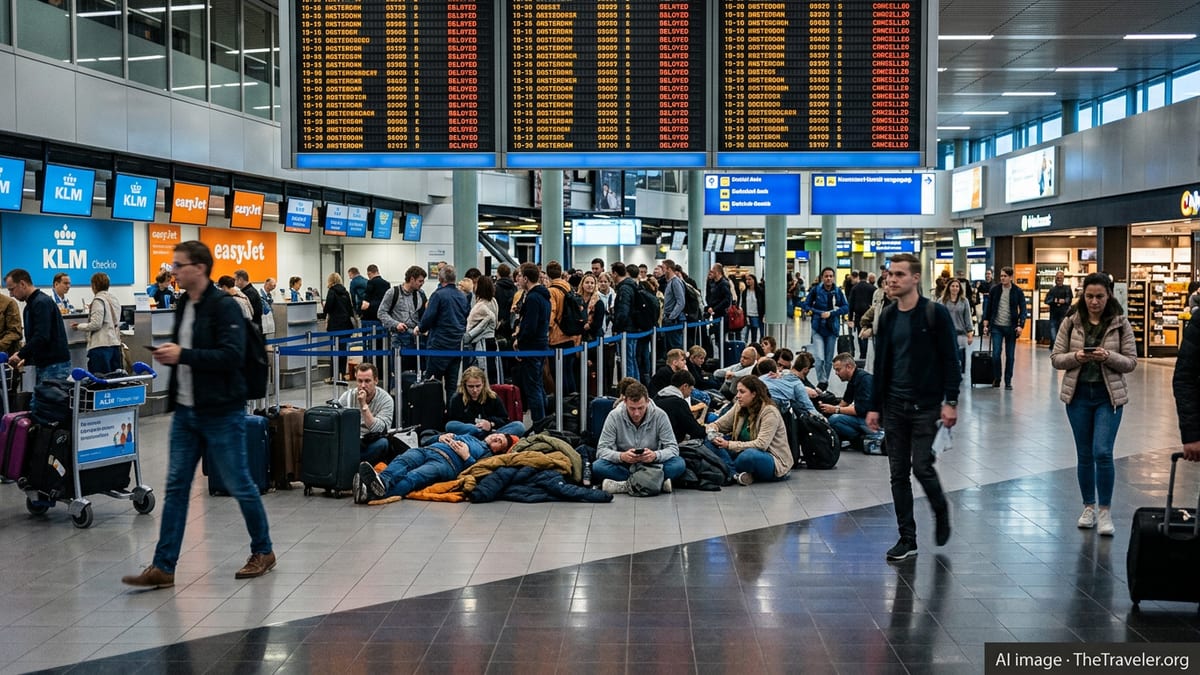
For travelers, the combined effect of cyber-related disruption, residual operational fragility and infrastructure constraints has been acute. Social media posts and local-language news coverage describe passengers stuck overnight at airports including Paris, Frankfurt, Amsterdam and Zurich after missed connections from Heathrow-bound flights left them without onward options.
In several cases reported by European travel outlets, passengers heading to Scotland, Ireland and northern England via London instead found themselves marooned in cities such as Athens or Milan, awaiting scarce seats on alternative routings. During previous Heathrow shutdowns, some travelers were diverted as far as Shannon or Goose Bay when transatlantic flights could not land in London, and analysts warn that similar patterns are re-emerging whenever major disruption hits the hub.
Travel-insurance briefings and consumer advisories note that knock-on disruption has been especially severe for those traveling on separate tickets, who are not automatically reprotected by airlines when an inbound delay causes them to miss a subsequent flight. With seats tight across the network in early April, rebooking has often meant long waits, overnight stays and improvised surface journeys across borders.
Visa and immigration policies have also come into play. Some stranded travelers connecting through non-Schengen hubs have needed emergency assistance to navigate entry rules, while others have faced challenges securing accommodation when events or trade fairs are filling local hotels, according to reports from regional tourism and hospitality media.
Airlines, Airports and Regulators Under Scrutiny
The latest Heathrow disruption has renewed scrutiny of the resilience of Europe’s aviation infrastructure. A detailed independent review commissioned after the 2025 power-outage shutdown concluded that weaknesses in contingency planning, power redundancy and crisis communication contributed to that meltdown. Industry commentators now question how much of that resilience agenda has been implemented in time to mitigate 2026’s rolling problems.
Financial reporting from European markets this week links share-price pressure on several major carriers to the latest Heathrow-related disruptions, as investors weigh both immediate revenue losses and the potential for higher compensation and support costs. Aviation consultants point out that repeated high-impact events can erode traveler confidence, especially among corporate clients who rely on tightly timed connections.
Legal analysis published by passenger-rights organizations emphasizes that the classification of cyber incidents and external IT failures as extraordinary circumstances under European compensation rules leaves many travelers without cash redress, even when they experience long delays or overnight stranding. At the same time, airlines remain responsible for basic care obligations such as meals and accommodation, increasing cost pressures during multi-day disruptions.
Airlines have responded with a mix of schedule trims, extended minimum connection times and temporary capacity shifts to secondary hubs. Some carriers have encouraged passengers to rebook away from Heathrow where possible, steering them through alternative airports including Gatwick, Manchester, Amsterdam and Madrid while operations stabilize.
What Travelers Can Expect in the Coming Days
Forward schedules and advisory notices for the week beginning April 7 suggest that the worst of the immediate chaos may be easing, but that disruption will continue to ripple through networks for several days. Aircraft and crews remain out of optimal position, and some airlines have proactively cancelled flights in order to create buffers in their schedules.
European travel news outlets are advising passengers transiting Heathrow to treat schedules as fluid, arrive early and maintain close contact with their airlines through official channels. Many carriers have temporarily relaxed change fees for affected routes, enabling passengers to switch flights or reroute without penalty, subject to availability.
Industry analysts caution that Heathrow’s central role in European and global connectivity means that even modest disruption there can quickly translate into far-reaching travel havoc. With broader geopolitical tensions, evolving cyber risks and seasonal weather events all feeding into an already complex operating environment, the airport and its partners face sustained pressure to demonstrate that lessons from recent crises have been learned.
For now, passengers across Europe continue to bear the brunt of Heathrow’s latest bout of instability, navigating queues, diversions and unexpected stopovers as the aviation system works to recover its rhythm ahead of the busy summer season.