

More news on this day
London Heathrow has seized the title of world’s best airport for shopping in a new global ranking of travel hubs, a result that places the UK gateway ahead of long-established retail powerhouses in Asia and the Middle East and reinforces Heathrow’s growing profile as a destination for luxury and high-street brands in its own right.
Get the latest news straight to your inbox!
A Surprise Upset in the Airport Retail Stakes
The latest international comparison of airport retail performance has put Heathrow at the top of the table, an outcome that many aviation watchers view as a striking reversal of recent trends. For more than a decade, airports in Doha, Singapore and Seoul have typically dominated discussions about duty free and high-end shopping, while Heathrow was often seen as a strong but secondary contender.
The new ranking, compiled from publicly available passenger survey data, commercial reporting and recent industry awards, places Heathrow ahead of Hamad International in Doha, Singapore Changi, Dubai International and Paris Charles de Gaulle. The study evaluates both the breadth and quality of retail, including luxury fashion, beauty, electronics, specialty British labels and everyday travel essentials, alongside layout, atmosphere and value perception.
Analysts note that the result diverges from some individual award schemes in recent years, several of which have highlighted Hamad International as the leader in airport shopping. The composite index behind Heathrow’s new title blends those accolades with passenger sentiment and spend patterns, capturing a wider picture of how travelers are actually using retail spaces as traffic rebounds and competition intensifies.
Heathrow’s victory is all the more notable given capacity constraints and ongoing infrastructure work at the airport. Yet the ranking suggests that, from a shopper’s point of view, the scale and cohesion of the retail offer in terminals 2, 3 and 5 is now more compelling than at many newer, architecturally showpiece hubs.
How Heathrow Built a Global Retail Powerhouse
Heathrow’s ascent has been years in the making. The airport has long promoted itself as a showcase for British and international brands, bringing together luxury houses, premium high-street labels and specialist boutiques in a relatively compact footprint. Retail strategies outlined in recent annual reports put sustained emphasis on curating tenant mix, redesigning stores and enhancing wayfinding to keep passengers circulating comfortably through shopping areas rather than simply queuing at gates.
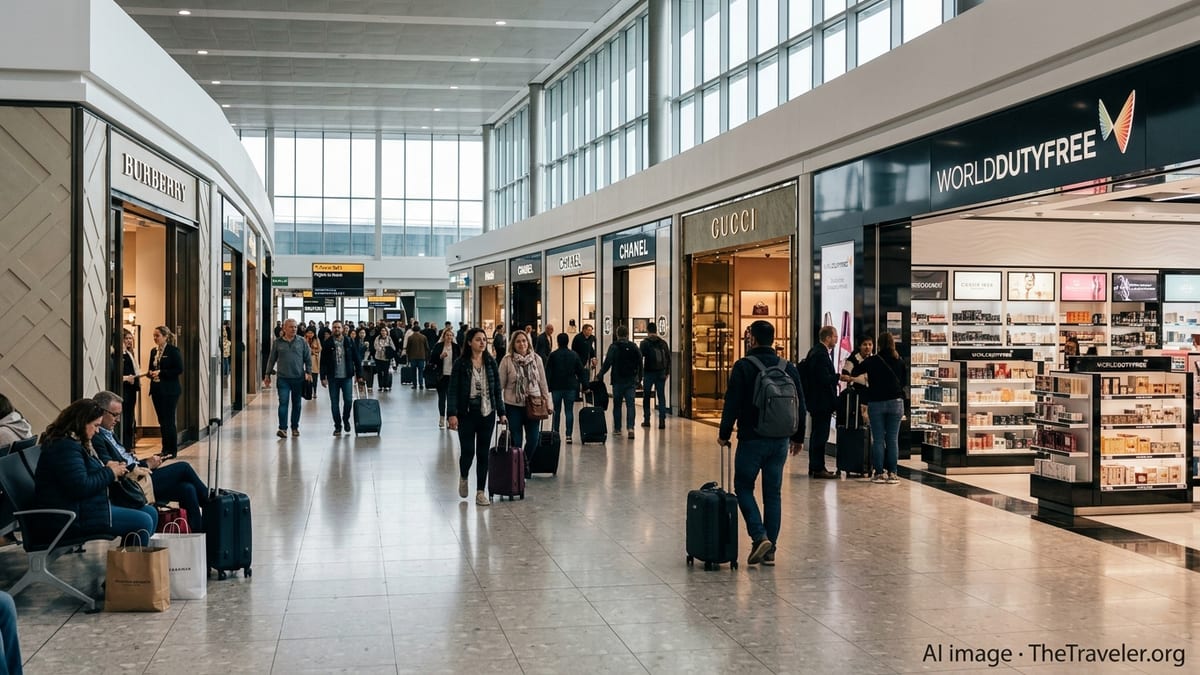
The redevelopment of Terminal 2 and the steady refinement of Terminal 5 have been central to that shift. Modernized retail corridors, higher ceilings, extensive glazing and integrated seating have helped these spaces feel closer to an upmarket urban mall than a traditional transit concourse. Operators have invested heavily in visual merchandising and digital signage, while walk-through duty free stores have been reshaped to reduce bottlenecks and highlight higher-margin categories such as fragrance, skincare and premium spirits.
At the same time, Heathrow has pushed to maintain a distinctly British flavor. Flagship outlets for heritage fashion and accessories, fine tea and whisky specialists, and London-focused souvenir concepts offer a sense of place that differentiates the airport’s retail from generic global line-ups. For many international travelers, especially those connecting between long-haul flights, these brands provide a curated snapshot of British style without leaving the terminal.
Another factor is Heathrow’s role as one of the world’s most connected hubs. High volumes of long-haul passengers with relatively long dwell times support a robust retail ecosystem, and commercial disclosures from the operator in recent years have highlighted strong per-passenger spending on both duty free and tax-paid goods. Together, these elements underpin the airport’s new status at the top of the shopping league table.
Rivals Left Chasing in a Tight Luxury Race
Heathrow’s new crown comes at the expense of several heavyweight competitors that have traditionally dominated conversations about airport shopping. Hamad International Airport in Doha has recently collected prominent awards for its retail offering, supported by a cluster of flagship luxury boutiques, expansive duty free halls and an emphasis on architectural spectacle. Singapore Changi, long the benchmark for many travelers, continues to draw attention with the Jewel complex and a dense mix of global and regional brands.
Despite these strengths, Heathrow’s showing in the latest ranking indicates that the contest at the top is tightening. The study’s methodology gives weight not only to luxury labels and design, but also to overall passenger satisfaction with pricing, variety and convenience. On those measures, Heathrow’s mix of high-end boutiques and more accessible chains appears to resonate strongly with a wide cross-section of travelers, from premium cabin frequent flyers to budget-conscious leisure passengers.
Other hubs, including Dubai International, Seoul Incheon, Istanbul and Munich, remain close behind. Many have invested heavily in new terminals, walk-through duty free concepts and high-profile partnerships with fashion and beauty brands. Yet the ranking suggests that, for now, Heathrow’s combination of retail density, brand recognition and customer familiarity has given it a narrow edge in the global retail stakes.
Industry observers point out that the competitive order can shift quickly, particularly as airports in Asia and the Middle East open new terminals or complete expansions. Several of Heathrow’s rivals have major projects under way that could reshape retail footprints over the next few years, setting up fresh battles for the top position.
What the Win Means for Travelers and Brands
For travelers passing through London, Heathrow’s upgraded standing is likely to reinforce its appeal as a place to arrive early and explore, rather than simply transit through. The breadth of shopping means passengers can compare prices on cosmetics and electronics, sample British food and drink, or browse capsule collections from global brands that treat the airport as a showcase for exclusive or limited-run products.
The ranking also signals the importance of airports as retail destinations in their own right. As airlines continue to refine cabin service and unbundle elements of the journey, much of the discretionary spending that once occurred on board has shifted to the terminal. Operators and retailers see airports as rare environments where large, relatively affluent audiences dwell for extended periods with limited competing distractions, supporting everything from impulse beauty purchases to high-ticket watch and jewelry sales.
For brands, a strong performance by Heathrow underscores the value of securing space in its terminals. Concession agreements can be costly, but the visibility to long-haul passengers from Europe, North America, the Middle East and Asia is difficult to replicate elsewhere. Successful concepts in Heathrow’s terminals often serve as templates for rollouts in other major hubs, further extending their influence.
Travelers, however, remain keenly aware of pricing. While some categories can offer savings compared with city-center stores, particularly for non-EU passengers buying duty free spirits and tobacco, others are more about convenience and exclusivity than outright discounts. The new ranking reflects a balance between perceived value and the overall quality of the shopping experience, rather than an assumption that airport retail always means lower prices.
A New Benchmark in the Post‑Pandemic Travel Era
Heathrow’s recognition as the world’s best airport for shopping also illustrates how the priorities of both passengers and operators have shifted in the years since global travel was severely disrupted. With volumes rebounding and airlines restoring long-haul networks, many hubs have moved beyond simply reopening shops toward rethinking how retail, dining and relaxation spaces fit into a more digitized, experience-focused journey.
Industry data and airport disclosures suggest that passengers are once again spending significant sums in terminals, but are more selective about where and how they spend. Airports that provide clear wayfinding, coherent layouts and a mix of brands that feel both aspirational and accessible are emerging as leaders. Heathrow’s climb to the top of the shopping rankings is often cited as an example of how an established, capacity-constrained hub can still reshape its commercial offering through targeted investment and design.
The result is likely to fuel further competition. Rival airports that have long marketed themselves as the ultimate destinations for duty free and luxury retail now face pressure to broaden their appeal and address passenger concerns about congestion, pricing and choice. New terminals and retail districts already in development across Asia, the Middle East and Europe are expected to place even greater emphasis on experiential elements such as immersive brand zones, curated local products and integrated digital services.
For now, the latest global retail assessment gives Heathrow a clear, if hard-won, advantage. Whether the UK hub can hold on to its newly acquired title will depend on how quickly competitors respond and how effectively Heathrow continues to balance luxury with practicality for the millions of travelers who will test its shopping credentials in the seasons ahead.