

More news on this day
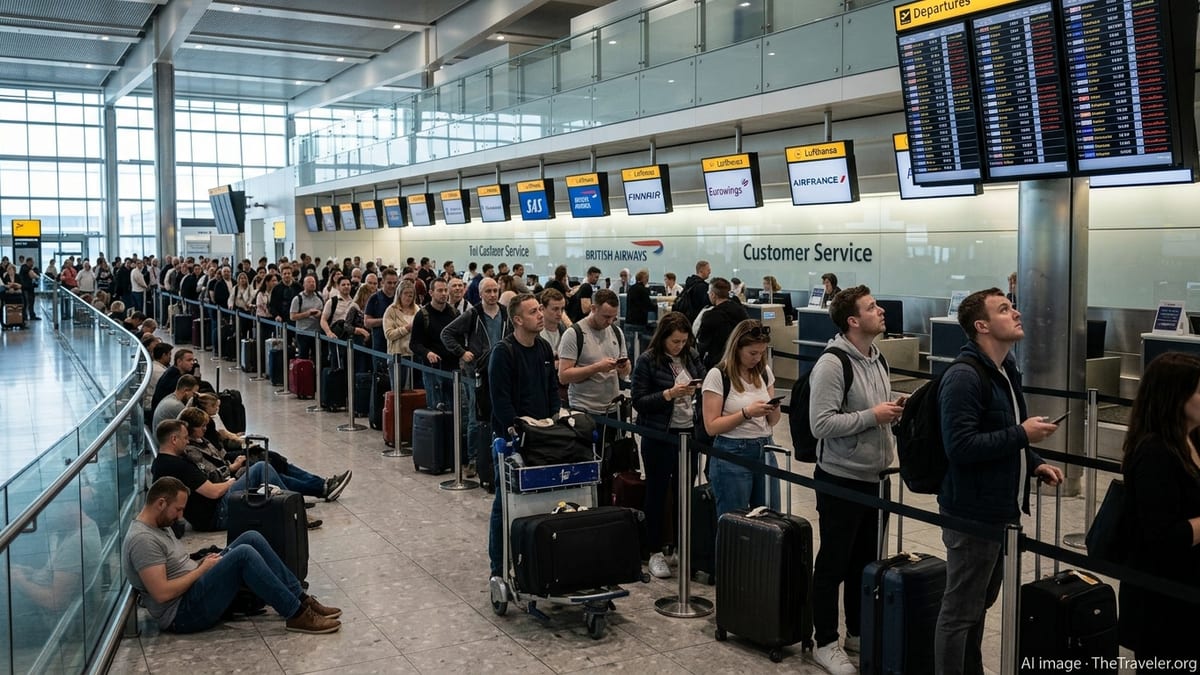
A fresh wave of disruption at London Heathrow Airport has triggered hundreds of delays and dozens of cancellations across major European routes, leaving travelers stranded in Iceland, Switzerland, Norway, Germany, France and Ireland as Lufthansa, SAS, British Airways, Finnair, Eurowings and Air France adjust or trim schedules amid ongoing operational pressures.
Get the latest news straight to your inbox!
Severe Knock-On Disruption Across Europe
Operational data and traveler reports indicate that Heathrow has seen a sharp spike in disrupted services, with around 420 delayed flights and at least 20 cancellations affecting short and medium haul links to multiple European hubs. The disruption has particularly hit services operated by Lufthansa, SAS, British Airways, Finnair, Eurowings and Air France, many of which connect London with major airports in Germany, France, Ireland, the Nordic region and the Alps.
While not all affected flights have been scrapped entirely, rolling delays of several hours have cascaded through the day’s schedule. Aircraft and crew rotations are being pushed off their planned timings, which in turn is causing missed connections and last-minute rebookings for passengers traveling between the United Kingdom and continental Europe.
Publicly available operational performance reports for recent months show that all six carriers already contend with tight turnarounds and heavily used aircraft on their Heathrow rotations. When even a modest number of flights run late, follow-on services quickly lose punctuality, especially at slot-constrained hubs such as London Heathrow, Frankfurt, Paris Charles de Gaulle and Dublin.
Travelers connecting onward from Heathrow to smaller European cities are experiencing the sharpest impact. With fewer daily frequencies and more complex connections, a delay or cancellation on a key feeder service often translates into an unexpected overnight stay or lengthy re-routing via third-country hubs.
Passengers Stranded in Iceland, Switzerland and the Nordics
The disruption has extended well beyond the United Kingdom, reverberating through airports in Iceland, Switzerland and the Nordic region that rely on tight scheduling and seasonal demand. Finnair and SAS are key operators on Heathrow routes into Helsinki, Oslo, Stockholm and Copenhagen, while British Airways and other partners carry passengers onward to Iceland and Swiss airports.
In Iceland, where connections to London are an important bridge for travelers heading to and from North America, day-of-operation schedule changes at Heathrow have left passengers facing long waits for the next available seat. With relatively few daily departures and high load factors in late winter and early spring, rebooking options can be extremely limited once a flight is heavily delayed or removed from the schedule.
In Switzerland and Norway, domestic and intra-European networks depend on steady flows of transfer passengers from Heathrow and other major hubs. When those feeder flights arrive hours late or not at all, onward services may depart with empty seats or require last-minute reticketing, stranding passengers far from their final destinations and placing additional pressure on airline call centers and airport customer service desks.
Scandinavian travelers are also contending with wider pressures on regional operations, including weather-driven disruptions and capacity adjustments. In such circumstances, a single compromised Heathrow rotation can tip an already stretched schedule into widespread delay, leaving travelers with limited alternatives on the same day.
Germany, France and Ireland Bear the Brunt
The heaviest concentration of affected flights links Heathrow with major airports in Germany, France and Ireland, where Lufthansa, Eurowings, Air France and British Airways operate dense shuttle-style schedules. These routes are vital arteries for business travelers, weekend leisure passengers and those connecting long haul, amplifying the impact of any widespread disruption.
Germany’s key hubs such as Frankfurt and Munich are particularly exposed due to their role as connection points for long haul services. When London arrivals are heavily delayed, passengers risk missing onward flights to Asia, Africa and the Americas, leading to overnight stays, missed events and complicated baggage handling situations.
France, with Paris Charles de Gaulle and other regional gateways, has also seen knock-on delays where aircraft arriving late from Heathrow are turned around for intra-European services. Even relatively short disruptions entering the French system can have an outsized effect, as ground operations juggle aircraft availability, crew duty time limits and already congested slot systems.
Ireland’s ties to Heathrow are similarly intensive, especially for Dublin and regional airports that use London as a primary transfer point. When Heathrow’s operation slows, departures to and from Ireland often face rolling delays, and the impact is felt acutely by passengers with onward intercontinental connections booked on tight margins.
Complex Mix of Causes Behind the Heathrow Turbulence
Publicly available information points to a combination of factors fuelling the current Heathrow disruption, rather than a single event. Airlines are operating in an environment shaped by ongoing industrial actions in parts of Europe, weather variability, air traffic control constraints and lingering operational fragility following the rapid post-pandemic ramp-up.
In recent months, several European carriers have adjusted schedules or temporarily suspended selected routes in response to staffing shortages and industrial disputes in parts of the aviation ecosystem, including ground handling and air traffic control. When such constraints intersect with peak travel days at Heathrow, the result can be a surge of delays and a cluster of short-notice cancellations as airlines attempt to stabilise operations.
Heathrow’s status as one of the world’s busiest and most tightly run hubs compounds the challenge. The airport’s slot system leaves limited flexibility for absorbing off-schedule arrivals and departures, so relatively small timetable shocks can propagate quickly. Once aircraft and crews are out of position, late-evening and early-morning rotations tend to be most at risk.
In parallel, long-haul disruptions in the Middle East and other regions have altered traditional traffic flows into Europe, placing unexpected pressure on certain Heathrow connections operated by Lufthansa, British Airways, Finnair, Air France and partner carriers. Travelers who would typically transit via Gulf hubs are increasingly funneled through London and other European airports, reducing spare capacity to accommodate irregular operations.
What Stranded Travelers Can Expect Next
For passengers currently stuck in Iceland, Switzerland, Norway, Germany, France and Ireland, the priority is securing alternative routings back through Heathrow or via other European hubs. Airlines are generally offering rebooking on the next available services, but limited spare seats mean some travelers may need to accept longer journey times, additional connections or overnight stops.
Airlines operating affected Heathrow flights are also managing obligations under European and UK passenger-rights regulations, which provide for care, assistance and in many cases compensation when flights are cancelled or heavily delayed for reasons within the carrier’s control. Travelers whose itineraries touch the European Union, the European Economic Area, Switzerland, Iceland, Norway or the United Kingdom may be eligible for fixed-sum payments alongside rebooking and basic support, depending on the circumstances.
Given the evolving nature of the disruption, passengers are being advised by consumer advocates and travel organizations to monitor their booking status frequently on official channels, allow additional time at airports, and keep documentation such as boarding passes and receipts for any reasonable expenses incurred during an enforced delay.
As the current wave of disruption works its way through the system, operational data suggests that schedules are likely to stabilise gradually over the following days, provided there are no further shocks from weather, industrial actions or airspace constraints. Until then, Heathrow’s performance will remain a critical stress test for European aviation’s resilience at the tail end of the winter season.