

More news on this day
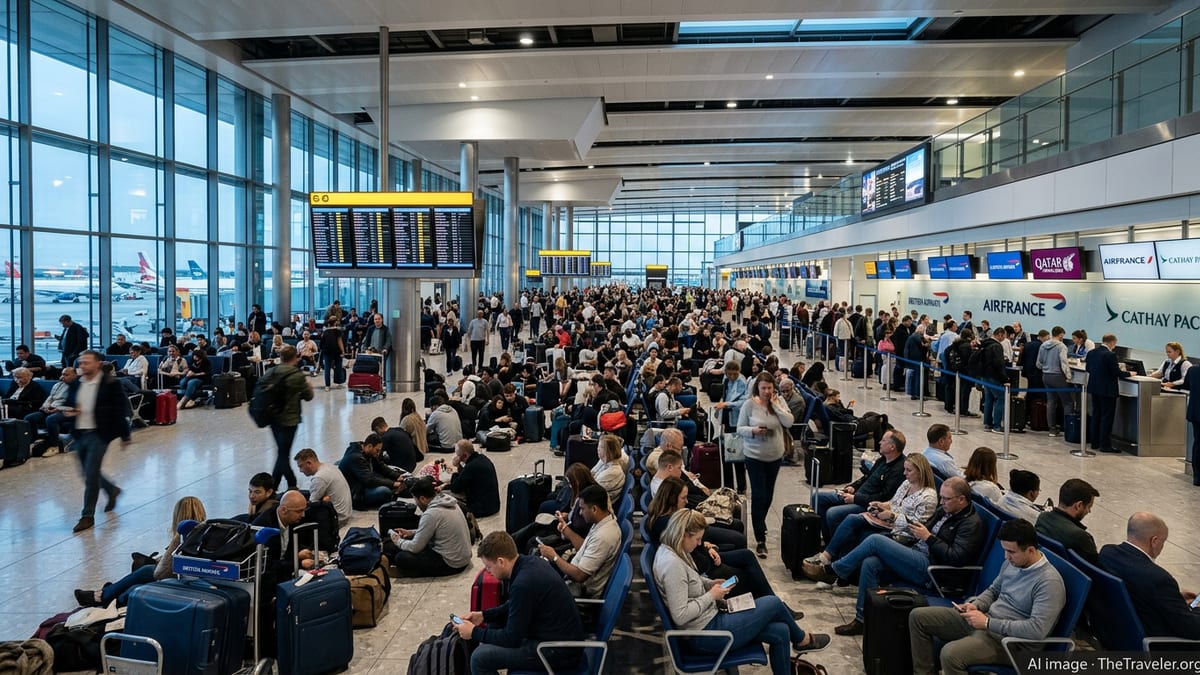
Hundreds of travelers across the United Kingdom and abroad are facing missed connections, overnight airport stays, and rapidly changing itineraries after significant disruption at London Heathrow Airport saw 177 flights delayed and 26 cancelled, affecting services from major carriers including British Airways, Qatar Airways, Air France, Cathay Pacific and others on key long-haul and European routes.
Get the latest news straight to your inbox!
Major Hub Disruption Ripples Across Global Network
Operational disruption at London Heathrow has triggered a wave of delays and cancellations that is rippling across one of the world’s busiest aviation networks. Publicly available flight-tracking and airport departure-board data show at least 177 flights delayed and 26 cancelled in a single day, with impacts concentrated on services run by large network carriers and their codeshare partners.
The disruption is centered on Heathrow’s dual role as both a global gateway and a tightly scheduled transfer hub. Even a modest proportion of delayed departures and arrivals can cause knock-on effects across multiple airlines’ schedules, quickly stranding travelers whose onward flights depart from other European or North American airports.
Reports from passengers and aviation monitoring services indicate that the affected flights include a mix of short-haul European routes and long-haul services linking London with North America, the Middle East and Asia. As aircraft and crews fall out of their assigned rotations, airlines are being forced to consolidate services, rebook travelers, and in some cases cancel departures altogether.
British Airways, Qatar Airways, Air France and Cathay Pacific Heavily Affected
British Airways, Heathrow’s largest operator, appears to be among the airlines most exposed to the latest disruption, with numerous departures and arrivals reported as significantly delayed or cancelled. The carrier’s dense schedule at its home hub, coupled with high levels of connecting traffic, leaves limited margin to absorb operational shocks without broader timetable changes.
Qatar Airways, which relies on Heathrow as a key European gateway to its Doha hub, is also seeing knock-on delays on departures to the Gulf and inbound services arriving into London. Publicly available information shows that delayed London flights can cascade into missed onward connections at Hamad International Airport, affecting travelers bound for destinations across Asia and Africa.
Air France and Cathay Pacific, which operate prominent services between Heathrow and Paris Charles de Gaulle and between London and major Asian hubs, are likewise managing schedule disruption. Network carriers often depend on tightly timed banks of connecting flights at their home airports, so late arrivals from London can force last-minute rebookings even for passengers who never planned to travel through the United Kingdom.
US and European Cities See Downline Consequences
The effects of Heathrow’s operational problems are being felt well beyond the United Kingdom. Flight data and passenger reports indicate disruption on routes linking London with major US and European cities, including Dallas, Paris, Newark and Frankfurt, as delayed aircraft arrive late or do not arrive at all.
On transatlantic routes, flights between Heathrow and US gateways such as Dallas and Newark are particularly sensitive to schedule changes. These services not only carry point-to-point passengers, but also large numbers of travelers connecting onward across North America. When a London departure leaves late or is cancelled, those passengers can miss domestic links and face extensive re-routing across multiple airlines.
European hubs such as Paris and Frankfurt are experiencing similar challenges. Delayed arrivals from Heathrow can disrupt connection banks at those airports, prompting adjustments to departure times or last-minute substitutions of aircraft. In some instances, passengers are being rebooked on alternative routings that bypass London altogether in an effort to keep long-haul journeys intact.
Passengers Face Long Queues, Uncertain Rebookings and Overnight Stays
For travelers caught in the middle of the disruption, the most immediate impact is the prospect of extended waits in crowded terminals. Social media posts and public comments describe long lines at airline service desks as passengers attempt to secure new itineraries or confirm their rights to accommodation and meal vouchers.
Standard airline practice in such situations varies according to the cause of the delay or cancellation and the jurisdiction in which the disruption occurs. Under UK and European passenger-protection rules, travelers on qualifying flights may be entitled to assistance ranging from refreshments to hotel stays, and in some cases financial compensation, although the applicability of these provisions depends on the underlying reason for the disruption.
Many travelers are also reporting challenges accessing timely information about the status of their flights. In rapidly evolving situations, online departure boards, airline apps and third-party trackers may show conflicting data on whether a service is delayed, cancelled or still operating. Aviation analysts frequently recommend that passengers monitor both the airline’s own channels and airport information, and be prepared for last-minute gate or schedule changes.
Airlines Work to Stabilize Schedules and Clear Backlogs
Industry observers note that recovery from a day of widespread delays and cancellations at a major hub can take several days, even after the initial trigger is resolved. Aircraft and crew may be left overnight at outstations, leaving gaps in the following day’s schedule from Heathrow. Carriers typically respond by trimming frequencies on less time-sensitive routes, combining lightly booked services, or deploying larger aircraft on certain flights to accommodate stranded passengers.
Public schedules indicate that airlines operating at Heathrow are already adjusting future rotations in an effort to restore regular operations. This can include bringing in spare aircraft, reassigning crews within regulatory working-time limits, and prioritizing long-haul services where alternative options for travelers may be limited.
For passengers with upcoming journeys through Heathrow over the coming days, travel experts generally advise checking flight status frequently, allowing additional time for connections, and considering flexible arrangements where possible. While the number of delayed and cancelled flights may gradually fall as schedules stabilize, the residual backlog of displaced travelers means that some routes and departure times are likely to remain under pressure in the short term.