

More news on this day
Days after a major power outage forced London Heathrow to halt operations and cancel hundreds of flights, stranded travelers across Europe and beyond are still dealing with disrupted journeys, missing luggage and a patchwork of relief measures that vary sharply by airline and destination.
Get the latest news straight to your inbox!
From Substation Fire to Worldwide Flight Disruption
The immediate trigger for the Heathrow shutdown was a fire at the North Hyde electrical substation in Hayes, which cut power to the airport and surrounding neighborhoods in west London. Publicly available information shows that Heathrow’s backup systems were unable to sustain full operations, prompting a rare decision to suspend almost all flights for many hours.
According to published coverage, the outage led to the cancellation or diversion of more than a thousand flights in less than a day, affecting well over one hundred thousand passengers on long haul and short haul routes. Aircraft already en route to London were forced to divert to regional hubs across the United Kingdom and continental Europe, where hotel capacity and handling resources were quickly strained.
Operational data shared by airlines indicates that the outage came on top of an already fragile European aviation system, which has recently been stressed by periodic air traffic control issues, staff shortages and earlier baggage system failures at Heathrow. The result has been a cascading effect, with delays and cancellations continuing for days on routes that had no direct link to the original power cut.
Industry analysts note that Heathrow’s role as a major transfer hub for Europe means disruption there can ripple through global networks. Missed connections at the airport have translated into broken itineraries reaching North America, the Middle East, Africa and Asia, as multi leg journeys unravel and need to be reassembled flight by flight.
Ongoing Cancellations, Long Queues and Limited Clarity
Even after electricity was restored and runways reopened, publicly available flight boards and airline updates show that schedules remain thinner than usual, with some carriers trimming frequencies to rebuild resilience. Passengers continue to report sudden cancellations hours before departure, as aircraft and crew remain out of position following the shutdown.
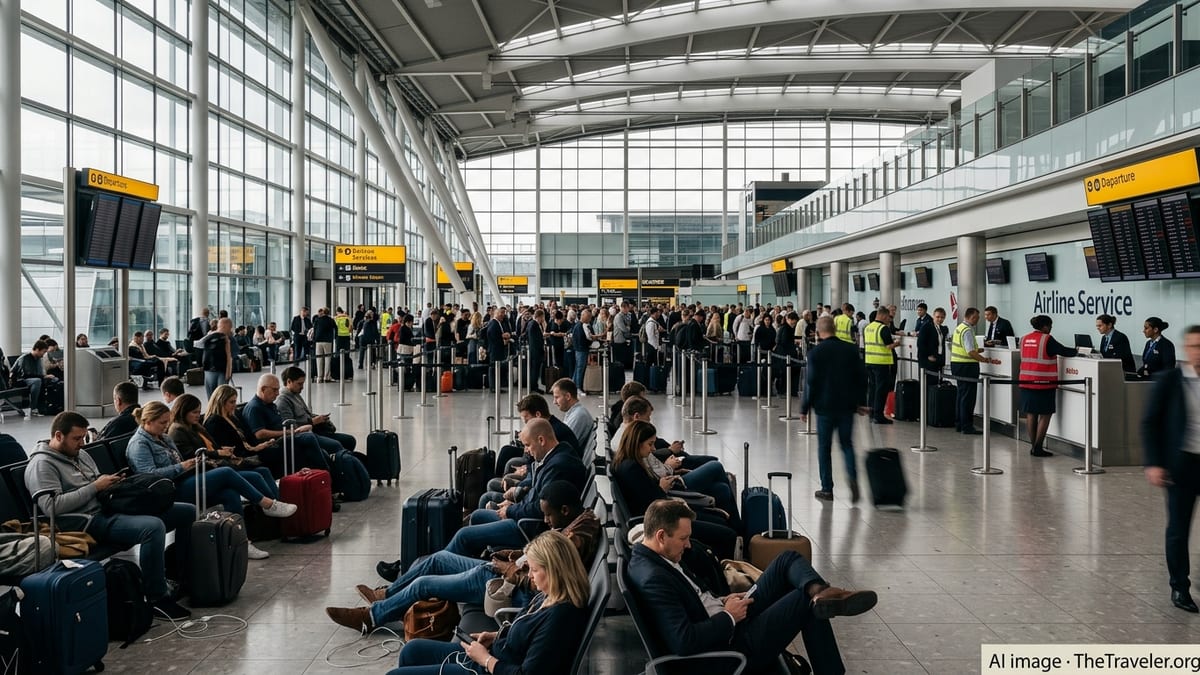
At Heathrow, images and descriptions in local and international coverage describe long queues at check in, ticket desks and security checkpoints, particularly in terminals serving major alliance carriers. Staff have been redeployed to manage rebooking and customer service, but the volume of disrupted travelers means many still face waits of several hours for in person assistance.
Some airlines are directing passengers to handle changes through apps and websites, yet digital channels have also struggled under heavy demand. Reports indicate that certain customers have been unable to complete rebookings online when their journeys involve multiple airlines on a single ticket, forcing them back into physical lines at the airport.
Travelers arriving into Heathrow are also confronting congestion at passport control and onward connections. With seats on domestic and European feeder flights in short supply, many are being offered new itineraries that add extra stops, overnight layovers or departure dates several days later than originally planned.
Baggage Backlogs and How to Recover Lost Luggage
One of the most visible legacies of the power outage is the backlog of unaccompanied baggage. When the electricity failed, automated handling systems and conveyor belts in several terminals stopped, leaving checked bags stranded in sorting halls rather than being loaded on aircraft.
According to airline and airport statements cited in news coverage, priority in the first phase of recovery has gone to restarting flight operations, with baggage processing ramping up more slowly. This has led to a situation where many travelers reached their destination days ago, but their luggage remains somewhere in the Heathrow system or at an intermediate hub.
Passengers are being advised in public information notices to file a property irregularity report before leaving the airport, or via airline channels if they became aware of the loss only after arrival. Once a report is logged, bags are typically scanned and matched to owners as systems return to normal, then forwarded on the next available service or by dedicated courier.
For those currently stranded at Heathrow, practical considerations are emerging. Retailers within the terminals report increased demand for basic clothing and toiletries from travelers whose checked bags are inaccessible. Travel insurance advisories point out that many policies provide limited reimbursement for essential items after a delay, but only when receipts and airline confirmation documents are kept.
Your Rights on Refunds, Rebooking and Care
Under European and United Kingdom air passenger regulations, travelers on flights departing from Heathrow may be entitled to assistance and in some cases financial compensation. Legal guidance summarized in consumer reports notes that, regardless of the cause of disruption, airlines must offer a choice between a refund and rerouting at the earliest opportunity when a flight is canceled.
Where seats are unavailable for several days, some carriers are arranging accommodation and meals, particularly for passengers stranded away from home. However, coverage across different outlets highlights inconsistency in how these obligations are applied. Travelers on low cost or point to point airlines sometimes receive fewer options than those booked on full service or alliance carriers, especially if separate tickets were used for connecting legs.
The question of compensation is more complex. Power failures stemming from external infrastructure, such as a regional electricity substation, are often categorized in airline policies as extraordinary circumstances. If that classification holds, published analyses suggest standard compensation payments may not apply, although rights to a refund or rerouting remain.
Travel experts recommend that passengers keep detailed records of boarding passes, booking confirmations, receipts and any written communication from airlines. These documents can support later claims with the carrier, through travel insurance, or via credit card chargeback procedures if services were not delivered as described.
Practical Steps for Travelers Still Caught in the Fallout
For travelers who remain stranded or whose upcoming trips pass through Heathrow, planning ahead is now essential. Publicly available airport guidance encourages passengers to check the status of their flight before setting out, and to arrive earlier than usual if traveling in the next several days, given the potential for renewed queues and last minute schedule changes.
Those with flexible plans may wish to consider rerouting through alternative hubs that have recovered more quickly, such as major continental European airports with strong transatlantic links. Travel industry commentary indicates that some airlines are already waiving change fees for itineraries involving Heathrow in the immediate aftermath of the outage, but conditions differ by carrier and fare type.
Where connections at Heathrow are unavoidable, experts suggest packing critical items, medications and at least a day’s worth of clothing in carry on bags, in case checked luggage is delayed by residual baggage handling issues. Keeping device chargers and portable power banks accessible can also help travelers stay informed as airlines update schedules and gate assignments throughout the day.
As investigations into the substation fire and airport power resilience continue, consumer groups are calling for clearer communication protocols and more robust contingency planning at major hubs. For now, passengers moving through Heathrow in the wake of the power outage can expect a travel experience that remains slower and less predictable than usual, with careful preparation offering the best chance of avoiding further disruption.