

More news on this day
Passengers across Europe are facing cascading disruption after a fresh spell of delays and cancellations at London Heathrow rippled through one of the world’s busiest aviation networks, stranding travelers from Athens to Amsterdam and forcing unexpected overnight stays in multiple cities.
Get the latest news straight to your inbox!
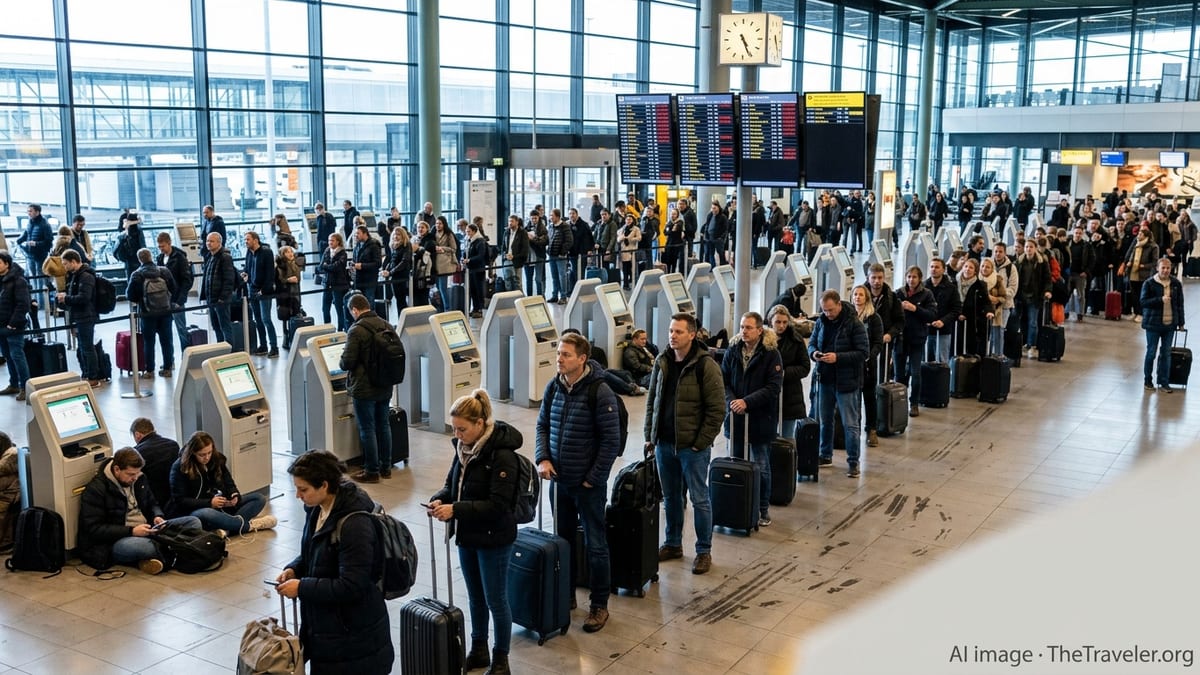
Knock-on Delays From Heathrow Hit Multiple European Hubs
Operational data from flight-tracking and passenger-rights platforms for early April 2026 indicate that Heathrow has been a central pressure point in a broader wave of disruption affecting European aviation. Reports of delays, missed connections and aircraft being out of position show that issues originating in London quickly spread to major hubs in Germany, Italy, Spain and the Nordic region.
Recent figures compiled by industry monitors for 7 and 8 April highlight how even a limited number of cancellations linked to Heathrow can translate into hundreds of late departures elsewhere. One analysis of 1,445 delays and 20 cancellations across Europe lists Heathrow among the worst affected airports for knock-on disruption, with more than one hundred flights out of schedule and many others forced into extended holding or ground waits.
Published coverage describes aircraft and crews arriving late into Heathrow after weather and airspace constraints, compressing already tight turnaround times. When those flights then depart behind schedule for Rome, Copenhagen or Zurich, the receiving airports struggle to absorb the delay, creating queues for gates and departure slots and fuelling a rolling pattern of disruption that lasts well beyond the initial weather event.
Heathrow’s role as a long haul and connecting hub has also amplified the effect of the delays. Passengers bound for destinations in North America, the Middle East and Africa have found themselves unexpectedly re-routed through alternative gateways in continental Europe when London connections became unworkable, increasing pressure on airports that were already dealing with their own weather and staffing challenges.
Weather Systems and Staffing Strain Combine Into a Perfect Storm
The latest disruption comes against a backdrop of unsettled spring weather across Western and Northern Europe. Meteorological reports point to a sequence of Atlantic storm systems bringing strong winds, heavy rain and, in some areas, late-season snow, particularly around the start of April. Aviation analysts note that such conditions routinely trigger air traffic flow restrictions, forcing airports like Heathrow to reduce capacity for safety reasons.
When those restrictions coincide with peak travel periods, even a modest cut in runway movements can cascade into large numbers of delays and missed connections. On 5 April, passenger-rights platforms recorded hundreds of affected flights across Europe, with Heathrow and Amsterdam Schiphol among the hubs experiencing significant schedule distortion as thunderstorms and low clouds moved through key air corridors.
Staffing constraints are adding a second layer of vulnerability. Publicly available reporting on airport operations indicates that air traffic control centers and ground handling teams in several countries are still operating with lean rosters after the pandemic years, while passenger volumes are edging back toward or beyond 2019 levels. When severe weather forces longer spacing between arrivals and departures, the same staffing pool must manage more complex recovery operations, from rebooking passengers to dealing with aircraft out of place.
Analysts describe this combination of volatile weather and stretched resources as a structural weakness in the European system. Rather than isolated bad days, the pattern is emerging as a series of recurring shock events in which a storm front or technical outage at one or two hubs, including Heathrow, triggers a chain reaction of knock-on delays that ripple across the continent for 24 to 48 hours.
Passengers Stranded From Athens to Oslo as Connections Collapse
The practical impact of the Heathrow-centered disruption has been felt far beyond London. News reports from Greece describe widespread delays at Athens International Airport on 5 April, with dozens of flights running late and several cancelled as aircraft failed to arrive on time from Western European hubs. Connections involving Heathrow and other major nodes left passengers facing long queues at rebooking desks and, in some cases, overnight stays at airport hotels.
Similar scenes have been reported at Italian gateways such as Rome Fiumicino and Milan Malpensa, where data from passenger-assistance firms show several hundred delays and multiple cancellations in a single day as the early April disruption unfolded. With many of those flights linked to Heathrow through codeshares or onward connections, travelers heading to regional destinations or long haul services found themselves stuck in crowded terminals as available seats on alternative departures quickly disappeared.
In northern Europe, airports including Oslo and Copenhagen have also seen elevated levels of late-running flights tied to the same weather systems and network bottlenecks. Publicly available information from flight-status aggregators shows that some short haul services were delayed by several hours, causing travelers to miss evening connections to London and onward long haul routes. For those passengers, the knock-on effect of delays at Heathrow translated into unscheduled nights in transit cities far from home.
Travel forums and social media posts from recent days describe passengers sleeping on terminal floors, scrambling to secure last-minute hotel rooms or being routed on complex multi-stop itineraries in an effort to bypass congested hubs. While such accounts are anecdotal, they underline the human cost of systemic strain in Europe’s interconnected aviation network.
Airlines Juggle Rebooking, Duty of Care and Mounting Costs
Under the EU’s air passenger rights rules, airlines operating within or from the European Union and the United Kingdom are required to provide support when significant delays or cancellations occur. Legal summaries of Regulation EC 261 and its UK equivalent explain that, even when disruptions are caused by extraordinary circumstances such as severe weather, carriers must still offer care in the form of meals, refreshments, communication access and, when necessary, hotel accommodation and transport between the airport and lodging.
Passenger advocacy organizations report that these obligations are being put to the test during the current disruption. With flights from Heathrow and other hubs heavily booked at the start of the spring travel season, rebooking options are limited and some travelers are being offered departures one or two days later than planned. Where hotel capacity near major airports is tight, airlines are turning to properties further afield or providing vouchers that passengers must redeem independently.
Industry commentary suggests that the financial burden of these events is significant. Even in situations where compensation payments are not due because weather is classified as an extraordinary circumstance, airlines face rising costs for accommodation, ground transport and repositioning aircraft and crews. Low margin carriers can be particularly exposed, especially when disruption hits at multiple airports simultaneously and aircraft utilization rates drop sharply.
At Heathrow, where many carriers rely on complex banks of inbound and outbound connections, operational planners are adjusting schedules and aircraft rotations in an attempt to restore punctuality. Publicly available data from recent days shows some airlines trimming frequencies on selected short haul routes and consolidating services so that they can focus resources on maintaining long haul operations and protecting the most time-sensitive connections.
Calls Grow for More Resilient Infrastructure and Passenger Communication
The latest travel havoc centered on Heathrow is prompting renewed debate over the resilience of Europe’s aviation infrastructure. Commentators in specialist aviation outlets argue that, as extreme weather events become more frequent and passenger numbers continue to rise, airports and air navigation providers may need to invest more heavily in surge capacity, advanced forecasting tools and improved coordination between hubs.
Some analysts point to the experience of earlier large scale disruptions in Europe as evidence that network planning must assume regular shocks rather than rare crises. They highlight that decisions made in the control centers of major hubs, such as temporarily reducing arrivals during a storm, can quickly strand tens of thousands of passengers across multiple countries if contingency plans and cross-border coordination are not robust enough.
Passenger groups are also emphasizing the importance of timely and transparent information. Recent accounts from affected travelers indicate that confusion at gate areas and contradictory updates in airline apps have compounded the frustration of long waits. Industry observers note that clearer communication about likely delays, rebooking options and entitlements under passenger-rights rules could help travelers make faster decisions about whether to accept alternative routings, seek refunds or arrange their own accommodation.
For now, forecasts suggest that unsettled weather could continue to affect parts of Western and Northern Europe through mid-April. With Heathrow operating close to capacity on many days, aviation analysts warn that further episodes of disruption are possible and that passengers planning to connect through London or other major hubs may wish to allow extra time, build in longer connection windows and monitor flight status closely in the hours before departure.