


More news on this day
Record-breaking temperatures across Europe this week are straining rail networks from France and Belgium to the United Kingdom and Spain, with speed restrictions, reduced timetables and targeted cancellations disrupting peak summer travel.
Get the latest news straight to your inbox!
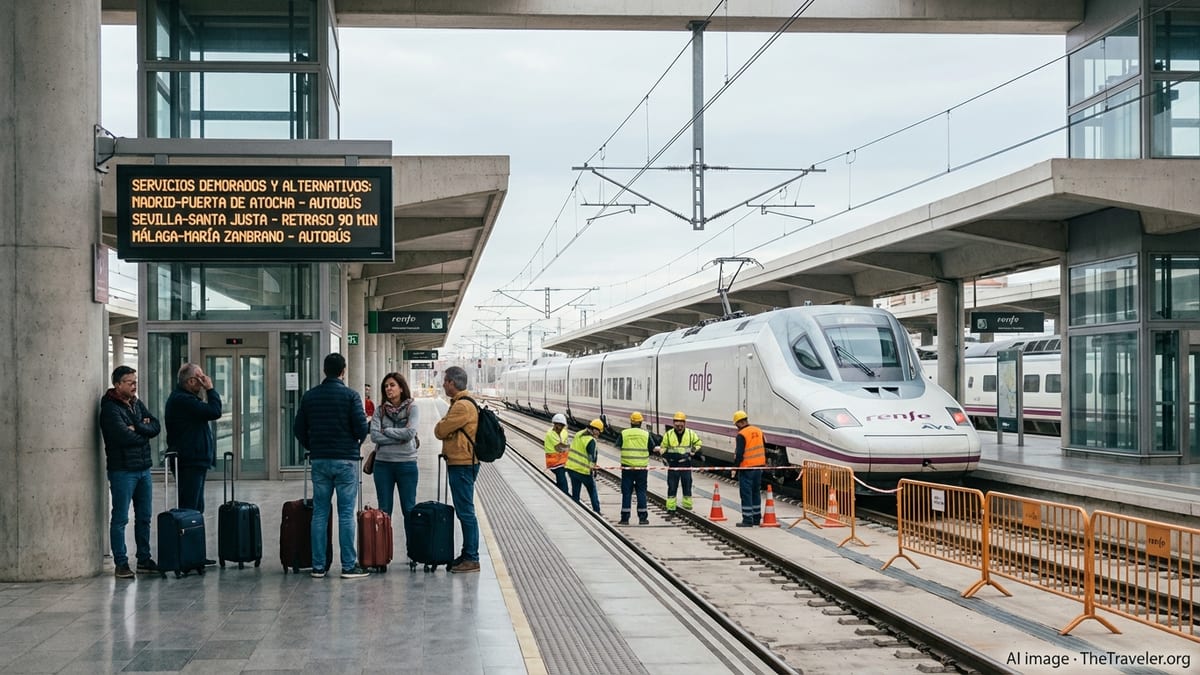
Speed Restrictions and Slower Journeys Become the New Normal
Publicly available information from rail operators and travel advisories shows that high temperatures are forcing widespread speed limits on key passenger routes across Western and Central Europe. When steel rails heat and expand, they can buckle out of alignment, so infrastructure managers are cutting maximum speeds during the hottest hours of the day. That precaution is lengthening journey times on busy intercity and commuter corridors just as holiday traffic builds.
Network advisories in the United Kingdom, Belgium and parts of Germany indicate that trains which normally run at full line speed are being held to significantly lower limits on exposed sections of track. Passengers are being told to expect fewer services, extended travel times and short-notice service alterations as control centers respond to real-time temperature readings and track inspections.
Travel updates shared by pan-European rail booking platforms also point to a pattern of “yellow” and “red” disruption alerts tied directly to the heat. These alerts flag delays and partial cancellations on cross-border routes linking France, the Benelux countries and western Germany, particularly in the afternoon windows when track temperatures are highest.
Targeted Cancellations Hit France, Belgium and Cross-Channel Links
The most visible rail impact so far has been a wave of targeted cancellations on long-distance and international services. In France, industry coverage reports that SNCF has pre-emptively cancelled dozens of Intercités trains on routes such as Paris to Clermont-Ferrand, Paris to Orléans, Limoges and Toulouse, and Bordeaux to Marseille during the peak of the heat. The operator is concentrating cuts in the middle of the day, when both infrastructure stress and onboard cooling demands are highest.
Belgium’s national operator has reduced peak-hour commuter services, with several P-trains suspended on key approaches into Brussels. Travel advisories describe a focus on maintaining a core timetable while trimming extra peak services that put additional strain on already stressed infrastructure.
Internationally, some cross-Channel trains between Paris and London have also been withdrawn or rescheduled. According to recent travel and business press coverage, Eurostar has cancelled selected departures and warned of potential knock-on delays, citing the combined impact of high temperatures on infrastructure and rolling stock. The company is offering flexible rebooking to affected passengers, a measure mirrored by several national carriers on the continent.
Local Disruption Spreads to Regional and Commuter Lines
The disruption is not limited to headline high-speed routes. Regional and commuter lines in the United Kingdom, France, Germany and the Low Countries are also reporting timetable changes linked to the heatwave. Public information from British regional operators in the Midlands and north of England, for example, points to “significantly reduced” weekday services and advisories against nonessential travel during the hottest days.
In smaller networks across Central Europe, speed reductions have been introduced on lightly built secondary lines where track structures are more vulnerable to thermal stress. In Slovenia and parts of Austria and southern Germany, rail companies have announced daytime speed caps on certain routes, particularly on lines with older infrastructure or tight curves that are more sensitive to track distortion.
These changes are rippling through to international itineraries used by visitors with rail passes. European rail planning sites are warning that some regional connections feeding into high-speed hubs may run less frequently or at altered times, making previously straightforward same-day connections more precarious for travelers.
Tourists Face Altered Itineraries and Packed Replacement Services
For leisure travelers, the timing of the heatwave during the early summer getaway period is amplifying the impact. Travel media reports describe passengers re-routing trips to avoid the hottest afternoon departures, shifting to early-morning or late-evening trains that are now becoming heavily booked. In some cases, replacement buses are being used on sections where rail speeds have been cut to unsustainable levels, adding road congestion and extending overall travel times.
Travel advisories aimed at visitors stress the importance of checking train status on the day of travel, building extra time for connections and preparing for warmer-than-usual conditions at stations and on board. Older trains and crowded commuter sets may struggle to maintain comfortable interior temperatures, particularly when long delays mean air-conditioning systems run at full power for extended periods.
Accommodation providers in major hubs such as Paris, Brussels and London are also beginning to report last-minute changes as rail passengers adjust plans. Some travelers are choosing to stay additional nights rather than risk tight onward connections, while others are abandoning rail segments in favor of last-minute car rentals or short-haul flights where those remain available.
Heatwave Underscores Climate Resilience Gaps in European Rail
The current disruption is highlighting the challenge of adapting Europe’s vast rail network to a climate in which episodes of extreme heat are becoming more frequent. Analysis published by climate and transport specialists notes that much of the continent’s infrastructure was designed for historic temperature ranges that no longer reflect present-day conditions. Rails, overhead power lines and signaling systems are all under stress during prolonged hot spells.
Recent reporting on a new assessment by the EU Agency for Railways points to heat, alongside flooding and landslides, as a growing operational threat. The agency has urged stronger standards for climate resilience in new construction and upgrades, including revised temperature thresholds for track materials, more extensive real-time monitoring systems and operational rules that balance safety with service continuity in extreme weather.
National rail companies are experimenting with measures such as painting rails in lighter colors on particularly exposed stretches, installing additional track sensors and expanding preventive maintenance during summer months. Even so, technical specialists quoted in European media coverage suggest that such solutions are expensive to deploy at scale and will take years to roll out comprehensively across the continent’s dense rail grids.
For now, rail passengers across Europe face an increasingly familiar summer scenario: slower trains, altered timetables and the possibility of sudden cancellations whenever temperatures spike. As the current heatwave continues, travel planners expect rail disruption to remain a significant factor for anyone crossing the continent by train in the days ahead.