

More news on this day
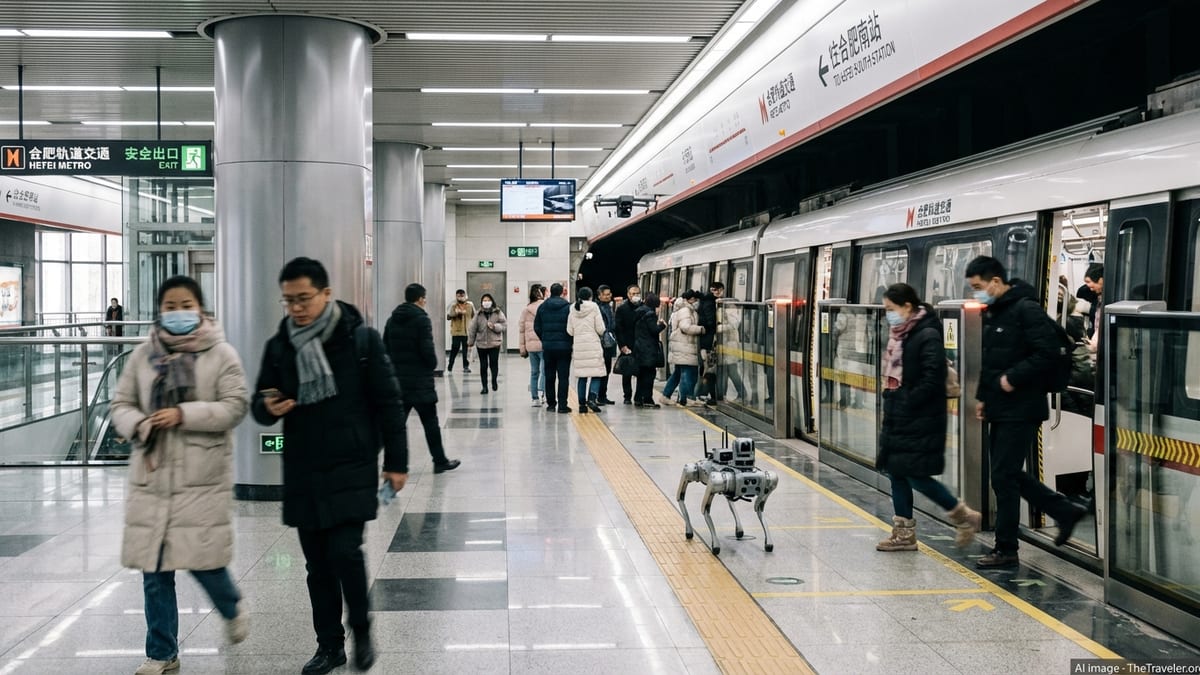
Commuters in the eastern Chinese city of Hefei are sharing platforms and tunnels with an unusual new workforce, as robot dogs, drones and humanoid assistants join staff on the metro in a large-scale trial that is being closely watched by transit operators worldwide.
A Pioneering ‘Robot Cluster’ for Urban Rail
The Hefei Rail Transit network has deployed what local authorities describe as China’s first full-space robot cluster for metro operations, covering station concourses, train depots and underground tunnels. Launched during the peak Spring Festival travel rush in February 2026, the project is designed to stress test how far automation can support staff while millions of trips are made in a compressed holiday period.
Humanoid service robots greet passengers in busy stations, answering questions, giving route guidance and helping direct flows of people. On the platforms, four-legged robot dogs patrol the edges and equipment rooms, using cameras and sensors to monitor crowds, doors and safety lines. Overhead, small drones fly inspection routes through tunnel sections and maintenance areas, scanning for structural issues or obstructions that might disrupt traffic.
Officials at Hefei Rail Transit’s Science and Education Center say the system is built around a central intelligent dispatching platform that assigns tasks to each type of robot. The aim is to ensure continuous coverage of key zones, automate routine checks that are normally done manually, and free human teams to focus on incidents, passenger service and complex maintenance work.
Planners argue that using the Spring Festival period as a proving ground provides a realistic test of both reliability and public reaction. With trains and stations operating at or near capacity, the network offers a rare opportunity to see how the machines cope with crowd surges, delays and a higher likelihood of equipment faults.
Robot Dogs and Drones Take on Hidden-View Inspections
Much of the new technology is focused on areas that are difficult or time-consuming for human inspectors to access. Underneath parked trains, compact wheeled robots and quadruped robot dogs move through narrow inspection trenches, using high-definition and infrared cameras along with ultrasonic sensors to scan wheels, brake components and bolts. Potential cracks, loose fasteners or fluid leaks are flagged to a control center in near real time.
In tunnels, drones follow pre-programmed flight paths, capturing detailed imagery of walls, overhead cabling, signal equipment and emergency walkways. Software compares live video with stored reference models, helping teams spot misalignments, water seepage or foreign objects before they become safety hazards. Data collected on each run feeds into a growing digital archive of the network’s infrastructure condition.
Engineers say these automated patrols compress inspections that would traditionally take teams hours, often working at night after the last train, into a fraction of the time. Reducing the need for workers to enter tight spaces, trenches and live-track areas also cuts occupational risk, particularly during intensive maintenance windows when fatigue can be an issue.
Hefei’s metro planners highlight that the robots are not operating autonomously in isolation. Each unit transmits its diagnostics and video back to human operators, who retain authority over operational decisions such as halting a train, imposing speed restrictions or closing sections of track for emergency repairs.
AI ‘Brain’ Promises Smarter, More Predictive Operations
Behind the scenes, Hefei’s robot cluster is linked by an AI-enabled control platform that coordinates hundreds of tasks, from dispatching a single robot dog to a reported anomaly to orchestrating simultaneous inspections across multiple lines. Officials say they intend to strengthen this central “brain” using large-scale AI models that can learn from patterns in the data generated every day.
In practice, that means the system could move from simply detecting faults to predicting where they are most likely to occur. By analyzing vibration signatures from train components, temperature changes in electrical cabinets or repeated crowding patterns at particular stations, the software can suggest targeted inspections, preventive maintenance and adjusted staffing levels.
The same data streams could feed into passenger-facing improvements. If drones and cameras detect sustained congestion at certain exits, or if service robots record frequent questions about specific transfers, the metro operator can redesign signage, modify train dispatching and tune announcements to address those pinch points.
Rail experts note that Hefei’s experiment fits into a broader wave of Chinese infrastructure projects that are using robotics for inspection and public service, from power grids to city patrols. What sets this metro trial apart is the attempt to integrate multiple types of robots into a single, coordinated system that spans the entire rail environment rather than isolated use cases.
Passenger Reactions and the Human Factor
The arrival of robot dogs and drones has turned Hefei’s metro into an unexpected spectacle for many travelers, with videos of the machines circulating widely on social media in China and abroad. For some passengers, the sight of four-legged robots pacing platforms or drones hovering near tunnel ceilings is a novelty that reinforces the city’s high-tech ambitions.
Others have raised questions about privacy, noise and the comfort of sharing confined spaces with mobile cameras. Metro officials emphasize that the focus is on safety and maintenance rather than detailed tracking of individual riders, and that imagery is handled under existing rules for station surveillance. They also stress that trained human staff remain visible and available throughout stations, and that no roles have been cut as part of the trial.
Unions and transport specialists are watching closely to see how responsibilities shift between humans and machines over time. While automation can support fatigue-prone tasks such as repetitive inspections, analysts point out that passenger trust in mass transit still relies heavily on human judgment, clear communication and the reassurance of staff presence during delays or emergencies.
Local authorities say they are collecting feedback from both passengers and employees during the Spring Festival period and will adjust deployment patterns, robot behavior and communication strategies based on the responses. The city has framed the project as a long-term exploration rather than a rapid move toward fully automated operations.
What Hefei’s Trial Signals for the Future of Train Travel
The Hefei metro experiment is already prompting comparisons with other cities testing robot dogs or drones in more limited roles, such as sidewalk patrols or power-line inspections. By concentrating multiple robotic systems inside a complex, high-density rail environment, the Anhui capital has effectively created a live laboratory for the future of urban transport management.
For global transit authorities grappling with rising ridership targets, maintenance backlogs and labor shortages, Hefei’s trial offers a glimpse of how coordinated robotics might help extend inspection coverage and relieve staff of some of the most hazardous, repetitive duties. If the system proves reliable over time, similar architectures could be adapted for metros, commuter rail and even airport operations elsewhere.
At the same time, the project underscores the regulatory and ethical questions that will accompany any large-scale automation of public infrastructure. Issues of data governance, cyber security, procurement transparency and accountability in the event of failures are likely to shape how quickly other cities follow suit.
For now, riders in Hefei find themselves on the front line of a transport experiment in which robot dogs and drones have moved from science fiction into the daily rhythm of commuting. How comfortably that partnership between people and machines settles will help determine whether this glimpse of tomorrow’s metro becomes a new global standard for train travel.