

More news on this day
A helicopter carrying passengers in eastern Nepal crash-landed during adverse weather conditions, leaving several people injured and renewing scrutiny of aviation safety in the country’s mountainous regions, according to early local reports and publicly available information.
Get the latest news straight to your inbox!
What is known so far about the crash
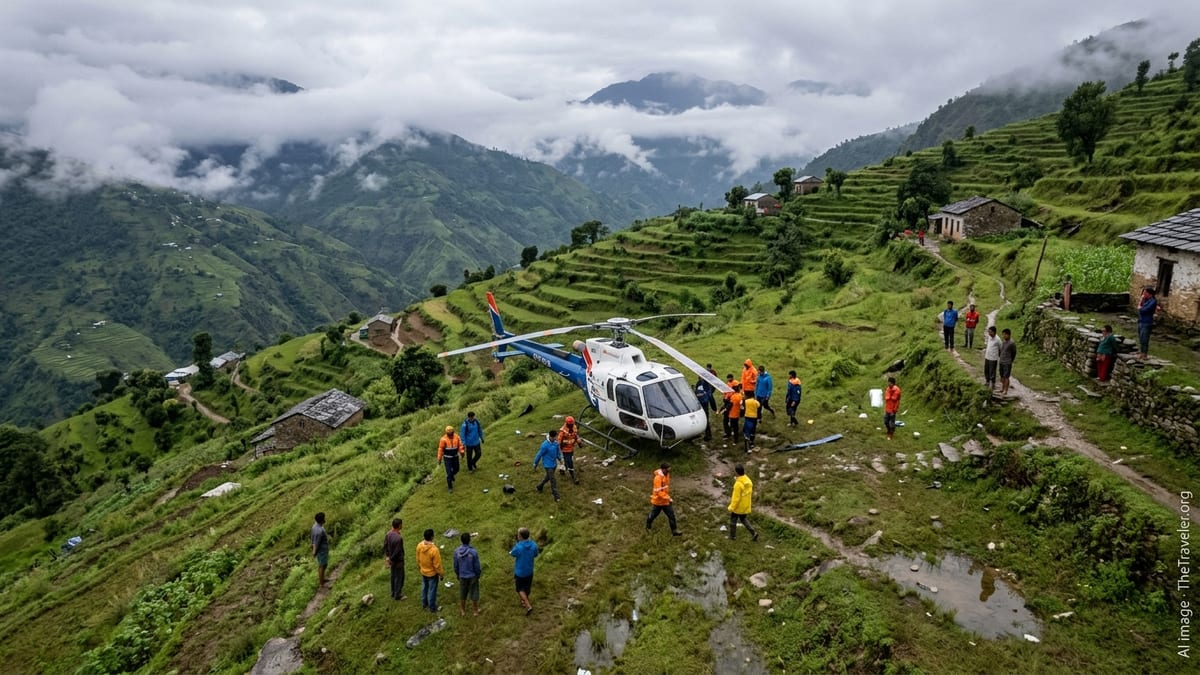
Initial coverage from Nepalese media and regional outlets indicates that the helicopter went down in eastern Nepal while attempting an emergency landing after encountering deteriorating weather. The aircraft was reportedly operating a domestic flight, carrying a small group of passengers along with at least one crew member when the incident occurred.
Publicly available reports suggest that the helicopter had been flying in a corridor commonly used to connect remote hill districts with larger towns. As cloud built up and visibility dropped, the crew appears to have sought a rapid landing site, but contact with the ground led to a hard impact. Images shared on social platforms show a heavily damaged airframe resting on uneven terrain.
Local rescue teams, supported by residents from nearby settlements, reached the scene shortly after the crash was reported. Passengers were moved away from the wreckage and transported toward medical facilities in the region, with some later transferred onward for specialist treatment in larger urban hospitals.
Early accounts indicate that there were no immediate reports of large post-crash fire, which may have reduced the severity of injuries. However, the full medical picture remains fluid as hospitals continue assessments and authorities work to reconcile passenger manifests with those admitted for care.
Passenger injuries and medical response
Regional news coverage and social media posts from the area describe several passengers sustaining injuries of varying seriousness, including fractures and head trauma. Some individuals were reportedly able to walk away from the helicopter with assistance, while others had to be carried out on improvised stretchers before ambulances arrived.
Doctors at local clinics have been treating patients for blunt-impact injuries consistent with a sudden vertical and lateral deceleration, a pattern that is often seen in hard helicopter landings in rugged terrain. Medical staff have also been monitoring for internal injuries and spinal trauma, which can be less obvious in the immediate aftermath of a crash.
Because many eastern Nepal settlements sit far from major hospitals, the emergency response relied on a mix of road ambulances, community vehicles, and additional air support once weather permitted. Publicly available information indicates that several injured passengers have been stabilized, though a small number reportedly remain in more serious condition, requiring ongoing observation.
Officials responsible for civil aviation oversight in Nepal typically coordinate with health authorities following such events to track patient outcomes and update official casualty figures. That process is still under way, and final tallies of minor versus serious injuries may change as more information becomes available.
How weather complicated the emergency landing
Weather over eastern Nepal is often highly variable, with rapid shifts in cloud, wind, and precipitation driven by complex mountain geography. Previous accident reports from the region have highlighted how localized clouds can quickly obscure ridgelines, river valleys, and informal landing sites, leaving very little margin for pilots operating under visual flight rules.
In this incident, publicly available descriptions point to a pattern of deteriorating visibility and increasing cloud, with the helicopter apparently attempting to reach a suitable landing zone before conditions closed in further. Low cloud ceilings and shifting winds can force pilots to maneuver at low altitude in narrow valleys, reducing options if a sudden descent or diversion becomes necessary.
Specialist analyses of past Nepal helicopter accidents have repeatedly noted that emergency landings in the hills and foothills can be particularly hazardous. Flat, obstruction-free surfaces are limited, and many unofficial landing spots are sloped fields, riverbeds, or road segments cut into steep terrain. Even a well-executed precautionary landing can turn into a hard impact if the ground is uneven, soft, or partially obscured by vegetation or dust.
The current crash appears to have followed a similar trajectory, with the crew trying to put the helicopter down quickly in marginal conditions. Investigators are expected to examine meteorological data, pilot reports, and any available flight tracking or cockpit recordings to reconstruct exactly how the weather evolved and which options were available at different moments of the flight.
Investigation and focus on safety record
Nepal’s civil aviation sector has long drawn international attention because of a series of crashes involving fixed-wing aircraft and helicopters in remote and mountainous regions. Previous government investigation reports have cited a recurring mix of challenging terrain, changeable weather, and human factors, alongside infrastructure constraints at smaller airfields.
In the aftermath of this latest helicopter crash, aviation regulators in Kathmandu are expected to initiate a formal inquiry. Such investigations typically involve collecting wreckage, reviewing maintenance and flight logs, interviewing surviving crew and passengers where possible, and assessing whether established operating procedures were followed.
International safety bodies and airlines that operate into Nepal have encouraged continued investment in pilot training, terrain awareness technology, and improved forecasting for mountain weather. Past recommendations have also focused on dispatch procedures for flights into remote valleys, with an emphasis on setting conservative go or no-go thresholds when convective cloud or afternoon storms are likely.
The findings from the eastern Nepal crash may influence future route planning and emergency-landing guidance for helicopter operators serving remote communities, trekking routes, and pilgrimage sites. Any emerging patterns that echo past accidents, such as pressure to complete flights in marginal conditions, are likely to attract particular scrutiny from safety advocates.
Implications for travelers and aviation in eastern Nepal
While helicopter and small-aircraft flights remain an essential lifeline for many parts of Nepal, incidents like this remind travelers of the unique risks associated with mountain aviation. Operators serving eastern regions often provide chartered flights for residents, trekkers, and pilgrims, and demand typically peaks during trekking seasons and religious festivals.
Travel industry observers note that Nepal has made incremental safety improvements in recent years, including stricter oversight of some operators and upgrades to navigation aids on key routes. However, the combination of topography and weather means that complete risk elimination is not possible, particularly for short-hop helicopter flights into high valleys and remote airstrips.
Prospective passengers are encouraged by aviation specialists to pay close attention to operator briefings, ask questions about weather delays, and accept schedule disruptions as a normal and necessary part of flying in the Himalaya. Choosing reputable operators with modern equipment and conservative safety cultures is widely regarded as one of the most practical steps individuals can take.
As more details emerge from the eastern Nepal crash, travel and aviation communities are likely to watch how lessons from the investigation are translated into concrete measures, from refined pilot training modules to tighter rules around flights in marginal conditions. For a country that relies heavily on air links to connect its remote regions, each incident reinforces the importance of continual investment in safety alongside continued access to the skies.