

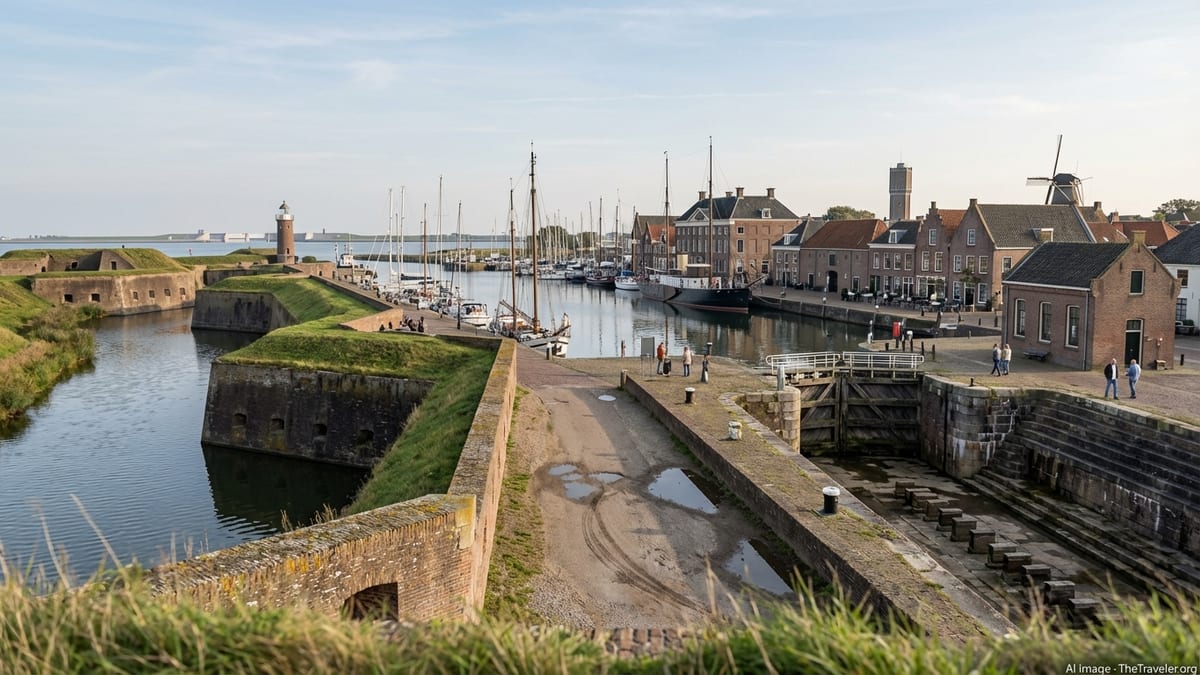
Once a crucial stronghold of Dutch sea power, the fortress town of Hellevoetsluis still wears its maritime past on its sleeve. On the southwestern edge of the Randstad, where the waters of the Haringvliet meet the reclaimed lands of Voorne-Putten, old ramparts encircle historic docks, arsenals, and a remarkable dry dock that once serviced the warships of a global trading empire.
Today, pleasure yachts have largely replaced men-of-war, and museums have taken over from the Admiralty, yet the fabric of Hellevoetsluis remains that of a naval base: compact, fortified, and oriented toward the sea.
From Marshland to Strategic Harbour
Hellevoetsluis began in a landscape that hardly suggested a major naval base. Early settlements clustered around a watercourse known as the Helle, later Latinised as Helinium or Helius. By the late Middle Ages, the low-lying land here was protected by dikes and drained by sluices, one of which gave the town its name: the Hellevoetse sluis, the sluice at the foot of the Helle. It was a practical place at first, more concerned with keeping water out than with sending ships to sea.
The town’s fortunes changed dramatically in the 16th and 17th centuries, during the Eighty Years’ War and the emergence of the Dutch Republic. As the new state sought secure bases for a rapidly expanding fleet, Hellevoetsluis offered something precious: a naturally sheltered anchorage with access to the North Sea, yet tucked deep enough in the delta to be defended and provisioned. This location between open water and the economic heartland around Rotterdam would define Hellevoetsluis for centuries.
By the early 1600s Hellevoetsluis was being reshaped from rural backwater into a purpose-built harbour. Quays were strengthened, basins excavated, and works thrown up to control the entrance channel. Over time, the town became less a conventional settlement and more a carefully engineered maritime machine, an integrated combination of docks, workshops, and defensive lines geared entirely toward sea power.
The Admiralty of de Maze and a Golden Age of Sea Power
The decisive moment in Hellevoetsluis’s rise came when it became the naval port of the Admiralty of de Maze, the body responsible for the fleet of Rotterdam. In the age of sail, each major Dutch port had its own admiralty, and each required a secure harbour where ships could be built, armed, and repaired. For the Rotterdam admiralty, Hellevoetsluis evolved into a kind of offshore arsenal, a fortress-enclosed wet dock where an entire fleet could lie in safety.
Here, some of the most famous Dutch admirals of the 17th century maintained their home base. Maarten Tromp, Michiel de Ruyter, and Piet Heyn all operated from Hellevoetsluis at various points, commanding squadrons that fought in wars against England, Spain, and France. Warships took on guns and stores behind earthworks and bastions, sailing out through the narrow entrance to challenge rival fleets in the Channel and beyond. In this period, Hellevoetsluis functioned as a kind of naval firewall for the western provinces: if an enemy navy wanted access to the Maas and Rotterdam, it first had to reckon with the ships lying ready here.
Hellevoetsluis also briefly stood at the center of European politics. In 1688 the invasion fleet of William III of Orange, which would help trigger the Glorious Revolution in England, gathered in Dutch waters and set sail from the Meuse estuary. Hellevoetsluis was among the key assembly ports where troops, horses, and supplies were embarked for the risky crossing. The quiet basins of today conceal a legacy of momentous departures and anxious returns.
Fortress in Brick and Earth
Hellevoetsluis is often described as a fortress town, and the word is more than a romantic label. From the 17th century onward, the settlement was systematically reshaped into a fortified complex. Bastioned ramparts, ravelins, and moats were laid out around the harbour and town, creating a defensive ring that could withstand artillery and control approaches by land and water.
Unlike many fortresses that merely enclosed a garrison and a marketplace, Hellevoetsluis wrapped its walls around an active naval dockyard. Gun batteries covered the harbour entrance, while thick earthworks shielded magazines, ropewalks, and storehouses. The result was a hybrid of military engineering and maritime infrastructure that today gives the old town its distinctive geometry of angled walls and water-filled ditches.
Walking the ramparts now, you encounter traces of that integrated system. Fort or Bastion Haerlem, with its heavy casemates, recalls the days when cannon commanded the harbour approaches. Former naval offices, such as the Admiraliteitsgebouw, testify to the administrative life behind the guns. Even the positioning of the windmill De Hoop and the later water tower made practical sense in a town that had to be self-reliant in times of siege, capable of grinding grain and managing water supplies within the walls.
What sets Hellevoetsluis apart from many other Dutch fortresses is how much of this defensive shell remains legible. While modern housing has expanded well beyond the historical core, the fortress ring itself is still recognisable, giving visitors a clear sense of where the naval town began and ended.
Dry Dock Jan Blanken and the Age of Naval Innovation
If the ramparts express Hellevoetsluis’s defensive mindset, the Dry Dock Jan Blanken reflects its technical sophistication. Conceived in the late 18th century, when warships were growing larger and traditional maintenance techniques were failing, this double dry dock was at the cutting edge of naval engineering. Instead of careening ships by heaving them onto their sides in tidal mud, the Dutch navy turned to controlled, dry environments where hulls could be inspected from keel to rail.
Engineer Jan Blanken proposed a radical solution for Hellevoetsluis: a dock complex with two chambers at different levels, served by a caisson door and powered by a steam engine. Construction began around 1798, at a time when the Netherlands was reorganising its navy under the Batavian Republic. The work involved not only building the dock itself but also rethinking local water management, since the surrounding polders had previously been drained through the naval harbour.
Completed in the early 19th century, the dry dock allowed large warships to be lifted above normal water levels, set on blocks, and serviced out of the sea. A pioneering steam-powered pump house, with machinery secretly sourced from Britain, provided the muscle to empty the chambers. For the navy, the advantages were immediate: ships could be maintained without the structural strain and damage associated with careening, saving costs and extending hull life.
Today, Dry Dock Jan Blanken survives as both an industrial monument and a working demonstration of early naval technology. Visitors can descend into the dock, admire the caisson door system, and trace the lines where ships once rested. The dock anchors an open-air maritime museum that brings together vessels, exhibitions, and guided tours, underscoring how central engineering was to Hellevoetsluis’s role as a naval base.
From Naval Outpost to Outport of Rotterdam
While Hellevoetsluis began as a military harbour, its strategic position inevitably drew commercial interest. In the early 19th century, plans took shape for a ship canal across the island of Voorne, connecting Hellevoetsluis more directly with the Nieuwe Maas and Rotterdam. The result, the Voorne Canal, opened in the 1830s and transformed the town into an outport, a seaward gateway for goods and passengers headed to the booming port city upriver.
The canal entered Hellevoetsluis just east of the fortress, linking its secure harbour to inland waterways. Deep-draught sailing ships could now reach Rotterdam without threading the treacherous sandbanks of the wider delta. For several decades this brought prosperity: shipyards worked at capacity, chandlers and victuallers supplied both naval and merchant vessels, and the town’s waterfront thrived on a mix of uniforms and civilian trade.
Yet the very forces that had once favoured Hellevoetsluis also sowed the seeds of change. As ships grew still larger in the late 19th and early 20th centuries, the canal’s dimensions and the harbour’s approaches became limiting factors. The construction of the Nieuwe Waterweg, a new, more direct route to Rotterdam, gradually eclipsed the importance of the Voorne Canal. Ocean-going traffic shifted away, and Hellevoetsluis began a slow economic decline even as its naval installations remained in use.
War, Relocation of the Fleet, and Postwar Reinvention
By the 1930s, strategic considerations and changing naval technology led the Dutch authorities to concentrate more of the fleet in Den Helder, farther north along the North Sea coast. The relocation reduced Hellevoetsluis’s importance as an active naval base. Government shipyards closed, and the town lost much of the direct military presence that had defined it for centuries.
The Second World War brought harsher blows. Occupying German forces exploited Hellevoetsluis’s harbour and canal system, using parts of the infrastructure for midget submarines and other operations. In 1944, amid retreat and scorched-earth tactics, large parts of the town were destroyed. An estimated three-quarters of its buildings were damaged or leveled, erasing whole streetscapes while leaving sections of the fortress and dockyard heavily scarred.
In 1953, the North Sea flood that devastated much of Zeeland and South Holland struck Hellevoetsluis as well. Sea defences failed, and storm-driven waters inundated the town, underlining both its enduring connection to the sea and its vulnerability. The disaster became one of the catalysts for the Delta Works, the vast system of dams and storm surge barriers that would reshape the entire Rhine-Meuse-Scheldt delta in the ensuing decades.
Postwar reconstruction recast Hellevoetsluis as a New Town on the water’s edge. From the 1960s onward it absorbed new housing estates, greenbelts, and infrastructure designed to accommodate commuters to Rotterdam and the Europoort industrial area. The population swelled, modern amenities arrived, and the fortress town that had once been almost entirely a naval enclave began to function as a residential hub, even as its historic core retained a strong maritime identity.
Historic Harbour, Museums, and Maritime Heritage Today
Modern Hellevoetsluis is a study in contrasts: contemporary suburbs and marinas stretch inland, while the old fortress encircles a cluster of 16th to 19th century buildings and maritime landmarks. This compact core now serves as a kind of open-air showcase of Dutch naval history, where visitors can trace the evolution from sail-powered fleets to industrial-age engineering.
The Dry Dock Jan Blanken complex forms one of the main attractions, offering an immersive introduction to historic ship maintenance and water management. Nearby, former naval warehouses and workshops have been repurposed as exhibition spaces, some housing collections devoted to coastal defence, shipbuilding, and everyday life in a garrison town. The ram turret ship Buffel, moored in the harbour as a museum vessel, provides a tangible link to the 19th century transition from wooden sailing ships to ironclad steam warships.
Other heritage sites complement this narrative. The original Admiraliteitsgebouw, once the nerve centre of naval administration, stands as a stately reminder of the bureaucracy behind the battle flags. The lighthouse watches over approaches that are far more placid today than in the days of sail. On the town side, the water tower illustrates how naval demands for secure freshwater supplies precipitated investments in civic infrastructure, long before surrounding communities enjoyed the same services.
Museums dedicated to firefighting and local history round out the picture, revealing how a defence-oriented settlement coped with everyday risks and domestic routines. Together, these institutions and monuments create a layered story: not only of admirals and shipwrights, but also of dock labourers, families, and officials whose lives were anchored in the rhythms of the naval base.
Vesting Town Life: Events and Waterfront Leisure
Despite its fortress origins, Hellevoetsluis today feels open and lively, particularly along the waterfront. The old basins that once hosted warships now shelter pleasure craft, and the quays are lined with terraces, cafes, and restaurants looking out over masts and rigging. On warm evenings, the atmosphere can feel almost Mediterranean, an easygoing counterpoint to the stern outlines of the bastions.
Water sports are a major draw. With the broad Haringvliet on one side and the North Sea within reach, Hellevoetsluis has developed into one of the larger recreational sailing centres in the Netherlands. Multiple marinas offer thousands of berths, and regattas and boating events dot the seasonal calendar. Sailors appreciate the combination of sheltered waters for training and racing, and the opportunity to venture farther offshore when conditions allow.
Cultural life in the fortress town is anchored by recurring events that deliberately highlight its heritage. Fortress Days, held in late summer, transform the historic core into a festival ground where classic ships, vintage vehicles, music, and markets converge. Re-enactments and demonstrations echo martial themes, yet the mood is festive, connecting residents and visitors to a past that is celebrated rather than merely preserved behind glass.
A growing emphasis on storytelling has also emerged, with guided walks, themed tours, and interpretive signage helping visitors make sense of the layered landscape. Instead of isolated monuments, the fortress, docks, and canals are increasingly presented as parts of an integrated story about Dutch water management, trade, and defence. The result is a town that is not only beautiful to stroll through, but intellectually engaging as well.
Planning a Visit: Experiencing the Fortress Town
For travellers interested in history, architecture, or maritime life, Hellevoetsluis rewards both short visits and longer stays. A sensible starting point is the fortress itself. Enter through one of the old gates, trace the line of the ramparts, and take time to understand the geometry of bastions and moats before descending into the harbour area. The town’s relatively small scale makes it easy to explore on foot, and many key sights lie within a short walking radius.
From the ramparts, descend to the historic docks to see Dry Dock Jan Blanken, the museum ship Buffel, and the surrounding quays. Check in advance which exhibitions and guided tours are available, as some experiences, particularly those inside the dock structures, may be accessible only at certain times. Even without formal tours, the visible machinery, stepped dock floors, and caisson gates are compelling in their own right.
Beyond the fortress, consider a stroll to the water tower and other listed monuments that speak to the town’s evolution from purely military enclave to mixed civilian settlement. If you are travelling with family, the combination of waterfront playgrounds, petting farms, and accessible museum displays can make the history approachable for younger visitors. Hellevoetsluis works well as a day trip from Rotterdam or The Hague but also offers enough variety to justify an overnight stay, particularly for sailing enthusiasts.
As with much of the Dutch coast, weather can change quickly, so flexible plans help. A blustery day might push you toward indoor exhibits and cafe terraces under awnings, while calm conditions invite longer walks and boat excursions. Regardless of the season, the sight of old fortifications wrapped around a living harbour remains constant, reminding you that this has always been a place where land, water, and security are intimately intertwined.
The Takeaway
Hellevoetsluis is more than a charming harbour town with an atmospheric old centre. It is one of the Netherlands’ most significant historic naval bases, a place where maritime power, military engineering, and everyday civic life intersected for centuries. From the heyday of the Admiralty of de Maze, when great admirals sailed from its wet docks, to the technical breakthroughs embodied in Dry Dock Jan Blanken, the town played a central role in safeguarding Dutch interests at sea.
Today, the fortress ring, the preserved docks, and the repurposed naval buildings offer a rare opportunity to experience that history in situ. Rather than presenting itself as a frozen museum, Hellevoetsluis has embraced its waterfront as a space for sailing, festivals, and relaxed enjoyment. Visitors can savour terraces overlooking busy marinas while standing within earthworks once designed for cannon, or descend into a centuries-old dry dock after lunch at a modern cafe.
In an era when many historic ports have been radically redeveloped, Hellevoetsluis stands out for the clarity with which its past remains visible. The outlines of bastions, canals, and dock basins still make sense when read against the stories of admirals, shipwrights, and engineers. For travellers willing to look beyond the obvious highlights of Amsterdam or Rotterdam, this fortress town on the Haringvliet offers a compelling, compact lesson in how a small harbour could become a linchpin of a maritime nation.
FAQ
Q1. Why was Hellevoetsluis chosen as a naval base in the first place?
The location combined a sheltered harbour within the Rhine-Meuse delta with direct access to the North Sea, allowing fleets to be equipped and protected behind fortifications yet sail quickly to major sea routes.
Q2. What is special about the Dry Dock Jan Blanken?
It is an early example of a double dry dock using advanced engineering and steam power to lift and service large warships out of the water, significantly improving maintenance compared to older methods like careening.
Q3. Can visitors go inside the fortress walls today?
Yes, the historic fortress area is an integral part of the town. You can walk the ramparts, explore the streets within the walls, and visit museums and harbour installations located in former naval buildings.
Q4. Is Hellevoetsluis still used by the navy?
The Dutch navy relocated its main operations to Den Helder in the 20th century. Hellevoetsluis now functions primarily as a civilian town and recreational sailing centre, with naval facilities preserved mainly for heritage and museum purposes.
Q5. What role did Hellevoetsluis play in the Glorious Revolution?
In 1688, the invasion fleet of William III of Orange, which crossed to England and helped trigger the Glorious Revolution, assembled and departed from ports in the Meuse estuary, with Hellevoetsluis serving as one of the key embarkation and staging harbours.
Q6. How badly was the town damaged during the Second World War?
By 1944, retreating German forces and wartime operations had left roughly three-quarters of Hellevoetsluis’s buildings destroyed or heavily damaged, though many core fortress structures and harbour works survived and were later restored.
Q7. What kinds of museums can I visit in Hellevoetsluis?
You will find maritime and naval history exhibits around Dry Dock Jan Blanken and the museum ship Buffel, as well as collections focused on firefighting, local heritage, and scale models showing the fortress and dockyard in earlier centuries.
Q8. When are the best times to experience local events in the fortress town?
Summer is particularly lively, with water sports events and Fortress Days in August bringing classic ships, music, markets, and re-enactments into the historic harbour and streets inside the ramparts.
Q9. Is Hellevoetsluis suitable for a family visit?
Yes, the combination of accessible museums, open ramparts, waterfront promenades, and family-friendly facilities such as playgrounds and petting farms makes it appealing for visitors of different ages.
Q10. How much time should I set aside to explore the historic naval area?
A focused half day is enough to walk the fortress, see the harbour, and visit one or two museums, but a full day allows a more relaxed pace, time on the waterfront terraces, and a deeper dive into the town’s naval heritage.