

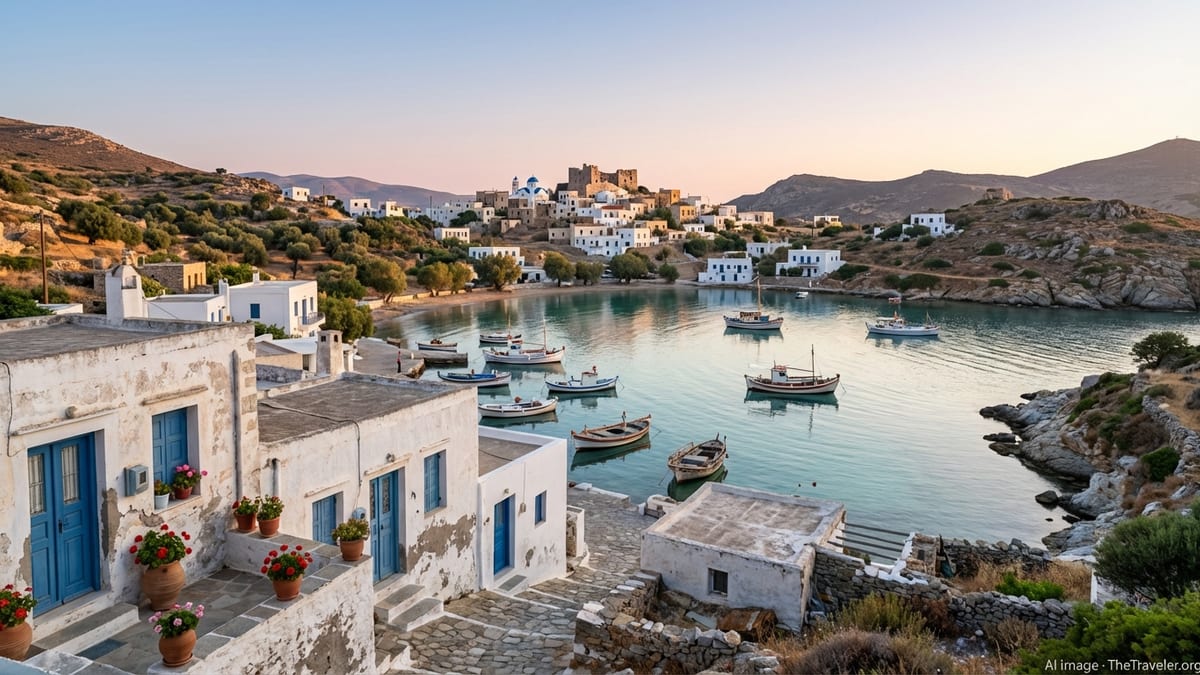
Greece’s superstar islands attract cruise ships, honeymooners, and headline-grabbing beach clubs each summer. Yet beyond Santorini’s caldera and Mykonos’s nightlife, a quieter Greece is still very much alive. On lesser-known islands, you can swim in empty coves at noon in August, find a table at the village taverna without a reservation, and hear only cicadas instead of DJ sets. These are the hidden Greek islands to choose when you want Cycladic charm and Aegean light, but not the crowds.
Why Choose Hidden Islands Over Household Names
The Greek islands most travelers recognize by name have become victims of their own success. Santorini’s clifftop paths can turn into slow-moving queues at sunset, and high-season hotel rates on Mykonos rival those of major world cities. Even traditionally laid-back places such as Rhodes and Corfu now juggle cruise arrivals, package resorts, and Instagram fame. For many visitors, that means less of the spontaneous hospitality and easy-going rhythm that once defined Greek island life.
Opting for a quieter island does not mean sacrificing scenery or comfort. Many lesser-known islands offer the same whitewashed villages, blue-domed chapels, and luminous bays that made their famous cousins so photogenic in the first place. What they often lack are big resorts, sprawling marinas, and high-rise developments. You are more likely to find small family-run guesthouses, owner-operated tavernas, and beaches where the loudest noise is the sea on the pebbles.
These islands reward travelers who are willing to trade a quick direct flight or high-speed ferry for an extra connection or a slightly longer crossing. The payoff is space: space on the sand, space on hiking paths, and space in your days. With fewer cruise groups and bus tours, you can slip more easily into local routines, whether that means long lunches that run into late afternoons or evening strolls when the villages finally cool down.
The following islands are not secrets to Greeks, but they remain under the radar for many international visitors. Each offers a compelling alternative to one of the famous hotspots, with its own version of dramatic landscapes, authentic villages, and quiet beaches.
Astypalaia: A Caldera-Free Alternative to Santorini
If Santorini’s clifftop villages and sunset views appeal, but you would rather avoid the cruise crowds and traffic, Astypalaia is a compelling alternative. Sitting at the western edge of the Dodecanese, yet looking and feeling much like a Cycladic island, it has white cubic houses, blue shutters, and a spectacular hilltop chora crowned by a Venetian castle. From the harbor at Pera Gialos, the village rises in a cascade of white that glows in the evening light, without the bus convoys and selfie sticks that dominate Santorini’s Oia in high season.
Astypalaia’s beaches remain relatively low-key, even in summer. Many are reached by rough tracks or boat, which naturally keeps numbers down. Small coves around the island reward those willing to rent a car or hop on local kaiki boats, with clear turquoise water and pebbly shorelines where you might share the bay with a handful of others. Off-shore islets such as Koutsomitis and Kounoupa have become known among in-the-know travelers for their luminous shallows and stripped-back, barefoot atmosphere, far removed from the packed catamarans of Santorini’s caldera.
Where Santorini leans heavily into high-end hotels and curated experiences, Astypalaia still feels personal. Many guesthouses are family enterprises, breakfast might include cheese or honey produced on the island, and it is still common for owners to sit for a drink with guests at the end of the day. Recent efforts to introduce electric vehicles and greener infrastructure have brought Astypalaia to the attention of sustainability-minded travelers, but development has remained small in scale. Even in peak season, you can usually wander the chora’s alleys at dusk and find a quiet taverna terrace with castle views and a table waiting.
Practicalities favor travelers willing to plan ahead. Astypalaia has flights from Athens and ferry links to Piraeus and other Dodecanese and Cycladic islands, but schedules can be limited, especially at the edges of the season. Once there, a rental car or electric scooter opens up more secluded coves and hilltop chapels, though some beaches are accessible by small bus services. For visitors seeking Santorini-like romance without the crowding and cruise timetable, this little butterfly-shaped island is hard to beat.
Kythira: Swap Crowded Ionian Resorts for a Slow Island Classic
Corfu and Zakynthos dominate conversations about the Ionian Sea, with package resorts, busy airports, and nightlife hubs that surge in summer. South of the Peloponnese, Kythira remains a quieter, more introspective counterpart. Officially part of the Ionian group but geographically isolated, it has an atmosphere that feels closer to a timeless, pre-resort Greece. Villages huddle on hilltops and bays, and roads wind past olive groves, gorges, and tiny churches clinging to cliffs.
The coastline delivers the same turquoise water and dramatic coves that have made the better-known Ionian islands famous, but with a fraction of the footfall. Beaches such as Kaladi, a three-part cove reached by stone steps, or Chalkos and Melidoni, framed by cliffs and scattered tamarisk trees, remain relatively uncrowded outside peak August weekends. In many places there are no large beach bars, only a simple canteen or nothing at all, encouraging visitors to bring water, an umbrella, and a sense of independence.
Inland, Kythira offers the kind of landscape often overlooked on more developed islands. The ruined medieval settlement of Paleochora stands on a narrow ridge above a gorge, a reminder of the island’s turbulent history with pirate raids and shifting powers. Traditional villages such as Potamos and Mylopotamos center life around shaded squares and old stone bridges. After a day of swimming or hiking, evenings unfold at a slower pace, with locals and visitors sharing tables under plane trees while children cycle around the platia.
Kythira is especially appealing to travelers who enjoy combining beach time with exploration. Short walks lead to waterfalls and rock pools, while coastal paths connect low-key bays such as Agia Pelagia and nearby hidden coves. Because the island requires either a domestic flight or a ferry via the Peloponnese or Crete, it has remained off most first-time itineraries. For those willing to make the extra journey, it offers an Ionian experience more reminiscent of earlier decades, with clear water, simple seaside tavernas, and nights that still feel dark and star-filled.
Ikaria: Choose Island Time Over Mykonos Nightlife
Mykonos is synonymous with beach clubs, late nights, and headline DJs. For a very different kind of island time, Ikaria offers a slower, more grounded alternative in the northeastern Aegean. The island has gained a degree of international attention as a so-called “blue zone,” where many residents live to an advanced age, but tourism here still feels low-key compared with the polished party scene of Mykonos. Distances are long, the terrain is mountainous, and daily life follows its own unhurried logic.
Beaches on Ikaria range from sandy, family-friendly stretches to wild, wind-exposed bays. While none has the organized intensity of Mykonos’s most famous strands, many have a relaxed bohemian atmosphere. In places like Seychelles beach, reached via a short but steep path and a small tunnel in the rock, swimmers are rewarded with luminous aquamarine water backed by cliffs and boulders. Elsewhere, long beaches such as Messakti and Livadi have room to spread out, with space for surfers, families, and those simply content to read under an umbrella.
What sets Ikaria apart is less any single sight and more the way time feels on the island. Traditional village festivals, or panigyria, can run well into the night, with live music, local wine, and communal dancing where visitors are welcome but not the focus. Daily routines run later than on many other islands, with some shops and cafes closing in the afternoon and reopening in the evening when the heat has passed. Instead of curated beach parties, you are more likely to find a group of locals sharing food and songs in a village square or a simple cafe perched above the sea.
Reaching Ikaria typically involves a domestic flight from Athens or a ferry through the northern Aegean, often combined with neighboring islands such as Samos or Chios. Once there, travelers should be prepared for winding roads and longer driving times, rewards for which include little-developed mountain villages, natural pools in rivers, and a coastline that feels remarkably uncrowded relative to its better-known neighbors. For those willing to swap nightlife for night skies and loud beats for cicadas, Ikaria provides a memorable antidote to the high-tempo energy of Mykonos.
Serifos: Wild Cycladic Beauty Instead of Packed Paros
Paros has emerged as one of the Cyclades’ busiest hubs, with a new generation of high-end hotels, beach clubs, and bars drawing visitors who might once have focused on Mykonos. For a wilder, more spacious version of Cycladic life, Serifos remains a strong alternative that feels far less polished yet deeply rewarding. Its striking chora climbs a conical hill above Livadi bay, white houses stacked in layers toward a small summit church and castle ruins.
Serifos’s coastline is dotted with sandy beaches reached by a mix of paved roads and rough tracks. Well-known favorites such as Psili Ammos and Agios Sostis can attract a gentle crowd in high summer, but they never approach the lines of loungers and high-decibel music now common on parts of Paros. Many other bays remain almost empty, especially in the early and late season or at the quieter times of day. It is still possible to park under a tamarisk tree, walk a short path, and find a cove with only a few umbrellas and the occasional fishing boat offshore.
Much of the island’s appeal lies in how little it has been reshaped for tourism. Former mines along the southern coast, rusting machinery, and old stone paths tell the story of Serifos’s industrial past. Hiking routes cross bare hillsides dotted with chapels and dry-stone walls, with views across the Aegean to Sifnos, Kythnos, and beyond. While there is a growing choice of stylish small hotels and carefully restored village houses, large-scale development remains limited. Evening life centers on the waterfront at Livadi and the lanes of the chora, where visitors and locals share the same bars and bakeries.
Serifos is particularly attractive to travelers who want the classic Cycladic palette of white and blue without the buzz of a major hub. Ferries from Piraeus make it straightforward to reach, especially in summer, but the island’s modest size and simple infrastructure have kept it from tipping into overdevelopment. It can be combined with neighboring Sifnos or Milos, yet many find that a week spent entirely on Serifos, rotating between beaches and hilltop walks, is enough to satisfy the urge for both rest and exploration.
Nisyros: Volcano Views Instead of Rhodes Resort Strips
Rhodes, the largest island of the Dodecanese, balances a medieval old town, beach resorts, and a busy cruise schedule. For travelers interested in dramatic landscapes and traditional villages rather than large hotels, smaller Nisyros to the south offers a more intimate experience. The island is dominated by a volcanic caldera, whose pale floor and smoking vents give a quietly otherworldly character to the interior, while white houses and bougainvillea spill down the slopes in villages such as Mandraki and Nikia.
Walking into the caldera, on marked paths around the main Stefanos crater and smaller vents, provides a glimpse of the island’s geological life that feels far removed from Rhodes’s busier coastal scene. The landscape here is raw and luminous, with sulfur-stained rocks, warm ground underfoot, and wide views back to the sea. Away from the volcano, Nisyros’s villages retain an old-fashioned rhythm: narrow lanes, painted courtyards, and small cafes where chairs spill onto the street. Even in high season, evenings feel relaxed rather than congested.
Coastal life on Nisyros is quieter than on Rhodes, with a handful of modest beaches and swimming spots. Pali, a small harbor village, offers a protected bay with tavernas and simple rooms, while rocky platforms and small coves near Mandraki allow for swims before or after wandering the monastery and castle above town. Without long resort strips, nightlife revolves around a few bars and festivals rather than a built-up promenade, and dark skies make stargazing on clear nights a simple pleasure.
Nisyros is usually reached by ferry from Kos or occasionally from Rhodes and other nearby islands. This extra step has helped keep visitor numbers modest. Those who make the journey are rewarded with a compact island where walking is often the best way to explore. For travelers who find Rhodes’s resort areas too busy, but still want Dodecanese history, food, and sea views, Nisyros offers a quieter, more introspective base.
Sikinos: A Tranquil Stand-In for Ios
Ios, once known primarily as a backpacker party enclave, has broadened its appeal with boutique hotels and stylish bars, but its reputation for nightlife and beach crowds persists. Just a short ferry ride away, Sikinos remains one of the Cyclades’ most low-key islands, ideal for visitors who want similar landscapes without late-night noise. Its main village, Kastro, perches on a ridge above the sea, a compact cluster of white houses, small squares, and a monastery visible from afar.
There are only a handful of beaches on Sikinos, and this scarcity has helped preserve the island’s peaceful character. Small bays such as Agios Georgios and Dialiskari are simple affairs: clear water, pebbles or sand, a few tamarisk trees, and perhaps a single taverna or no facilities at all. Rather than hopping from bar to bar, days tend to follow a natural rhythm of swimming, reading, napping, and maybe a gentle walk in the late afternoon. The absence of large clubs and organized water sports is a feature rather than a drawback for the island’s loyal visitors.
Sikinos’s charm lies in details that can be easy to miss on busier islands. Old stone terraces curve around hillsides where grapes and olives are still cultivated on a small scale. Footpaths link chapels and viewpoints, rewarding early risers and sunset walkers with big skies and uninterrupted Aegean horizons. Dinner might be at a family-run taverna where much of the produce comes from the owners’ fields, and conversations drift between regulars and newcomers without the pressure of table turn times.
Connections to Sikinos are less frequent than to Ios, usually involving ferries from Athens via other Cycladic stops, or short hops from neighboring islands. This relative inaccessibility is exactly what keeps Sikinos quiet. It suits travelers happy with a narrower choice of restaurants and limited nightlife in exchange for calm, starry evenings and uncrowded paths. For those who enjoy the idea of Cycladic minimalism in both architecture and atmosphere, Sikinos may feel like a perfect fit.
The Takeaway
Choosing a hidden Greek island instead of a famous one is less about discovering someplace that no one has ever heard of and more about aligning your expectations with reality. On smaller, less-developed islands, beaches can be quieter, interactions more personal, and daily life shaped more by local needs than tourist timetables. At the same time, services may be simpler, transport less frequent, and nightlife modest. The reward for embracing those trade-offs is a deeper sense of place.
Astypalaia offers clifftop drama without Santorini’s crush of visitors. Kythira gives the Ionian’s turquoise water and lush valleys without large resort clusters. Ikaria invites you into a different relationship with time than the nightclub-focused nights of Mykonos, while Serifos and Sikinos keep Cycladic beauty intact without the built-up feel of Paros or Ios. Nisyros adds volcanic landscapes and quiet harbor life as an alternative to the busier corners of Rhodes.
In the end, the best island for you depends on whether you value silence over nightlife, paths over promenades, and small tavernas over large hotel buffets. Greece’s quieter islands are not going to stay unknown forever, but for now they still offer something that is increasingly hard to find in the age of social media: room to discover your own favorite cove, cafe, or village lane without following a crowd. Plan for a slightly longer journey and a more flexible schedule, and the Aegean and Ionian seas will still reward you with places that feel, if not secret, then at least satisfyingly your own.
FAQ
Q1. Are these lesser-known Greek islands suitable for first-time visitors to Greece?
Yes, they are suitable for first-time visitors who value quieter atmospheres and are comfortable with slightly more complex travel logistics than the main resort islands.
Q2. How busy do these hidden islands get in July and August?
They are busier in peak season but generally far less crowded than Santorini, Mykonos, or Rhodes, with more space on beaches and in villages.
Q3. Do these islands have enough accommodation options?
Most have a good range of small hotels, guesthouses, and rental apartments, though choices can be limited, so booking early for high season is sensible.
Q4. Is renting a car necessary on these islands?
On many of them a car or scooter is very helpful for reaching remote beaches and hilltop villages, as public transport is limited outside main routes and hours.
Q5. Are there nightlife options on quieter islands like Sikinos or Ikaria?
Nightlife is usually low-key, centered on cafes, bars, and village festivals rather than large clubs or organized beach parties.
Q6. What is the best time of year to visit these hidden islands?
Late May to early July and September to early October balance warm weather and swimmable seas with fewer visitors and calmer overall conditions.
Q7. Can families with children enjoy these lesser-known islands?
Yes, many families appreciate the relaxed pace, smaller crowds, and shallow, sheltered bays, provided they are comfortable with simpler facilities and quieter evenings.
Q8. How reliable are ferry connections to these islands?
Ferry links are generally reliable in summer but can be affected by wind or schedule changes, so it is wise to allow buffer days and check timetables frequently.
Q9. Are these islands more expensive or cheaper than the famous ones?
Daily costs for food and lodging are often comparable or slightly lower than on headline islands, though very budget and ultra-luxury options may be fewer.
Q10. Do I need to speak Greek to travel comfortably on these islands?
No, basic English is widely spoken in tourism-related businesses, but learning a few Greek phrases is appreciated and can enhance local interactions.