

More news on this day
Visitors heading to Los Cabos for the holiday weekend are being urged to approach the region’s beaches with heightened caution as powerful Pacific swells, strong rip currents, and rapidly changing surf conditions align with one of the busiest travel periods of the season.
Get the latest news straight to your inbox!
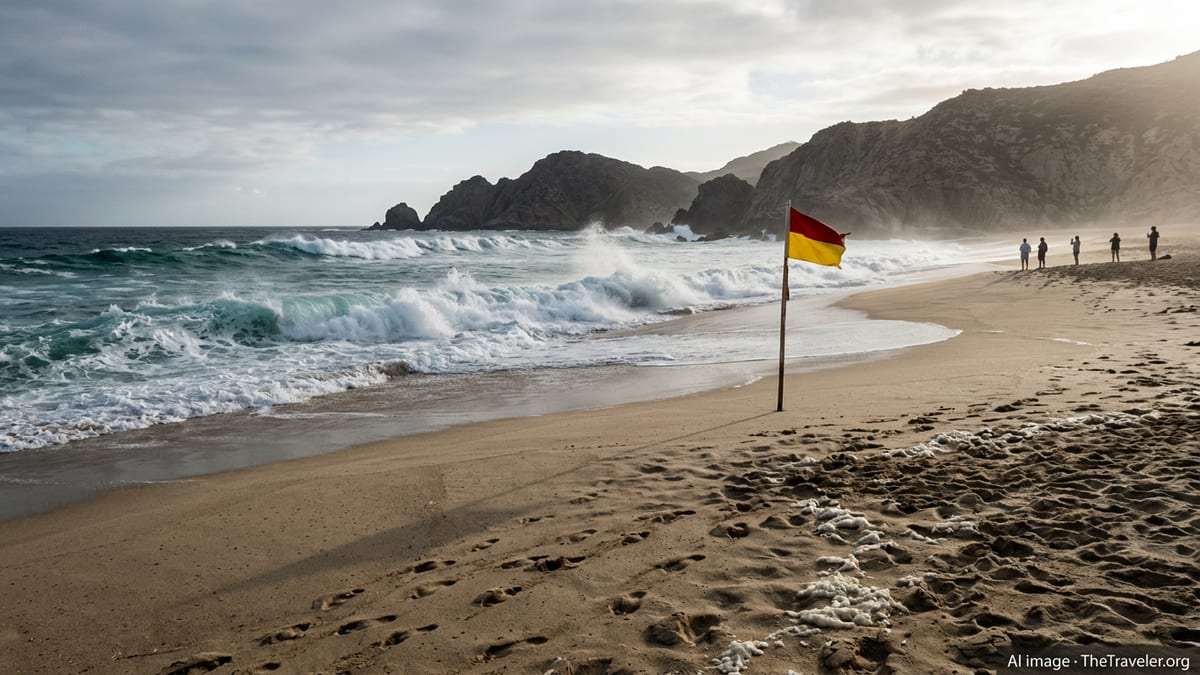
Holiday Crowds Meet a Powerful Pacific
Publicly available marine forecasts for the southern Baja California peninsula indicate a period of elevated Pacific swell coinciding with the holiday weekend, bringing rougher seas and stronger currents to much of the Los Cabos coastline. While conditions are not uniform across every beach, reports point to heavier sets and more frequent surges at open-ocean beaches along the corridor between Cabo San Lucas and San José del Cabo.
Travel coverage focused on Los Cabos frequently highlights that many beaches here are primarily scenic rather than swimmable, due to steep underwater drop-offs and the way incoming swells meet the coastline. Under normal conditions, this combination can already produce unexpectedly strong shore breaks and pullbacks. With added holiday swell energy, the margin for error narrows even further for inexperienced swimmers and those unfamiliar with local hazards.
Local tourism-oriented publications note that even on otherwise calm days, Los Cabos lifeguards and resort staff routinely restrict ocean access at certain stretches when surf rises or currents become unstable. During high-demand periods such as this weekend, that pattern can intensify, with more red and yellow warning flags, temporary closures of surf zones, and increased emphasis on keeping visitors out of hazardous water.
Understanding Flag Systems and Hidden Hazards
Recent safety guidance aimed at visitors to Los Cabos emphasizes that beach flag systems are a primary tool for communicating changing ocean risk levels. Green typically signals relatively low risk, yellow reflects moderate surf or currents where only strong swimmers should enter with caution, and red or black flags indicate that entering the water is considered unsafe. Travel safety explainers stress that these advisories can shift within hours as wind direction and swell height change.
Ocean-safety analyses of the region describe how rip currents, shore break, and sudden drop-offs often occur together in Los Cabos. A seemingly manageable wave line can mask a powerful outgoing flow that drags water seaward along the bottom, especially near rock formations or sandbars. Once a swimmer is caught in that flow, the combination of deep water and heavy, collapsing waves can make self-rescue extremely difficult.
Background reporting on Baja California Sur points to a multi‑year pattern of water-related incidents disproportionately affecting visitors who were unaware of local marine hazards or who entered the ocean despite warning flags. These summaries highlight a recurring theme: people are more likely to underestimate risk when beaches look calm from shore or when others are wading in just a few steps, only to encounter much stronger forces moments later.
Which Los Cabos Beaches Are Most Affected?
Travel guides consistently describe a sharp contrast between relatively sheltered swimming areas and exposed stretches of coast in Los Cabos. Playa El Médano, located in Cabo San Lucas Bay, is often referenced as the area’s most reliably swimmable beach, thanks to its protected position and regular lifeguard presence. Even there, however, reports note that higher surf events can trigger stricter flag warnings and temporary no‑swim periods, particularly near water-sports corridors.
By contrast, many beaches along the Tourist Corridor and toward the Pacific side, including stretches below clifftop resorts and golf communities, are routinely classified as “look‑but‑do‑not‑swim” zones in visitor advisories. Under the holiday weekend’s more energetic swell, these already challenging locations can see amplified shore break and stronger rip currents, further limiting any safe access to the water.
Travel writers covering all‑inclusive properties in the region frequently mention that resort staff caution guests against entering the surf directly in front of certain hotels, even for shallow wading. Several recent reviews describe scenarios where guests were advised that ankle‑deep water could become dangerous within a single set of incoming waves, underscoring how quickly conditions can change along steep, wave‑exposed beaches.
Practical Safety Steps for Holiday Visitors
Publicly shared safety recommendations for Los Cabos emphasize staying on designated swimming beaches, observing flags at every entrance, and treating any red or black flag as a firm boundary rather than a suggestion. Travelers are also encouraged to ask resort or hotel staff which nearby beaches are monitored and which are considered unsafe for swimming, even when the sea appears calm.
Marine safety explainers for Baja California Sur recommend that anyone choosing to enter the ocean do so only in daylight, within sight of lifeguards, and away from rocky outcrops, piers, or river mouths where currents can concentrate. Strong swimmers are advised to enter slowly, testing for pull and footing, and to avoid turning their backs on the waves, since larger sets can arrive unpredictably and knock people down in shallow water.
Families traveling with children or less confident swimmers are widely advised to favor resort pools or sheltered, lifeguard‑patrolled sections of beach over open-ocean surf zones. Additional suggestions include avoiding alcohol before swimming, not using inflatables in rough water, and agreeing on a land-based meeting point in case anyone is separated by a strong wave or current.
Staying Informed Through the Weekend
Marine and beach conditions around Los Cabos are expected to remain dynamic throughout the holiday period, with changing swell directions and tides affecting different stretches of coastline at different times. Public information from weather and ocean services indicates that updates can be issued with relatively short notice, especially if incoming systems strengthen or shift.
Travel reporting on recent trips to Cabo San Lucas and San José del Cabo suggests that, despite broader concerns, day‑to‑day life in the main resort corridors continues largely uninterrupted, with most visitors enjoying pool, golf, dining, and sightseeing activities as planned. The primary focus for this holiday weekend centers on respecting the ocean and avoiding unnecessary risk at the water’s edge.
For travelers already on the ground or arriving in the coming days, the safest approach, according to widely shared guidance, is to treat the Pacific as a dramatic backdrop rather than a playground whenever surf is elevated. Combining real-time flag awareness with conservative decisions about entering the water can help ensure that a holiday escape to Los Cabos remains memorable for the right reasons.