

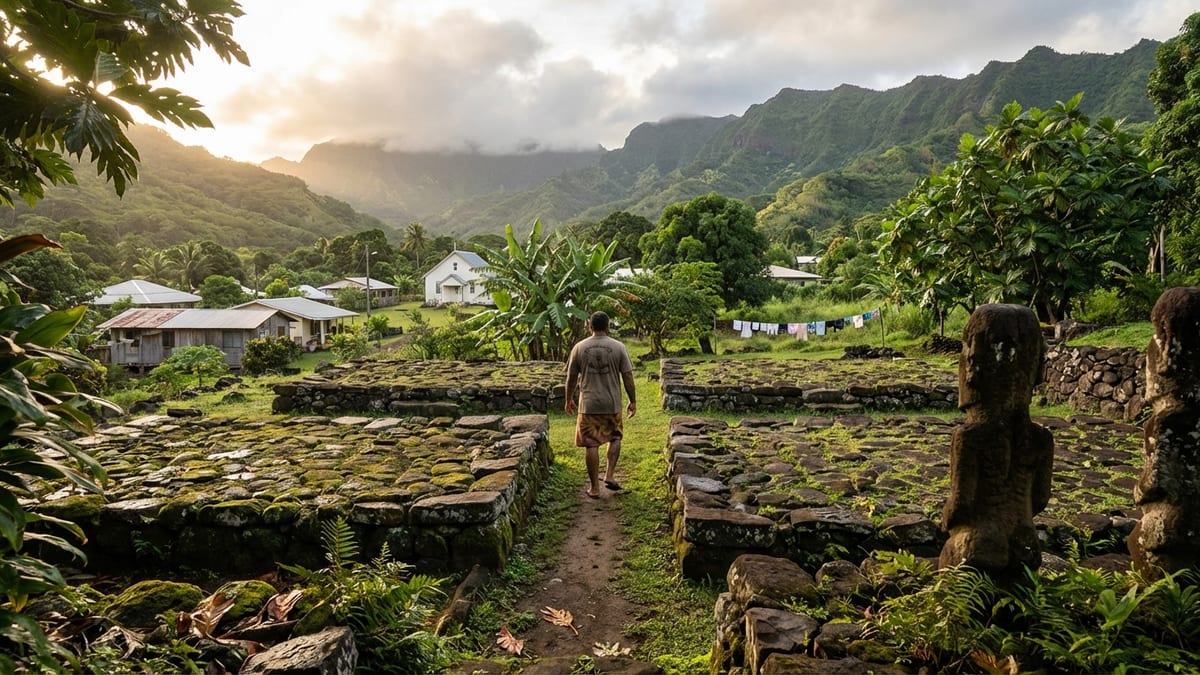
Long before Hiva Oa became a remote dot on world maps or a pilgrimage site for fans of Paul Gauguin and Jacques Brel, it was already the beating heart of a powerful archipelago. In the high, cloud-brushed valleys and wave-battered coasts of this island, the Marquesan people built their largest ceremonial centers, carved their most imposing stone tikis, and developed a rich, resilient culture that still shapes Polynesian identity today.
To understand why Hiva Oa is regarded as the cultural heart of the Marquesas, you have to look beyond the romantic legends and postcard vistas and step into a living landscape where history, spirituality, and contemporary island life are tightly entwined.
The Island That Holds the House Together
In traditional Marquesan cosmology, the archipelago is imagined as a great house built by the gods. Each island represents a part of that sacred structure. Hiva Oa takes the name often translated as “long ridge,” evoking the central beam that holds a great house together. It is a symbolic clue to the island’s role: a kind of backbone for the southern Marquesas, both physically and culturally.
Geographically, Hiva Oa is the largest and most fertile island in the southern group and second only to Nuku Hiva in the entire archipelago. Its ridgeline is a collapsed volcano whose steep valleys run down to indented bays and surf-pounded headlands. Isolated hamlets cling to valley floors and hilltops where breadfruit, taro, coconut, and bananas grow in abundance. That fertility supported dense precontact populations and powerful tribal polities, allowing complex religious and ceremonial life to flourish.
Today the population is modest, but the island is still a regional anchor. Atuona, the main village, serves as the administrative center for the commune of Hiva Oa and a gateway for visitors arriving by air or sea. From its black-sand bay, roads and tracks climb toward remote valleys where ancient stones lie under thick fern and banyan. It is in those interior landscapes that the island’s cultural weight truly becomes evident.
Land of Giants: Tikis, Meae and Ceremonial Landscapes
Across Polynesia, few places rival Hiva Oa for the scale and density of its ancient stone monuments. The island is renowned for having some of the largest tiki statues in French Polynesia, monumental guardians that once stood at the heart of religious and political life. For modern visitors, they are an arresting visual shorthand for the island’s spiritual gravity, but for Marquesans they remain a palpable link to ancestor worship and the sacred.
Near the village of Puamau, the Ipona site gathers some of the most impressive tikis in the archipelago. Here, towering stone figures emerge from moss and leaf litter, their wide eyes, flexed knees, and intricate carvings suggesting both power and vigilance. The largest of these statues reaches several meters in height and is often described as one of the great masterpieces of Polynesian stone carving. The site itself was once part of a valley controlled by an influential clan, its religious importance reinforced by ritual tapu long after warfare reshaped the island’s tribal map.
Equally significant, though less immediately theatrical, are the meae and tohua that structure many of Hiva Oa’s valleys. Meae are religious complexes comprised of terraces, platforms, and shrines. Tohua functioned as broad ceremonial plazas where dances, feasts, tattoo rituals, and political gatherings unfolded. In the Taaoa valley, the vast Upeke ceremonial center stretches across several hectares, framing a long central plaza with stone platforms and sacred spaces. Archaeological surveys and restorations in the late twentieth century brought Upeke back into view, revealing the scale of pre-European ceremonial organization and reinforcing Hiva Oa’s status as a central stage for Marquesan ritual life.
These sites are not preserved as static museum pieces. They are periodically reactivated during cultural events and festivals, visited by families whose genealogies tie them to particular stones, and used by carvers, tattooists, and dancers as touchstones of inspiration. Walking among the paepae platforms and carved stones, you are not simply looking at ruins but at the architecture of a still-living cultural memory.
Atuona: Small Village, Global Imagination
If the valleys are where ancestral spirits seem closest, Atuona is where Hiva Oa’s cultural story collides most visibly with the outside world. The village nestles between steep green slopes and the wide Taaoa Bay, protected by curls of headland and the towering bulk of Mount Temetiu. It feels intimate and local, yet its cemetery and cultural centers keep drawing visitors from Europe and beyond.
Atuona was the final home of the French painter Paul Gauguin, who arrived at the turn of the twentieth century seeking a kind of primitive paradise that existed more in his mind than in local reality. He died here in 1903 and is buried in the Calvaire Cemetery above the village. Nearby lies the grave of Belgian singer Jacques Brel, who settled on Hiva Oa in the late 1970s and used his small aircraft to provide essential transport for islanders between remote ports and Tahiti. Their presence could have overshadowed local culture, yet over time Hiva Oa has balanced this outsider fame with a strong emphasis on telling its own story.
The Paul Gauguin Cultural Center in Atuona offers a curated narrative of the artist’s years in the Marquesas, but it also functions as a broader cultural hub, with exhibits and events that place Marquesan life at the foreground rather than as backdrop. A separate space celebrates Jacques Brel’s music and his humanitarian role in the islands, drawing a different stream of pilgrims who often discover Marquesan culture almost by accident and leave captivated by it.
These global artistic connections helped put Hiva Oa on the cultural map, but what keeps the island at the heart of Marquesan identity is how local people have appropriated that attention. Craftspeople sell woodcarvings and tapa cloth near the harbor; musicians blend traditional drum rhythms with contemporary styles; and storytellers fold tales of Gauguin and Brel into a much older narrative of voyaging ancestors and legendary chiefs.
A Living Archive of Marquesan Arts
From tattoo to carving and dance, Marquesan culture is among the most visually distinctive in Polynesia, and Hiva Oa remains one of its most vital incubators. Historically, the island’s isolation and rugged terrain allowed art forms to evolve with minimal outside interference, even after European contact brought disease, missionization, and demographic collapse. In the last half-century, a cultural renaissance has seen many of these traditions revived with vigor and pride.
Tattooing has perhaps the most immediately recognizable style. Dense patterns of interlocking motifs climb legs, arms, and torsos, often telling stories of genealogy, social rank, and major life events. On Hiva Oa, traditional tattooists have worked with elders and archaeologists to recover old designs from carved stones, ancient artifacts, and early sketches made by visiting explorers. The result is an art that feels both deeply rooted and strikingly contemporary, attracting visitors who come expressly to receive Marquesan tattoos under the hands of master artists.
Wood and stone carving also flourish on the island. Workshops in Atuona and smaller villages produce everything from large ceremonial tikis and drums to finely carved bowls, war clubs, and jewelry. Many carvers trace their lineage to ancestors who once shaped the great statues at Ipona or the stonework at Upeke, and they consciously position themselves as guardians of that legacy. While some pieces are created for the tourist market, prestige still attaches to works destined for local ceremonies or community spaces, where artistry and spiritual responsibility converge.
Dance and music complete the triad. Traditional performances combine powerful drum ensembles with tightly choreographed group movements, punctuated by chants that recount mythic episodes or honor chiefs and ancestors. Hiva Oa’s troupes are often at the center of regional festivals, and when delegations travel to Tahiti or abroad, they carry the island’s styles and narratives with them, reinforcing its reputation as a cultural reference point for the entire archipelago.
Festivals, Rituals and the Return of Mana
Festivals across the Marquesas have played a crucial role in cultural revival, and Hiva Oa often takes a leading role in this cycle of celebration. The archipelago’s main arts festival, held on a rotating basis among the islands, transforms whichever host community is chosen into a temporary capital of Polynesian performance. When Hiva Oa hosts, its ceremonial platforms, village squares, and beaches become natural amphitheaters for days of dance, chanting, carving demonstrations, and oratory.
For local families, these festivals are more than entertainment. They are moments when the mana, or spiritual potency, of sites like Upeke and Ipona is recharged through use. Young people learn chants and choreographies from elders, artisans exhibit major works, and tattooists showcase live sessions that reconnect body art with ancestral meanings. The presence of delegations from other islands and from diaspora communities reinforces Hiva Oa’s image as a gathering place where Marquesan identity is actively negotiated and reaffirmed.
Beyond large festivals, the island’s ritual life is woven into everyday rhythms. Catholic churches dot the coast and valleys, a legacy of nineteenth-century missionization, yet many Marquesans hold a dual sense of faith that includes older beliefs in ancestral spirits, sacred stones, and tapu groves. On Hiva Oa, stories persist of tikis with protective powers and valleys where the spirits of the dead linger at dusk. These narratives are not treated as quaint folklore but as part of a living spiritual geography that shapes how people move through land and seascape.
As cultural tourism grows, community leaders on Hiva Oa have had to balance economic opportunities with respect for sacred spaces. Some meae and burial sites remain off-limits, while others are carefully managed with the guidance of local custodians. This negotiation itself is a sign of cultural vitality: the island is not merely preserving the past, but actively deciding how it should be experienced and by whom.
Daily Life at the Edge of the Map
One reason Hiva Oa retains such a strong cultural core is that it remains, in many ways, hard to reach and self-reliant. Flights connect the island mostly via Nuku Hiva and Tahiti, and supply ships call on a scheduled but infrequent basis. Road networks are limited, and several of the most culturally important valleys are accessible only by rough tracks, boat rides, or long hikes. This isolation can be challenging for residents, but it also insulates local customs from rapid homogenization.
Most families maintain small-scale agriculture and fishing alongside salaried work in administration, education, or tourism. Breadfruit, taro, yams, and bananas fill gardens. Pigs and goats roam valley paths, and fishing canoes dot the bays in the early morning. Communal events, from church services to sports tournaments and dance rehearsals, structure social life, reinforcing a sense of shared identity that goes beyond any single village.
In such a setting, the boundary between “heritage” and “everyday life” is porous. A carved tiki may stand outside a modern home; a tattoo artist may split time between cultural projects and commercial commissions; youth might stream global music while practicing traditional drumming. What keeps Hiva Oa at the cultural center of the Marquesas is not a refusal of modernity, but an insistence that modern life must be lived in dialogue with ancestral knowledge and responsibilities.
Visitors who spend time beyond a short stopover often remark that the strongest impressions come not from famous graves or museums, but from conversations on village verandas, shared meals in family kitchens, and impromptu dance practices on school grounds. In these moments, the island’s cultural heart beats loudest, unmediated by guidebooks or gallery labels.
Traveling Respectfully in the Cultural Heart
For travelers, recognizing Hiva Oa as the cultural heart of the Marquesas carries certain responsibilities. This is not a theme park of ruins and exotic rituals, but a living homeland for a people whose history includes trauma, depopulation, and the pressures of continuing marginalization. Approaching the island with curiosity must be matched by a commitment to learn, listen, and tread lightly.
Local guides are essential intermediaries between visitors and sacred landscapes. They know which sites are open for exploration and which should be observed from a distance, how to behave at ceremonial platforms, and when photography is inappropriate. Engaging their services does more than enrich a trip; it directly supports families who are investing in cultural continuity through storytelling and stewardship.
Spending money on locally made art rather than imported souvenirs also has an outsized impact. A carved wooden tiki, a piece of hand-tapped cloth, or a recording by a local music group carries with it not only aesthetic value but cultural significance. Many artisans use traditional materials and motifs that carry ancestral meanings, and they are usually eager to explain those layers of symbolism to respectful visitors.
Time is perhaps the most important investment. Hiva Oa does not reveal itself on a rushed itinerary. Staying several days, walking slowly through valleys, attending mass in a village church, or watching a dance rehearsal on a dusty field all create the conditions for more genuine cultural encounters. As relationships form, many travelers find themselves invited into homes or community events where the island’s role as a cultural heart is not explained, but simply experienced.
The Takeaway
Hiva Oa’s claim to be the cultural heart of the Marquesas is not based on a single monument, famous artist, or marketing slogan. It rests on a deep, layered reality. The island holds some of the greatest ceremonial centers and stone tikis in Polynesia, anchors a flourishing tradition of carving, tattoo, dance, and song, and has repeatedly served as a gathering place where Marquesans rethink and renew their identity.
From the monumental to the intimate, culture on Hiva Oa is both visible and subtle. It is carved into basalt tiki faces and sung in evening chants, traced in tattoo lines and embodied in the slow rhythm of village life. Visitors who come seeking the ghost of Gauguin or the echoes of Jacques Brel often leave with a far richer understanding: that the most compelling story here belongs not to outsiders who came to escape their own worlds, but to the Marquesan people who have sustained a complex, resilient culture on this green volcanic ridge in the middle of the Pacific.
To stand on a terrace at Upeke, in the cemetery at Calvaire, or on the black sands of Taaoa Bay is to feel that continuity underfoot. The house built by the gods still stands, and on its long ridge, the cultural heart of the Marquesas keeps beating, steady and strong.
FAQ
Q1. Where is Hiva Oa and how do I get there?
Hiva Oa is part of the Marquesas Islands in French Polynesia, in the eastern South Pacific. Most travelers reach it by flying from Tahiti to Nuku Hiva or directly to Atuona, the island’s main village, on regional carriers, or by arriving on supply ships and small cruise vessels that include the Marquesas in their itineraries.
Q2. Why is Hiva Oa considered the cultural heart of the Marquesas?
Hiva Oa concentrates several of the archipelago’s most important ceremonial centers, some of its largest stone tikis, and a vibrant community of carvers, tattooists, dancers, and storytellers. Combined with its symbolic role in traditional cosmology and its leadership in cultural festivals, this makes the island a focal point for Marquesan identity and arts.
Q3. What are the must-see cultural sites on Hiva Oa?
Key cultural highlights include the Ipona site near Puamau with its monumental stone tikis, the vast Upeke ceremonial complex in the Taaoa valley, the Calvaire Cemetery in Atuona where Paul Gauguin and Jacques Brel are buried, and the cultural centers in the village that showcase Marquesan arts and history.
Q4. Can visitors attend traditional festivals or ceremonies?
Yes, but timing is crucial. Major arts festivals rotate among the Marquesas and are usually announced well in advance, drawing performers from across the region. Smaller village events, church celebrations, and dance rehearsals happen throughout the year. Travelers who stay longer and build relationships with locals are more likely to be welcomed into these gatherings as respectful observers.
Q5. Is it possible to get a traditional Marquesan tattoo on Hiva Oa?
Several tattoo artists on Hiva Oa specialize in traditional Marquesan designs. It is advisable to make inquiries and appointments in advance through local guesthouses or cultural centers. Sessions can be lengthy and designs are deeply symbolic, so expect to spend time discussing meanings and placement with the artist.
Q6. How should I behave at sacred sites like meae and tiki fields?
Visitors should always go with a local guide when possible, follow posted signs, avoid climbing on tiki statues or platforms, speak quietly, and never remove stones or artifacts. Some areas may be off-limits or require special permission; respecting these restrictions is a key part of traveling responsibly in the Marquesas.
Q7. What role do Gauguin and Brel play in Hiva Oa’s cultural story?
Paul Gauguin and Jacques Brel are important because their lives and deaths on Hiva Oa drew global attention to the island. Their graves and associated cultural spaces attract international visitors, but local communities increasingly frame their stories within a broader narrative that centers Marquesan history, spirituality, and contemporary creativity.
Q8. Is Hiva Oa suitable for independent travelers, or do I need a tour?
Independent travel is possible, particularly for experienced travelers comfortable with remote destinations, but infrastructure is limited. Many visitors combine independent stays with guided excursions to cultural and archaeological sites. Organized cruises and expedition-style voyages provide a more structured way to experience the island for those who prefer not to manage logistics themselves.
Q9. What languages are spoken, and will I get by with English?
French is the official language and widely used in administration and schools, while Marquesan is spoken in homes and cultural contexts. English is less common but often understood in tourism-facing businesses. Learning a few basic phrases in French and showing interest in Marquesan words and place names is greatly appreciated.
Q10. When is the best time to visit Hiva Oa for cultural experiences?
Cultural life continues year-round, but the most intense concentrations of performances and events happen around major regional festivals, church holidays, and school vacations. The drier season generally offers more reliable travel conditions. Regardless of season, staying several days and engaging with local guides offers the best chance to encounter the island’s cultural heart in a meaningful way.