

More news on this day
Hong Kong International Airport recorded its busiest February on record this year, as Lunar New Year travel demand, stronger mainland Chinese traffic and new regional routes combined to push passenger volumes and daily peaks beyond pre-pandemic levels.
Get the latest news straight to your inbox!
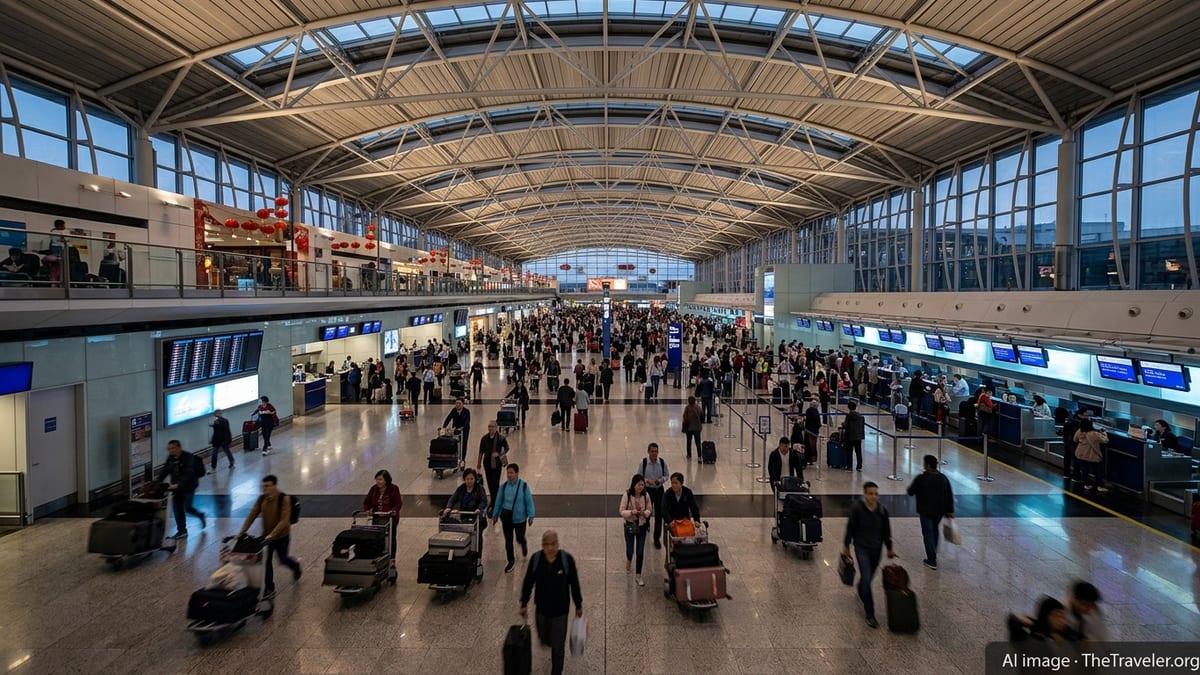
Record-Breaking February by the Numbers
Publicly available figures from Airport Authority Hong Kong indicate that Hong Kong International Airport handled about 5.3 million passengers in February, a sharp year-on-year increase and the highest February total since the airport opened at Chek Lap Kok in 1998. Industry reports highlight that daily passenger peaks during the core Lunar New Year period surpassed previous post-pandemic highs, underscoring how strongly regional travel has rebounded.
Data summarised in regional aviation coverage shows that passenger traffic in February rose by more than 30 percent compared with the same month a year earlier, driven largely by cross-border holiday traffic and returning overseas Hong Kong residents. Flight movements also rose at a double-digit pace, supported by dense schedules on short-haul routes within Asia and continued recovery on long-haul services to North America and Europe.
The February surge fits into a broader rebound. Provisional full-year estimates for 2025 point to around 61 million passenger trips through Hong Kong, approaching the 2019 pre-pandemic benchmark while cementing the airport’s role as a leading international hub for both origin–destination and transfer traffic.
Chinese New Year Travel Crush Lifts Hong Kong
The timing of the Lunar New Year holiday was central to the record numbers. Chinese New Year fell in late January and early February on the Gregorian calendar, concentrating outbound and inbound travel into a compressed window. Reports from Hong Kong media and airline traffic updates describe crowded departure halls, fully booked regional flights and heavy transit flows as travellers used Hong Kong as a connecting point between mainland China, Southeast Asia and long-haul destinations.
According to published airline traffic figures, Hong Kong’s dominant home carrier group, together with low-cost affiliate HK Express, carried more than 111,000 passengers on a single day at the start of the Lunar New Year peak, marking a new post-pandemic record for the group. Separate data from HK Express for the 2026 Lunar New Year period shows a 15 percent year-on-year increase in passengers carried, illustrating how demand around the Spring Festival has become one of the strongest drivers of recovery for Hong Kong’s aviation market.
During the core Chinese New Year travel window, which typically spans about two weeks including the eve and the first several days of the lunar calendar, airport statistics cited in regional aviation analysis point to average daily traffic of well over 150,000 passengers and close to 1,000 flight movements. Popular routes included services between Hong Kong and major mainland cities, as well as leisure destinations in Japan, South Korea and Southeast Asia that have become favourites for holidaymakers from southern China.
Where the Growth Came From
Breakdowns of February traffic published by Airport Authority Hong Kong and industry outlets show that travel between Hong Kong and mainland China was the single largest contributor to the surge, reflecting the resumption of cross-border family visits and holiday trips after the full normalisation of travel arrangements. Routes to Southeast Asia and Taiwan also recorded strong year-on-year growth, boosted by competitive fares and an expanding network of low-cost carriers using Hong Kong as a base.
Transit and transfer passengers added another layer of growth. With most of its long-haul network restored to near pre-pandemic levels, Hong Kong again served as a convenient midpoint for journeys between North America or Europe and secondary cities in mainland China and Asia. Publicly available data and airline schedules suggest that these transfer flows now represent a significant share of overall passengers, helping to stabilise load factors outside core holiday peaks.
At the same time, cargo volumes at the airport remained broadly stable compared with the previous year, according to freight industry summaries, even as passenger numbers surged. Hong Kong retained its long-standing position as the world’s busiest cargo airport by tonnage, with logistics traffic underpinned by strong transshipment demand for e-commerce, electronics and high-value goods moving between mainland China, Asia and global markets.
Operational Strain and Passenger Experience
The record February tested airport operations but did not result in widespread disruption. Travellers posting on forums and social platforms described busy but manageable check-in areas and security queues, with most noting that peak-time congestion was most evident in immigration halls and at popular food and retail outlets. Baggage waiting times reportedly lengthened on some late-night and early-morning arrivals, echoing concerns raised in earlier travel seasons as staffing and ground handling scaled back up.
Airport Authority Hong Kong has signalled through public briefings and planning documents that it is investing in automation and additional staffing to cope with rising volumes. Recent enhancements include more e-security gates, expanded smart check-in options and improved wayfinding within Terminal 1. The continued rollout of the three-runway system, including taxiway and airfield upgrades, is designed to support higher aircraft movements per hour and reduce bottlenecks during peak travel waves such as Lunar New Year and summer holidays.
Publicly available passenger satisfaction surveys and anecdotal accounts suggest that, despite the crowds, many travellers value Hong Kong International Airport’s connectivity, short minimum connection times and extensive lounge and retail offerings. However, the February surge also revived long-running debates within the city about tourism capacity, the balance between mainland tour groups and independent travellers, and the need to diversify Hong Kong’s appeal beyond shopping and dining.
What Travelers Should Know Now
For passengers planning to travel through Hong Kong around future Lunar New Year periods, the latest February figures offer several practical lessons. First, the days immediately before and after the Chinese New Year public holidays are now among the busiest of the year at HKIA, rivaling summer peaks. Travellers may wish to build in additional time for check-in, immigration and baggage collection, particularly if connecting to or from low-cost carriers that operate from busier gate areas.
Second, the renewed strength of mainland and short-haul Asian routes means that prime departure banks to cities such as Shanghai, Beijing, Taipei, Tokyo, Osaka and Seoul can be heavily overbooked during festival periods. Public schedules show that some of these routes operate at near shuttle frequency, but high load factors can still limit last-minute availability and push fares higher than off-peak levels.
Finally, the February record underlines that Hong Kong’s role as an international transfer hub is firmly back. Travelers using the airport as a connecting point will find a wide choice of onward flights across Asia and beyond, but they should monitor minimum connection times and terminal layout when booking complex itineraries. With the three-runway system and associated terminal projects progressing, publicly available planning documents indicate that capacity will continue to grow over the coming years, positioning Hong Kong International Airport to handle even larger festival surges and to compete aggressively with regional rivals for long-haul transit traffic.