

Across from the soaring twin spires of Cologne Cathedral, an iron lattice of arches strides over the Rhine. Trains thunder past, pedestrians linger at the railings, and a shimmering skin of metal glints in the sun.
This is Cologne’s Hohenzollern Bridge, a vital rail artery, a survivor of war, and one of Europe’s most iconic “love lock” bridges. For visitors, it is as much a place to feel the pulse of the city as it is a vantage point for some of the finest river views in Germany.
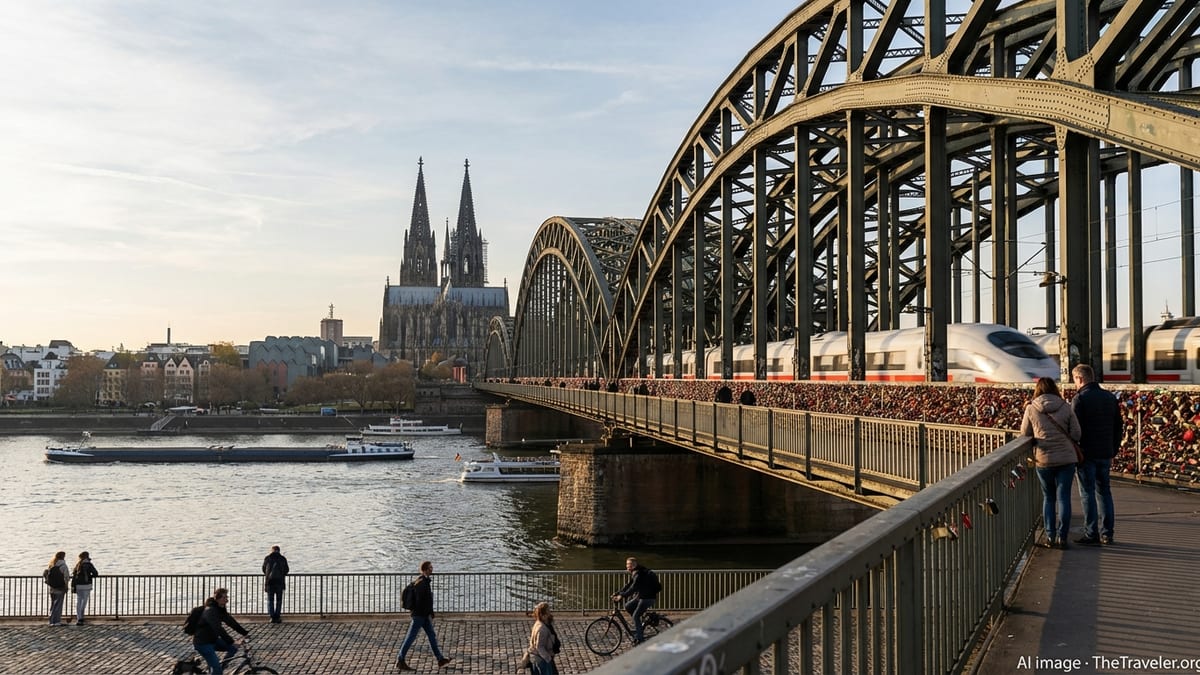
The Bridge That Frames Cologne
The Hohenzollern Bridge is many things at once. It is Germany’s busiest railway bridge, carrying more than a thousand trains a day between Cologne’s main station on the west bank and the Köln Messe/Deutz station on the east. It is a pedestrian thoroughfare, linking the historic Old Town with the trade fair grounds, business districts, and modern developments across the water. And it is a visual anchor for one of Europe’s most recognisable cityscapes, its dark steel arches framing the Gothic bulk of Cologne Cathedral.
The bridge runs for just over 400 meters, but it commands a far bigger presence. Approached from the cathedral side, you pass the plaza behind Museum Ludwig and step directly onto the pedestrian walkway, with the river flowing below and the old town’s pastel facades lining the bank. To the east, the path leads toward the KölnTriangle tower and the Deutz district, offering sweeping, postcard-perfect perspectives back toward the cathedral and the old city.
Its central location makes the Hohenzollern Bridge almost impossible to miss. Even if you arrive in Cologne with no plan to hunt down romantic rituals or industrial architecture, you will likely find yourself crossing it at least once, drawn by the views, the river breeze, and the bands of padlocks that have turned its railings into a vast open-air artwork.
From Imperial Ambition to Wartime Ruin
The story of the Hohenzollern Bridge begins in the early 20th century, when Cologne was a fast-growing Prussian city and rail travel was transforming Europe. The older Cathedral Bridge could no longer handle the booming traffic of trains streaming in and out of the newly developed main station. In 1907, work began on a new crossing, more imposing, more efficient, and aligned with the era’s taste for monumental engineering.
Named after the Hohenzollern dynasty, the ruling house of Prussia and the German Empire, the bridge opened in 1911. It was designed as a broad, triple-arched steel structure that carried a combination of railway and road traffic. Statues of Prussian kings and emperors, mounted on horseback, flanked the approaches, reinforcing its imperial symbolism. For pre-war Cologne, this was both a practical infrastructure upgrade and a proud statement of modernity and power.
During the Second World War, the bridge’s significance increased. It was a key rail link on the Rhine corridor, vital for military logistics. Despite heavy Allied bombing raids on Cologne, the Hohenzollern Bridge remained largely intact. In the final months of the war, however, retreating German forces chose to blow up the structure on 6 March 1945, hoping to slow the Allied advance into the heart of Germany. The arches collapsed into the river, leaving a brutal gap in the city’s transport network and skyline.
The immediate post-war years saw makeshift crossings and improvised solutions while a lasting reconstruction plan took shape. Like much of Cologne, the bridge had to be rebuilt in a very different political and economic context from the one in which it was conceived. The era of emperors was over; the priority now was functionality and recovery rather than monumental symbolism.
Rebuilding a Lifeline Over the Rhine
Reconstruction of the Hohenzollern Bridge unfolded in stages between the late 1940s and the 1980s. By May 1948, pedestrians could once again cross the Rhine on a provisional structure, a symbolic milestone for a city struggling to reconnect divided districts and resurrect daily life in the ruins of war. Over the following decade, engineers completed a more permanent solution, retaining some elements of the original design while simplifying the overall form.
The roadways that once accompanied the railway decks were removed, and the rebuilt bridge was dedicated primarily to trains and foot traffic. Some remnants of the old approaches and road ramps survived for a time, particularly on the Deutz side, but even those were gradually incorporated into new urban projects as Cologne reshaped its riverfront. In 1959, the main reconstruction work was completed, and the bridge resumed its role as a central transport artery.
Further modifications came in the 1980s, when additional tracks were added to cope with rising rail demand. Today, the bridge carries six railway tracks plus two broad pedestrian paths, one on each side. This mix of hard-working infrastructure and accessible public space has become part of its unique character. Commuters and intercity travelers flash through the arches at speed, while walkers linger at the railings, watching barges, sightseeing cruises, and the light shifting on the river.
Little remains of the original imperial symbolism beyond a handful of statues and historical photos. The post-war Hohenzollern Bridge is more modest in decor but no less impressive in scale. Its great steel ribs, marching rhythmically across the Rhine, speak less of royal grandeur and more of the practical, enduring drive to connect one bank with the other.
The Rise of the Love Locks Tradition
For all its engineering importance, the Hohenzollern Bridge might have remained primarily a transport story if not for a romantic trend that arrived in Cologne in the late 2000s. Around 2008, couples began attaching padlocks to the railings along the pedestrian walkway, often engraved with names, initials, or a special date. After securing the lock, they would throw the key into the Rhine as a symbolic gesture of an unbreakable bond.
What started as a trickle of locks quickly became a phenomenon. By the early 2010s, there were already thousands of padlocks decorating the bridge’s interior railings. City folklorists and cultural researchers took notice, documenting how this imported custom had been adopted and reshaped in a Cologne context. Visitors from across Germany and far beyond contributed to the growing metallic mosaic, each lock representing a story, a promise, or a memory.
Estimates today suggest that tens of thousands of locks cling to the bridge, and the exact number is in constant flux as new ones appear and older ones are occasionally removed or corroded away. Some are simple brass or steel rectangles, bought at a nearby hardware store. Others are heart-shaped, brightly painted, or intricately engraved. Many are marked not only with names and dates but also with short messages: declarations of love, anniversaries, wedding vows, or notes to absent friends and relatives.
The collective effect is striking. As you walk the bridge, entire panels of the railing are almost completely obscured by metal, layered and interlocked. The padlocks catch the light, withstand the rain, and form a kind of evolving public artwork. For many travelers, placing a love lock on the Hohenzollern Bridge has become a highlight of their visit to Cologne, a ritual on par with climbing the cathedral tower or sipping a glass of local Kölsch beer.
Debate, Safety Concerns, and Local Attitudes
As the number of love locks grew, so did debate about their impact. Bridge operators and engineers weighed the cumulative weight of the metal hanging from the railings, mindful of examples in other European cities where similar traditions had strained older structures. In Paris, sections of the Pont des Arts had to be cleared when railings buckled, and authorities imposed bans on new locks. Venice and other heritage-rich cities have introduced fines or active removal campaigns to protect delicate architecture.
In Cologne, the conversation took a different path. The bridge is managed by the national rail company, which initially considered removing the locks, citing concerns about safety and maintenance. Public opinion, however, leaned decidedly in favor of keeping them. Locals had grown attached to this new expression of urban romance and saw it as a distinctive marker of their city’s character. The love locks had become a talking point, a backdrop for engagement photos, and a small but meaningful symbol of Cologne’s open, tolerant spirit.
After discussions and public feedback, officials ultimately chose to tolerate the locks rather than launch a sweeping removal program. Engineers assessed the extra load and found that, at current levels, the weight did not pose a serious threat to the structure. Regular monitoring continues, but for now, visitors are still free to clip their padlocks to the bridge so long as they follow basic safety rules and avoid interfering with the rails or emergency equipment.
This relatively relaxed approach has helped the Hohenzollern Bridge avoid the tensions seen in some other cities. While there is awareness of potential long-term issues such as rust, cleaning challenges, and occasional vandalism, the prevailing mood remains that of cautious acceptance. The locks are not officially encouraged in the sense of designated panels or city-sponsored campaigns, but they are widely promoted in tourism materials and embraced by many residents as part of Cologne’s contemporary folklore.
Experiencing the Rhine Views
The romantic reputation of the Hohenzollern Bridge is about more than padlocks. For visitors, the primary draw is often the view. From the mid-point of the span, the Rhine curves gently through the city, flanked by church spires, historic warehouses, and modern glass facades. To the west, the cathedral rises majestically above the rooftops, its blackened stone contrasting with the river’s shifting blues and greys. To the east, the skyline opens toward trade fair halls, office towers, and the distinctive silhouette of the KölnTriangle.
At almost any hour of the day, there is something to watch. Long cargo barges slip beneath the arches, heading toward the industrial heartlands upriver. Tourist boats describe slow loops, their decks crowded with sightseers. Cyclists and walkers file along the embankments, while trains cross in rapid succession overhead. After dark, the bridge and cathedral are illuminated, reflected in the water below to create one of the most atmospheric night scenes in western Germany.
Many photographers consider the Hohenzollern Bridge one of the best spots for capturing Cologne’s skyline, particularly at sunset or during the blue hour when the sky deepens and city lights begin to glow. The east bank, just beyond the bridge in Deutz, offers especially strong vantage points. From here, you can frame the cathedral behind the arches, with the river and riverfront promenades completing the composition.
Even if you are not carrying a camera, a slow walk across the bridge rewards you with shifting perspectives and small vignettes of daily life. Couples pause to browse the locks and search for engraved messages in their own language. Commuters stride past in a familiar blur. Street musicians sometimes add a soundtrack, their notes competing with the steady rumble of trains overhead. In the space of a few hundred meters, you get a compact, vivid sense of Cologne as a living river city.
Practical Tips for Visitors
Reaching the Hohenzollern Bridge is straightforward. From Cologne’s main train station, follow the signs toward the cathedral exit, then walk around the back of the cathedral and past the modernist shell of Museum Ludwig. Within a few minutes, you will step onto the western entrance to the bridge. The walk to the Deutz side is short and level, making it accessible to most visitors, including families with strollers and travelers with rolling luggage.
If you plan to add a love lock of your own, you can either bring one with you or purchase one in the city center. Several souvenir shops and key-cutting services near the main station and in the old town offer ready-engraved locks or can personalize them on the spot. While there is no formally designated area for locks, most are attached to the inner fences that separate the pedestrian path from the railway tracks. You may need to hunt for an empty spot, as some sections are already densely covered.
For the best photographic conditions, consider visiting early in the morning or late in the afternoon. Morning light often illuminates the cathedral side of the river, while sunset can paint the sky behind the spires in warm tones. Night visits are equally worthwhile, especially if you enjoy city lights and reflections. The bridge is open at all hours, and there is no entrance fee, but be mindful of your belongings and stay within the pedestrian areas, as trains operate late into the night.
Combining the bridge with nearby attractions makes for a natural half-day itinerary. You might climb the cathedral tower, explore the Roman-Germanic Museum or Museum Ludwig, stroll along the Rhine promenade, then cross to Deutz for panoramic views and a different perspective on the city. Throughout, the Hohenzollern Bridge serves as both route and destination, a spine connecting many of Cologne’s highlights.
Responsible Tourism and Future of the Love Locks
As the love locks tradition continues to grow, so does the conversation about its sustainability. The metal may look charming, but every additional lock increases the burden on the bridge and complicates routine maintenance. Engineers must factor the added weight into inspections, cleaning teams have to work around clusters of tightly packed padlocks, and any necessary repairs to the railings become more complex when thousands of sentimental objects are in the way.
For now, the consensus in Cologne is that the practice can continue, provided it remains within manageable limits and does not endanger the structure or disrupt rail operations. Deutsche Bahn and city authorities monitor the situation, occasionally removing locks from specific sections if needed. Visitors can do their part by ensuring that their lock is attached securely and in a place that does not interfere with emergency exits, signage, or safety equipment.
Some travelers and locals argue for alternatives, such as virtual love locks or designated art installations that mimic the padlock tradition without placing physical strain on historic structures. Others feel that the physical act of locking and throwing away the key is central to the symbolism and should be preserved. The debate reflects broader questions about how mass tourism interacts with public spaces, especially in heritage-rich cities where even seemingly small gestures can accumulate into major impacts over time.
Whatever direction the policy takes in the coming years, the story of the Hohenzollern Bridge and its locks is already a case study in how contemporary rituals can transform the meaning of a place. A structure once built to project imperial power and move troops and goods has become a canvas for of-the-moment expressions of love and belonging, layered over its industrial bones and turbulent history.
The Takeaway
The Hohenzollern Bridge is more than a way to get from one side of the Rhine to the other. It is a place where Cologne’s past and present meet: imperial architecture and post-war pragmatism, heavy rail traffic and leisurely strolls, steel engineering and sentimental ritual. Stand in its center and you can feel that mix all around you: the vibration of trains, the wind off the water, the chime of locks brushing against one another, and the long, dark silhouette of the cathedral watching over it all.
For travelers, the bridge offers one of the city’s simplest yet most rewarding experiences. It costs nothing, requires no ticket or reservation, and can be enjoyed at any hour, in any season. Whether you come to clip a small piece of your own story to the railings, to photograph the skyline at dusk, or simply to watch the river traffic and imagine the generations of people who have crossed here before, the Hohenzollern Bridge invites you to linger.
In a city that has reinvented itself more than once, this span of steel has become an enduring symbol of connection: between old and new, between banks of the Rhine, and between the everyday routines of locals and the fleeting moments of visitors. To understand Cologne, spend some time on its bridge. The trains will keep crossing, the locks will keep multiplying, and the river will keep flowing past, carrying stories as surely as it carries water.
FAQ
Q1. Where is the Hohenzollern Bridge located in Cologne?
The Hohenzollern Bridge crosses the River Rhine right next to Cologne’s main train station on the western bank and the Köln Messe/Deutz station on the eastern bank, a short walk from Cologne Cathedral.
Q2. Why is the Hohenzollern Bridge famous for love locks?
The bridge became known as a love lock destination after couples began attaching engraved padlocks to its railings around 2008, then throwing the keys into the Rhine as a symbol of enduring love. Over the years, this evolved into one of the largest and most visible love lock collections in Germany.
Q3. Is it still allowed to attach a love lock to the Hohenzollern Bridge?
Yes, as of now couples are still allowed to attach love locks, and the practice is widely tolerated. Authorities monitor the situation to ensure the added weight and maintenance needs do not compromise the bridge’s safety, but there is no general ban in place.
Q4. How old is the Hohenzollern Bridge?
The original bridge opened in 1911, replacing an earlier crossing that could no longer cope with rising rail traffic. It was destroyed in 1945 during the Second World War and rebuilt in the post-war years, with further modifications added in the 1980s.
Q5. How many trains cross the Hohenzollern Bridge each day?
The Hohenzollern Bridge is one of Germany’s busiest railway crossings, with more than 1,000 trains passing over it daily, including long-distance, regional, and local services.
Q6. What are the best views you can get from the bridge?
From the bridge you enjoy panoramic views of Cologne Cathedral, the old town waterfront, and the modern skyline of the Deutz district. Many visitors consider the views at sunset or after dark, when the cathedral and riverfront are illuminated, to be the most spectacular.
Q7. How do I get to the Hohenzollern Bridge as a visitor?
From Cologne’s main station, exit toward the cathedral, walk behind it past Museum Ludwig, and follow the signs toward the Rhine. The western entrance to the bridge is just a few minutes away on foot. You can also access it easily from the Köln Messe/Deutz station on the east side.
Q8. Is there an entrance fee or set opening times for the bridge?
No, there is no entrance fee, and the pedestrian paths on the Hohenzollern Bridge are open at all hours. You can visit any time, day or night, though many people prefer daylight or evening hours for safety, photos, and river views.
Q9. Can the weight of the love locks damage the bridge?
Engineers keep an eye on the cumulative weight, but the Hohenzollern Bridge is a robust steel structure designed for heavy rail traffic. Current assessments indicate that the locks do not pose a serious structural risk, though localized removals may occur if specific sections need repair or relief.
Q10. Besides love locks, what else should I do around the Hohenzollern Bridge?
Before or after crossing the bridge, you can visit Cologne Cathedral, explore the nearby museums, stroll along the Rhine promenade, or head to the Deutz side for wide-angle views of the skyline. Many visitors combine a walk across the bridge with a river cruise or a climb up the cathedral tower for complementary perspectives on the city.