

More news on this day
Hohhot Shengle International Airport in northern China has reached operational readiness as Inner Mongolia’s first 4F-class aviation hub, positioning the new gateway to handle Airbus A380 superjumbos and significantly expand the region’s long-haul and international flight potential.
Get the latest news straight to your inbox!
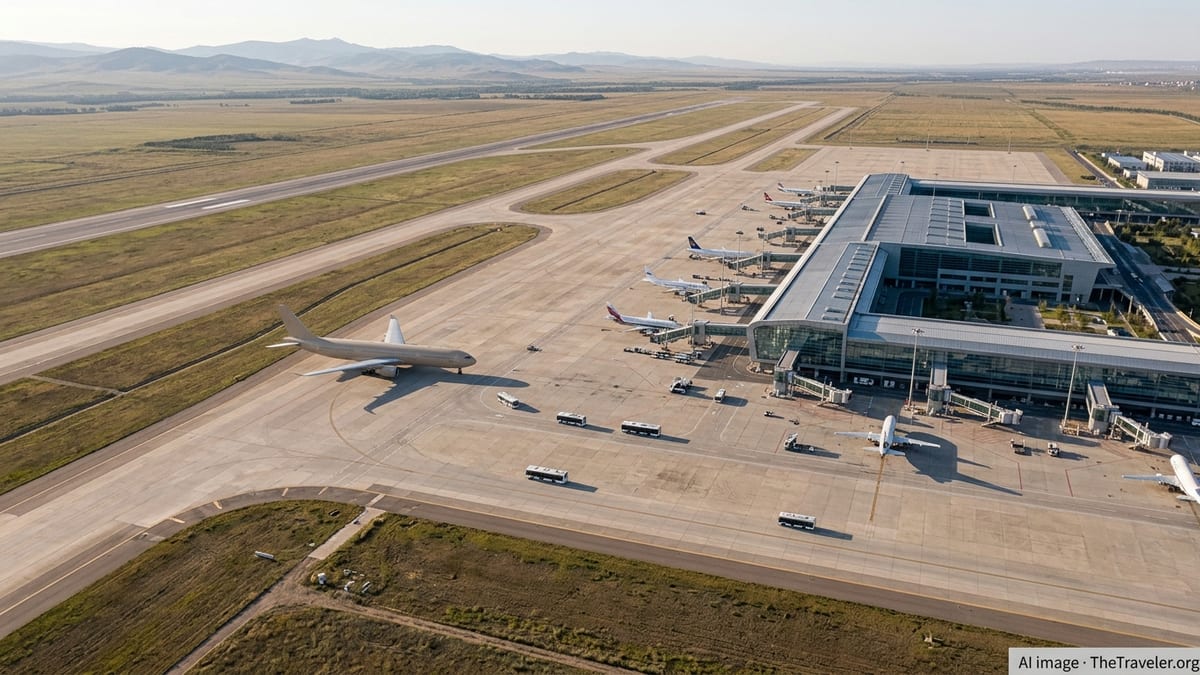
First 4F-Class Gateway Transforms Inner Mongolia’s Aviation Map
Recent reports indicate that Hohhot Shengle International Airport has completed its on-site verification and calibration test flights, marking a decisive shift from construction to operational preparation. Classified as a 4F airport, the highest grade in civil aviation for airfield infrastructure, the new facility is designed to accommodate the world’s largest commercial aircraft, including the Airbus A380 and Boeing 747, and to support high-density global traffic.
Publicly available information shows that Shengle serves as a replacement for Hohhot Baita International Airport as the main air gateway for Hohhot, capital of the Inner Mongolia Autonomous Region. Once commercial operations begin, air transport services currently handled by Baita are expected to transition to the new hub, consolidating passenger and cargo movements at a single, higher-capacity site south of the city center.
The airport’s elevation in status comes at a time when China continues to upgrade key regional hubs to 4F standards, adding another top-tier facility to a growing national network. For Inner Mongolia, long dependent on connections via Beijing and other coastal cities, the emergence of a homegrown 4F hub represents a structural change in how the region can access both domestic and overseas markets.
Runway Power and Terminal Scale Built for A380-Era Traffic
According to technical profiles and planning documents, Hohhot Shengle International Airport has been laid out with two parallel runways and an expansive apron to manage widebody operations. The southern runway is being built to 4F standards, with a length of around 3,800 meters and a width of 60 meters, adequate for routine A380 and other large aircraft movements. A second runway meets 4E specifications, supporting a broad range of long-haul and regional jets.
The terminal complex, covering more than 300,000 square meters in some published descriptions, has been designed to support an annual capacity of about 28 million passengers and 320,000 tonnes of cargo by 2030. The apron will initially offer around 75 aircraft stands, providing flexibility for simultaneous handling of multiple widebodies alongside a steady flow of narrowbody traffic.
Navigation, communications, and aerodrome lighting systems have been verified through extended test flights using a range of aircraft types. These trials assessed runway surfaces, taxiway markings, and instrument procedures to ensure compliance with current standards for 4F operations. The successful completion of these checks is widely viewed as a key milestone before certification and the gradual rollout of commercial schedules.
Strategic Hub Role on China’s “Air Silk Road”
Industry and regional development coverage increasingly frames Shengle as more than a replacement airport for Hohhot. Planners have positioned the facility as a strategic hub anchoring Inner Mongolia on what Chinese policy documents describe as the “Air Silk Road,” linking central and northern China with markets across Eurasia. The airport is intended to strengthen connectivity with neighboring Mongolia and Russia, and to serve as a bridge between northeastern and northwestern parts of the country.
The 4F classification allows airlines to consider nonstop or one-stop routes from Hohhot to major intercontinental gateways, rather than routing all long-haul flows through Beijing or coastal hubs. Medium-haul corridors to Central Asia and Eastern Europe are considered especially promising, given Hohhot’s location on key overland and energy corridors. Cargo operators are also watching the new capacity as a potential node for northbound and westbound freight flows.
Public information on regional planning indicates that Shengle has been identified as a primary alternate airport for the Beijing-Tianjin-Hebei cluster. In practice, this means the airport can support diversions and contingency operations for some of the busiest airspace in the country, adding resilience to northern China’s aviation network and reinforcing Hohhot’s status in national planning.
From Regional Airport to Emerging International Hub
For Inner Mongolia’s travelers, the upgrade from the older Baita airport to a purpose-built 4F facility is expected to bring a step change in route options. Domestic demand is likely to be the first beneficiary, with added links to coastal megacities and high-growth inland centers, but the infrastructure is clearly oriented toward future long-haul and intercontinental operations. Aviation analysts note that the ability to host A380-scale aircraft signals long-term ambitions, even if initial international services may be served by smaller widebodies.
As airlines evaluate potential deployment to Hohhot, typical early targets could include expanded connections to Beijing and Tianjin, as well as new services to Shanghai and key southern hubs that act as onward gateways to Southeast Asia and Oceania. Over time, the combination of runway length, airfield category, and terminal capacity opens the door to direct or one-stop flights linking Inner Mongolia with destinations in Europe, the Middle East, Central Asia, and potentially North America.
Growth in freight volumes is another central objective. With significant mineral resources, energy projects, and cross-border trade, Inner Mongolia is well placed to leverage improved belly cargo capacity on passenger flights and the potential stationing of dedicated freighter services. The airport’s long runways and high code rating make it suitable for fully loaded long-range freighters, reinforcing its role as a logistics platform as well as a passenger gateway.
What the Milestone Means for Travelers and Tourism
The rise of Shengle as a 4F hub may gradually change how international travelers approach itineraries involving Inner Mongolia. Rather than backtracking through Beijing or coastal cities, future schedules could allow more direct access to Hohhot as a first point of entry, especially for group tours and business delegations. This would shorten total travel time to key scenic areas such as the nearby grasslands and desert landscapes that have long attracted domestic visitors.
Tourism authorities are expected to highlight the new airport’s role in supporting integrated air-rail-road itineraries, coupling international arrivals with fast onward connections to regional cities and border crossings. The prospect of more convenient long-haul services also aligns with growing interest among overseas travelers in lesser-known destinations in northern China, where cultural ties with Mongolian, Hui, and Han communities create distinctive experiences.
For now, the successful completion of verification test flights marks the most concrete sign yet that Shengle is moving from blueprint to reality. As final preparations continue and regulatory approvals are secured, airlines and travelers alike will be watching to see how quickly Inner Mongolia’s first 4F airport converts its heavy-lift infrastructure into regular A380-ready operations and a broader menu of global routes.