

More news on this day
Ten years after Japan’s northern bullet train first pierced the seabed beneath the Tsugaru Strait, the long-promised high-speed ride all the way to Sapporo is receding into the distance, with fresh timelines pointing to 2038 and raising new questions about the future of Hokkaido’s tourism and transport ambitions.
Get the latest news straight to your inbox!
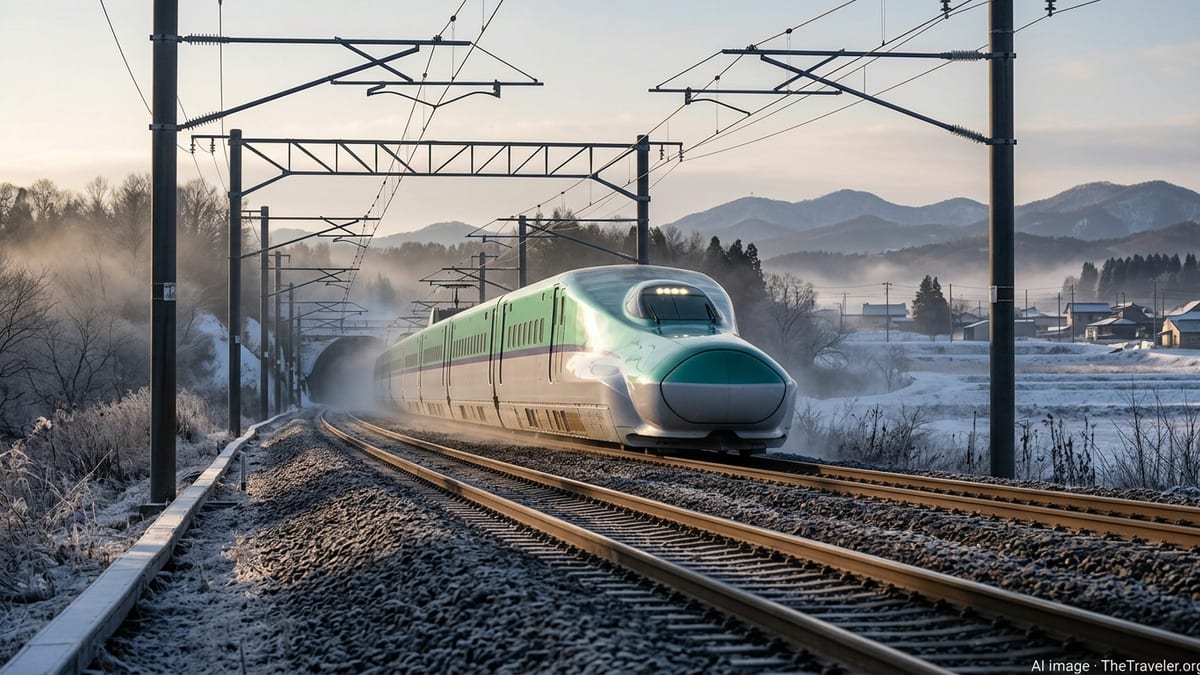
A 10th Anniversary Marked by an Eight-Year Delay
The Hokkaido Shinkansen opened on March 26, 2016, linking Shin-Aomori on Honshu with Shin-Hakodate-Hokuto in southern Hokkaido via the Seikan Tunnel. The launch was hailed as a breakthrough for Japan’s far north, promising faster access for domestic and international visitors and a foundation for a future extension to Sapporo, the island’s largest city.
That extension, a 211.8 kilometer stretch from Shin-Hakodate-Hokuto to Sapporo, was originally slated for completion by the end of fiscal 2030. Publicly available information released in late 2024 shows the opening now pushed back to at least the end of fiscal 2038, effectively turning what was planned as a 14-year build into a more than three-decade endeavor.
The revised schedule arrives just as the line celebrates its 10th anniversary in 2026, highlighting the gap between early political promises of swift northward expansion and the reality of complex mountain tunneling, cost overruns and demographic headwinds. For future travelers hoping to roll directly into Sapporo on high-speed rails, the wait is now expected to stretch another 12 years or more.
Tunneling Troubles Beneath Hokkaido’s Mountains
The core reason for the delay lies underground. The new route to Sapporo requires long tunnels through difficult geology in southern and central Hokkaido. Reports on the Oshima Tunnel and other sections describe unstable ground, mud inflows and surface collapses that have complicated excavation and forced repeated redesigns and safety reviews.
One widely reported incident near the Jinya-no-sawa River highlighted how sensitive the terrain can be. An investigation cited in domestic coverage concluded that construction for a shinkansen tunnel had disrupted groundwater and caused a stretch of river to run dry, prompting environmental scrutiny and compensation arrangements for affected farmers. Such episodes have added both technical and political pressure to already demanding worksites.
The Seikan Tunnel itself, the undersea backbone that carries the Hokkaido Shinkansen between Honshu and Hokkaido, also demands heightened maintenance as traffic grows older and more varied. Operators have announced Sunday service suspensions on parts of the line in 2026 to allow extended overnight replacement of overhead lines inside the 53.85 kilometer tunnel, underlining how upkeep on the existing link competes for resources with the new build toward Sapporo.
Soaring Costs and Strain on Local Rail Networks
Cost inflation is another pillar of the postponement. Media analyses of government and railway documents indicate that total project expenses for the Sapporo extension have swollen significantly from initial estimates, driven by tunneling challenges, rising material prices and labor shortages in Japan’s construction sector.
Local communities along the planned route face a separate but related dilemma. The high-speed line is meant to replace sections of conventional track that now carry both regional passenger services and freight. Prefectural and municipal budgets are under pressure, and several reports describe concern that local governments cannot afford to maintain parallel legacy lines once shinkansen operations begin.
Rail experts and agricultural groups in Hokkaido have warned that an eventual closure of the parallel conventional line through the Seikan corridor could weaken the only direct freight rail link between Hokkaido and the rest of Japan. For tourism planners, the prospect of fewer local trains and shifting freight patterns adds another layer of uncertainty around how visitors will circulate beyond the main high-speed hubs.
The Four-Hour Battle With Planes to Sapporo
Even if the shinkansen reaches Sapporo in the late 2030s, it will enter a market dominated by air travel. Today, frequent flights connect Tokyo and New Chitose Airport in about 90 minutes, and publicly available fare comparisons often show aviation undercutting the bullet train on price for long northbound journeys.
Rail advocates argue that to seriously challenge air routes, Tokyo to Sapporo journey times need to fall to around four hours or less. Current projections for the completed extension suggest travel times that may still struggle to beat that psychological benchmark once intermediate stops and shared use of the Seikan Tunnel with freight trains are taken into account.
Analysts note that while environmental policy and carbon reduction goals could tilt some demand back toward electrified rail, cost-sensitive tourists and domestic travelers are unlikely to abandon low-cost flights unless high-speed tickets and timings become clearly competitive. That sets the stage for a prolonged “four-hour battle” between rail and air as policymakers refine timetables, subsidies and airport access improvements well into the 2030s.
Tourism Dreams Deferred for Japan’s Northern Frontier
For Hokkaido’s tourism industry, the delay lands at a delicate moment. The island has spent much of the past decade positioning itself as a four-season destination, from Sapporo’s winter snow festivals and Niseko’s powder slopes to summer hiking, hot springs and emerging food tourism. Regional strategies often assumed that a direct shinkansen link to Sapporo around 2030 would help spread visitors beyond the traditional gateways of New Chitose Airport and Hakodate.
Instead, the northern bullet train will likely spend another decade as a partial link that stops short of Hokkaido’s main urban and tourism clusters. Travelers headed to Sapporo and central Hokkaido resorts will continue to rely on a mix of flights, limited express trains and highway buses, while the shinkansen remains most attractive for those combining Tohoku and southern Hokkaido in one overland itinerary.
Public planning documents indicate that national and local authorities are now reassessing investment priorities along the corridor, weighing station-area development, bus and regional rail connections, and alternative tourism campaigns that do not depend on imminent high-speed access. For visitors of the 2030s and beyond, the vision of gliding directly from Tokyo to Sapporo in a single high-speed hop remains alive, but the journey to make that trip possible is proving far longer and more complicated than early forecasts ever suggested.