

More news on this day
Travelers hoping for a magical holiday getaway to Paris, London, or New York are confronting a harsh new reality this year, as airfares on key transatlantic and domestic routes spike to eye-watering levels, upending family plans and sending tourists into a scramble for alternatives.
Get the latest news straight to your inbox!
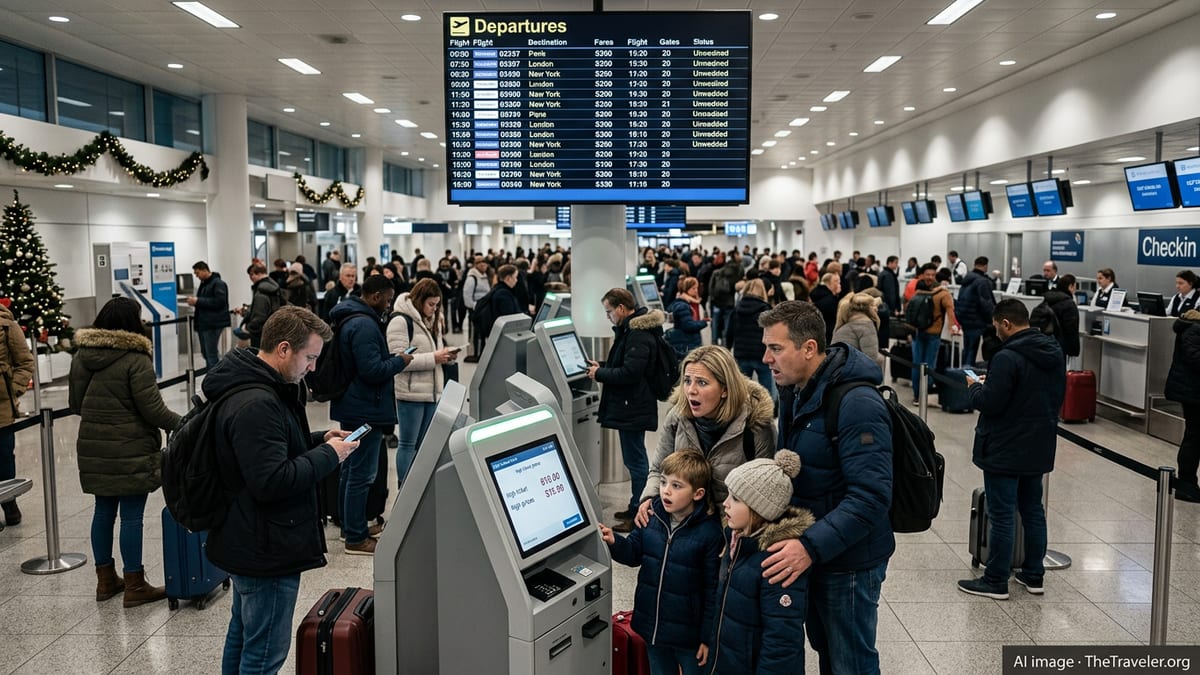
Holiday Shock on Iconic Transatlantic Routes
Data from industry analysts and booking platforms tracking 2025 and early 2026 holiday demand show sharp price escalations on flights linking North America and Europe, particularly between New York, London, and Paris. While airfares fell for some off-peak periods earlier in 2025, capacity constraints, concentrated demand around school breaks, and aggressive revenue strategies are now converging to push Christmas and New Year fares dramatically higher on these flagship routes.
Travel search behavior is reinforcing the trend. Research released in late 2025 found Americans starting their searches for Christmas flights roughly two weeks earlier than in 2024, a sign that travelers are bracing for steeper prices and limited availability and moving sooner to lock in seats. Yet many are still discovering that even early-bird bookings to hubs such as Paris Charles de Gaulle, London Heathrow, and New York JFK are hundreds of dollars more expensive than comparable dates just a year or two ago.
On the New York to London corridor, often one of the most competitive in the world, analysts report that average December fares now sit significantly above shoulder-season levels, with premium economy and business cabins on key departure days selling out months in advance. Travelers who once relied on last-minute sales are instead watching prices surge as seat inventories tighten in the final weeks before departure.
Paris and London See Capacity Squeezed at the Worst Time
Europe’s tourism capitals are bearing the brunt of the holiday spike. Paris, buoyed by its enduring draw as a festive-season destination and recent infrastructure and tourism campaigns, is seeing particularly steep increases for departures in the narrow window between just before Christmas and shortly after New Year. Industry forecasts for 2026 point to December demand on major U.S. to Europe routes exceeding 2025 levels, even as airlines continue to adjust where they deploy capacity.
In the United Kingdom, British and European carriers are fine-tuning their winter schedules, trimming some U.S. services and reallocating aircraft toward sun destinations in Canada, Mexico, and the Caribbean where leisure demand is booming. That has left London-bound holiday travelers facing fewer nonstop options from certain American cities than they had during the recent transatlantic expansion phase. With less slack in the system, any surge in bookings quickly translates into higher fares, especially around the busiest departure days.
For travelers attempting to mix a visit to both London and Paris on the same holiday trip, the sticker shock is compounded. Multi-city itineraries that tie together New York, London, and Paris over Christmas week and into early January now commonly price out far above separate off-peak round trips, and in many cases exceed what some travelers paid for similar trips before the pandemic recovery.
New York Holiday Crowds Collide With Dynamic Pricing
New York, long a magnet for Christmas markets, New Year’s Eve celebrations, and shopping trips, is experiencing its own squeeze. Domestic routes feeding New York’s airports are showing robust demand, with some December flights from secondary U.S. cities into JFK, LaGuardia, and Newark pricing higher than recent transcontinental averages. Airline executives point to packed schedules, strong corporate travel recovery, and a rush of visitors targeting only a few key vacation days.
Dynamic pricing systems are amplifying the effect. As soon as searches spike around specific holiday dates, fare algorithms respond by nudging base prices upward on the most popular departure and return combinations. That leaves late-booking tourists confronting fares that can jump in a matter of days, with some economy tickets to New York over Christmas reportedly doubling compared with shoulder-season benchmarks.
The result is a perception among many travelers that the market has tipped into what they view as near price gouging, particularly for families who need to coordinate school breaks and can only travel on peak days. Consumer advocates note that while the underlying economics of limited seats and high demand are straightforward, the pace and volatility of price changes are fueling frustration and a sense of panic as holidays approach.
Why Fares Are So High Despite Mixed Signals Elsewhere
The surge in holiday pricing comes against a backdrop of seemingly contradictory signals. Analysis of U.S. to Europe fares in early 2025 highlighted the lowest average prices in three years for some off-peak periods, as airlines added capacity and competed aggressively for shoulder-season travelers. At the same time, global forecasts for 2026 warn that peak December travel demand will continue to edge higher, especially on long-haul leisure routes favored by North American and European tourists.
Industry consultants say this split reality is the new normal. Outside the tight windows of school holidays and major celebrations, carriers have learned to stimulate demand through discounts and promotions, using sophisticated tools and alerts to fill seats during slower weeks. Over Christmas and New Year, however, those same tools are increasingly focused on capturing maximum revenue, not offering bargains. With aviation fuel prices off their highs but still volatile, and labor and airport costs elevated, airlines are prioritizing yield on the dates when they know planes will be full.
Another factor is the compression of holiday travel into just a handful of departure and return days. In December 2026, calendar patterns are expected to funnel even more passengers into a short period around Christmas weekend. Analysts who have examined millions of historical bookings say that when this happens, fares for those core days can climb 35 to 70 percent above what travelers would pay by flying just a few days earlier or later.
Scramble for Workarounds as Travelers Brace for 2026
Faced with these soaring prices, would-be visitors to Paris, London, and New York are increasingly turning to workarounds. Travel advisers report growing interest in flying on the holidays themselves, particularly on Christmas Day or New Year’s Day, which often carry lower fares than the peak departure days immediately before. Others are piecing together complex itineraries that route through secondary hubs or combine low-cost carriers in Europe with separate tickets across the Atlantic to shave costs, albeit with added risk if delays occur.
Experts caution travelers to watch for hidden trade-offs. Lower fares may come with punishing layovers, inconvenient overnight connections, or tighter minimum connection times in busy hubs during winter weather season. Some of the cheapest tickets also carry stiff change penalties or lack flexibility if prices drop later, limiting travelers’ ability to rebook should the market shift.
Looking ahead, analysts say there is little sign that the holiday premium on flights to and from Paris, London, and New York will ease in 2026. With demand still strong and airlines closely managing capacity on their most lucrative routes, travelers hoping to spend the festive season under the Eiffel Tower, along the Thames, or in Times Square may need to budget more, book earlier, and remain flexible about dates and routing if they want to avoid the most punishing of the latest price surges.